
What Is an Applicant Tracking System?
Understand what an applicant tracking system does, how employers use it, and how it affects the way you prepare a resume.
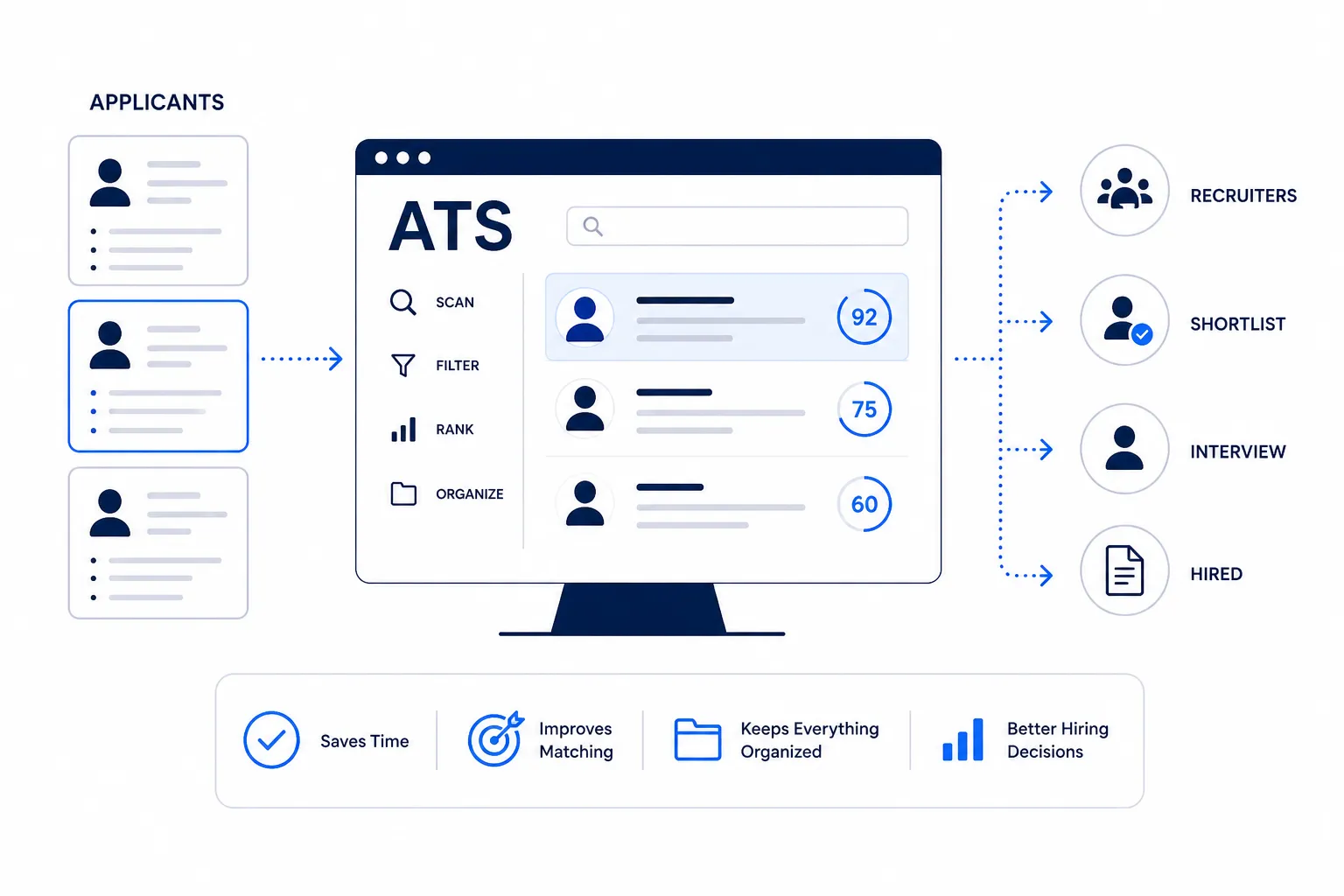
An applicant tracking system, or ATS, is software employers use to collect applications, organize candidate records, coordinate hiring steps, and search for relevant applicants. It is not a single universal robot that decides who gets hired. Employers configure different systems and workflows, and recruiters still review applications in context.
Why employers use ATS software
Hiring teams receive applications from careers pages, job boards, referrals, and recruiters. An ATS keeps that information in one place. It can associate candidates with a job opening, record interview feedback, send communication, and support compliance or reporting processes.
For an applicant, the important implication is simple: your resume must carry its meaning as clear text. The system should be able to identify your titles, dates, skills, and work history, while a recruiter should be able to scan the same information quickly.
How an ATS usually handles a resume
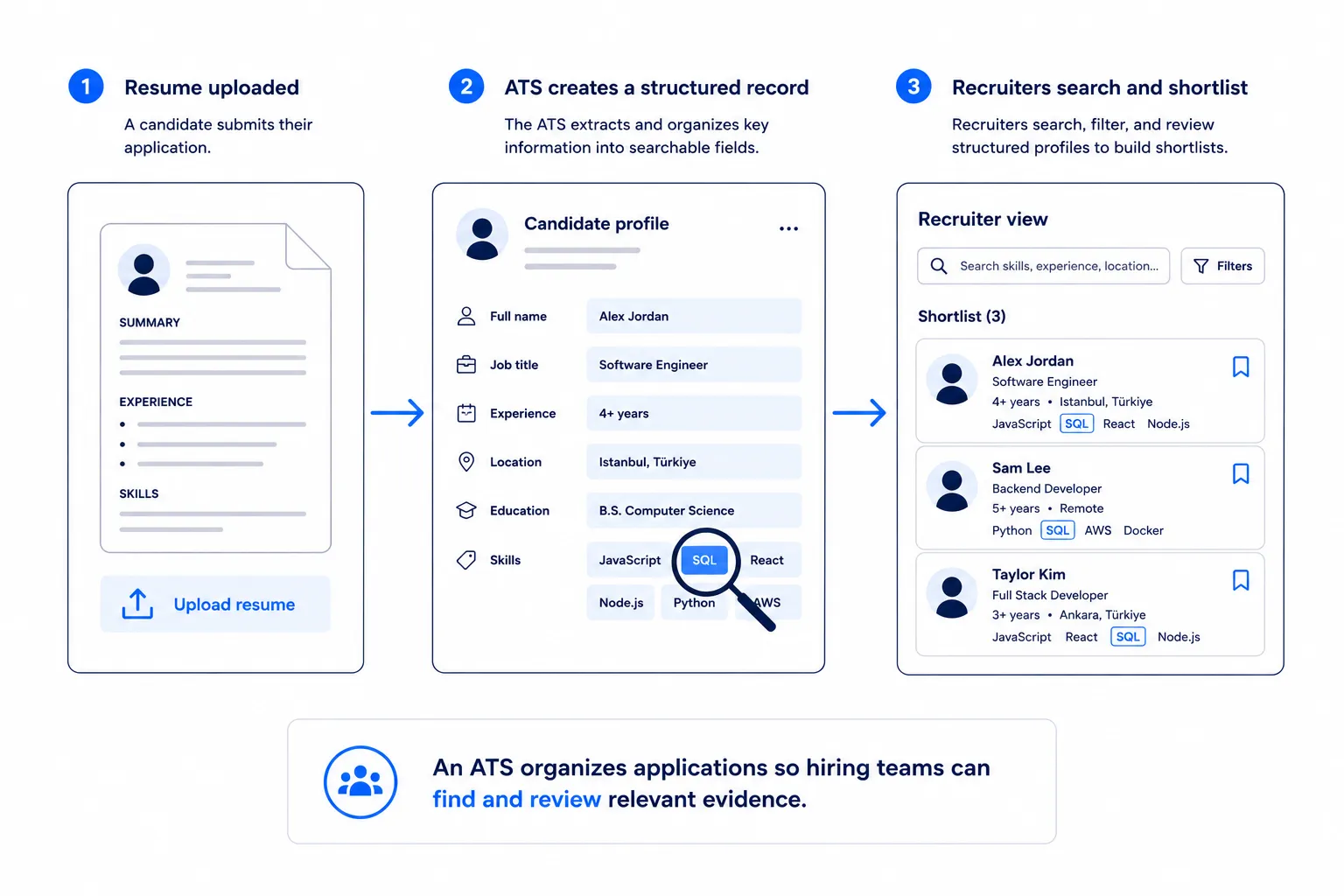
When you upload a file, a system may extract text and map it to fields such as name, contact details, employers, job titles, dates, education, and skills. This process is called resume parsing. A recruiter may then search records by a term, review applicants in a stage, or compare submitted answers.
Some systems show match indicators or ranking tools. These are aids, not a reliable prediction of an interview. A high match cannot replace relevant experience. A low match may reflect wording, incomplete parsing, employer preferences, or a tool configuration you cannot see.
What this means for your resume
Use common headings, a simple reading order, and language from the job description when it accurately describes your work. Avoid important details in image files, unusual graphics, or places that do not copy as text. Read How to Write an ATS-Friendly Resume for the practical format and tailoring process.
What an ATS does not tell you
An ATS record cannot reliably capture every part of a candidate’s suitability. It may not show why a career change makes sense, how a candidate works with others, or how closely a project resembles the employer’s current problem. That is why a readable summary, evidence-based bullets, application answers, portfolio, and interview examples still matter.
It is also inaccurate to assume that a system “rejects” every application it cannot perfectly parse. Some employers use automated questions or filters, and some use ranking tools. Others review every submitted application manually. The candidate does not control the configuration. The useful action is to submit the requested format, make core information easy to read, and apply only terms that truthfully describe the work.
How recruiters use search
Recruiters may search a candidate database by title, location, work authorization, certification, skills, or phrases connected to the role. Search can help narrow a large applicant pool, but the resulting list still needs review. A term in a skills list is weaker evidence than the same term used in a clear work example.
For instance, a recruiter hiring for a customer onboarding role may search for implementation or onboarding. A candidate whose resume says Led implementation planning for new mid-market customers, coordinating data migration and first-week training gives useful context. A candidate who simply lists onboarding may still be considered, but the recruiter has less evidence to assess.
Practical limits for applicants
Do not redesign your resume around guesses about a hidden algorithm. You cannot know every employer’s workflow, search terms, or review preferences. You can control the clarity and accuracy of your materials. Use standard structure, keep important information in selectable text, state your role precisely, and tailor the evidence to the published requirements.
If an application asks screening questions, answer them directly and consistently with your resume. If it asks for a work sample, follow the instructions rather than relying on a general resume to do all the explaining. Each element gives the employer another way to understand your qualifications.
This balanced approach is more useful than trying to outguess the software.
It lets your qualifications remain understandable to both systems and people.
That clarity remains valuable regardless of the employer’s specific technology or process.
A realistic example
An employer seeks a data analyst who uses SQL, dashboarding, and stakeholder communication. A recruiter searches the applicant pool for SQL and reviews candidates whose experience shows analysis work. An applicant who writes queried customer behavior data in SQL and presented weekly dashboard findings to product leaders gives both the system and person useful evidence. An applicant who only lists data may be harder to assess.
Common misconceptions
- “An ATS rejects every creative resume.” The issue is not creativity alone. It is whether essential information remains readable and relevant.
- “Keywords guarantee an interview.” Keywords help show alignment only when backed by real experience.
- “Every employer uses the same parser.” Products, settings, and review practices vary.
- “A score decides the hiring outcome.” Hiring includes human judgment, job requirements, timing, and many factors outside a score.
Continue learning
Use Democruit to tailor a readable resume, then learn about resume keywords, ATS-friendly formatting, and resume parsing.
Related articles
How to Write an ATS-Friendly Resume
Learn how to format, tailor, and proofread a resume that applicant tracking systems and recruiters can read clearly.
What Are Resume Keywords?
Learn what resume keywords are, where to find them, and how to use them truthfully in a targeted job application.
Can an ATS read a PDF resume?
Get a clear, practical answer to can an ats read a pdf resume, with the next step for a stronger job application.