What Are Resume Keywords?
Learn what resume keywords are, where to find them, and how to use them truthfully in a targeted job application.
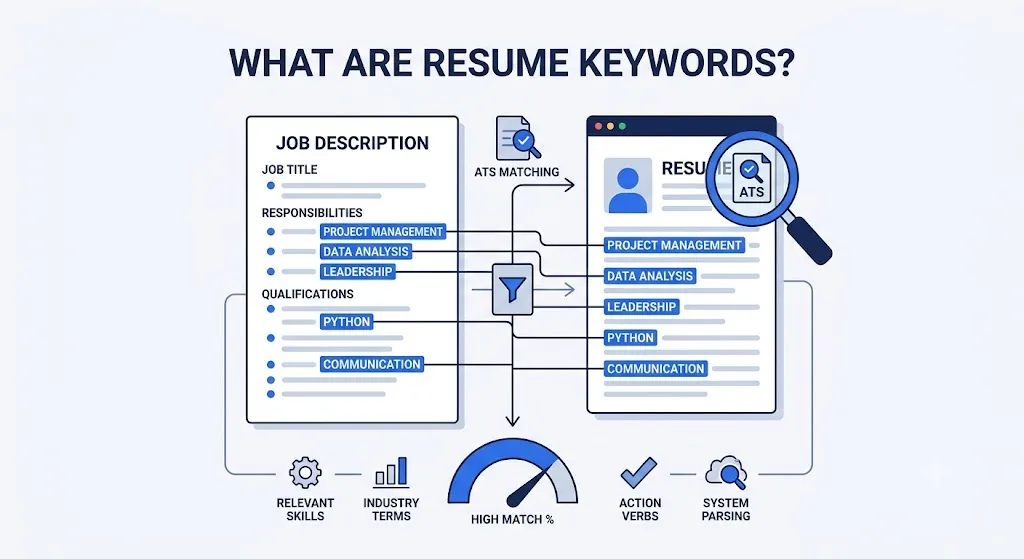
Resume keywords are the specific skills, tools, qualifications, job titles, responsibilities, and industry terms that an employer uses to describe a role. They help a recruiter and an applicant tracking system connect your experience to the job. Good keyword use is truthful and contextual, not copy-and-paste repetition.
Where keywords come from
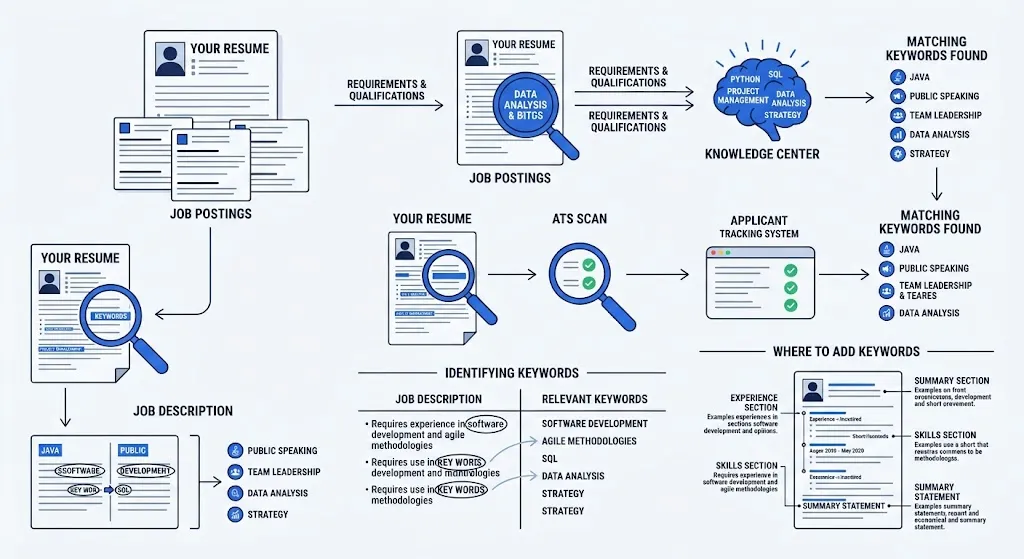
Start with the job description. Look at the title, required qualifications, preferred skills, software, recurring verbs, and outcomes. The employer’s careers page, product language, and team descriptions can add context, but the job description should remain the main source.
For a project coordinator job, keywords may include project schedules, risk tracking, Jira, cross-functional, and status reports. Group them by skill, tool, responsibility, and domain rather than treating them as one long list.
How to use them
Put the most relevant accurate terms in your summary, skills, work bullets, projects, and certifications. Context is stronger than a list alone.
List only: Jira, status reporting, stakeholder communication
In context: Maintained Jira project boards and prepared weekly status reports that helped marketing, design, and engineering resolve launch dependencies.
The contextual version says how you used the terms. It also gives the recruiter a better question to ask in an interview.
What keywords cannot do
Keywords cannot create missing experience or bypass a recruiter’s judgment. Do not add tools you have never used, certifications you do not have, or responsibilities you did not perform. If you are adjacent to a requirement, explain the related work honestly: used Google Sheets to maintain project trackers is not the same claim as advanced Excel modeling.
A practical keyword review process
Read the job description once for the overall purpose of the role. Then read it again and mark repeated nouns, verbs, tools, credentials, and outcomes. Repetition is a useful signal, but the section where a term appears matters too. A tool under “required qualifications” may be more important than a general value in the company description.
Create a short working list with three columns: the employer’s term, evidence from your background, and the best place to show it. For example, customer onboarding may map to an implementation bullet, Salesforce to both a skills section and an achievement, and executive communication to a project result. This prevents a late, unstructured keyword dump.
After you revise, remove any term that you cannot support. A recruiter may search for exact wording, but an interview will test the work behind it. Honest adjacent experience is more durable than a match created by copying a phrase.
Examples of useful and weak placement
For a marketing operations role, a resume that lists HubSpot, reporting, campaigns gives limited information. A stronger bullet is: Built HubSpot campaign reports for demand-generation programs, helping marketing and sales teams review lead quality after each launch. It contains relevant terms and explains the candidate’s contribution.
For a nursing role, a skills section can list patient education and electronic health records, but the experience section should show the setting and work: Provided discharge education and documented care plans in the electronic health record for post-surgical patients. The words are useful because they are tied to real practice.
When the employer uses unfamiliar language
Some employers use internal labels, uncommon acronyms, or titles that do not match the rest of the industry. You can include the term once when it is understandable and relevant, then use plain language to explain the underlying work. If you do not understand what the phrase means, do not guess. Research the company, review other openings, or ask a clarifying question during the process.
This approach also helps with acronyms. Spell out a widely recognized term the first time if it improves clarity, especially when a recruiter outside the specialty may review the application first.
Check for a natural reading experience
Read the resume from top to bottom after tailoring. If a sentence sounds forced because a keyword was inserted, rewrite it in your normal professional language. The reader should see a coherent career story, not a set of highlighted search terms. A targeted resume helps the employer find relevant evidence quickly, and a natural explanation helps them trust it.
When in doubt, prioritize the terms that name the work you can demonstrate. That balance supports both searchability and credibility.
It also makes future interviews easier, because each relevant phrase already points to a real example you can discuss.
If a keyword does not point to an example, leave it out or describe your adjacent experience accurately instead.
That is the strongest form of tailoring.
Common misconceptions
- A keyword is not always a technical skill.
Client onboardingandbudget forecastingcan be important role phrases. - Exact wording helps sometimes, but clear equivalent language is also useful. Explain an unfamiliar acronym once.
- More keywords are not automatically better. Relevance and proof matter more than density.
Continue learning
Use Democruit to compare a target job with your draft, then apply the ATS-friendly resume guide and resume bullet guide. See also Keyword.
Related articles
How to Write an ATS-Friendly Resume
Learn how to format, tailor, and proofread a resume that applicant tracking systems and recruiters can read clearly.
How to Write Strong Resume Bullet Points
Write resume bullet points that connect specific actions, useful context, and credible results to the skills and outcomes employers need.
Should I copy keywords from a job description?
Use job-description keywords accurately by matching them to real evidence, recognizing synonyms, and avoiding unsupported phrases or hidden keyword lists.