Resume Format: Chronological, Functional, and Combination Resumes Explained
Learn which resume format is right for your career. Compare reverse chronological, functional, and combination resumes, including when to use each format, ATS-friendly formatting tips, and how to highlight your strongest qualifications.
Resume Format: Chronological, Functional, and Combination Resumes Explained
Choosing the right resume format determines what a hiring manager notices first. A strong format makes relevant experience easy to find; the wrong one can draw attention to employment gaps, unrelated roles, or a lack of progression before your qualifications get a fair look.
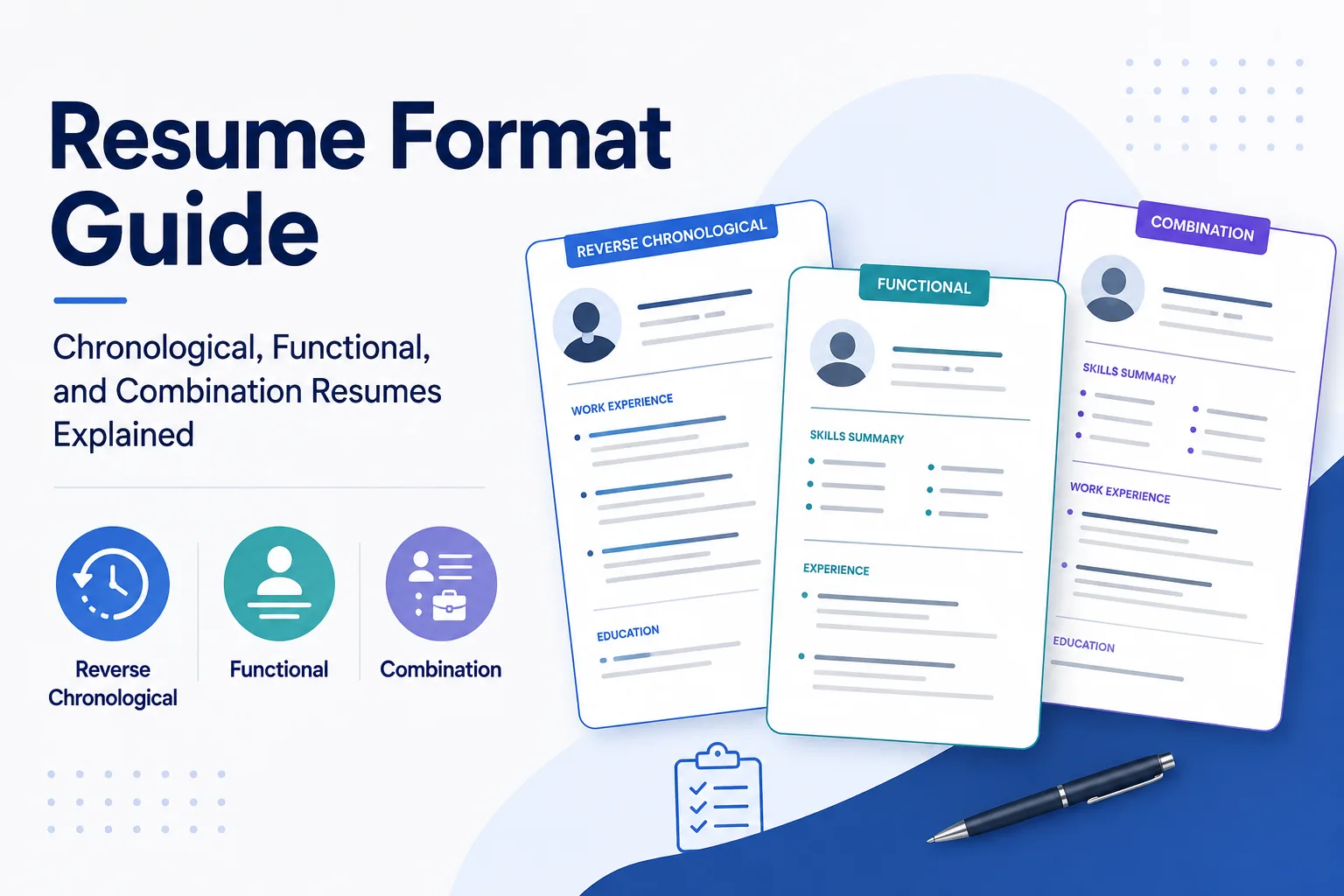
The three main options are reverse chronological format, functional format, and combination format. The best choice depends less on your career stage than on which part of your background provides the strongest evidence for the target job.
Resume Formats at a Glance: Which One Fits Your Background?
Resume format | Best when | What it emphasizes | Main drawback |
Reverse chronological | Your recent experience is relevant | Career progression and recent roles | Makes gaps or unrelated experience more visible |
Functional | Skills matter more than job sequence | Capabilities and transferable skills | Can make experience context harder to assess |
Combination | You need skills and chronology | Relevant skills plus work history | Can become repetitive if poorly structured |
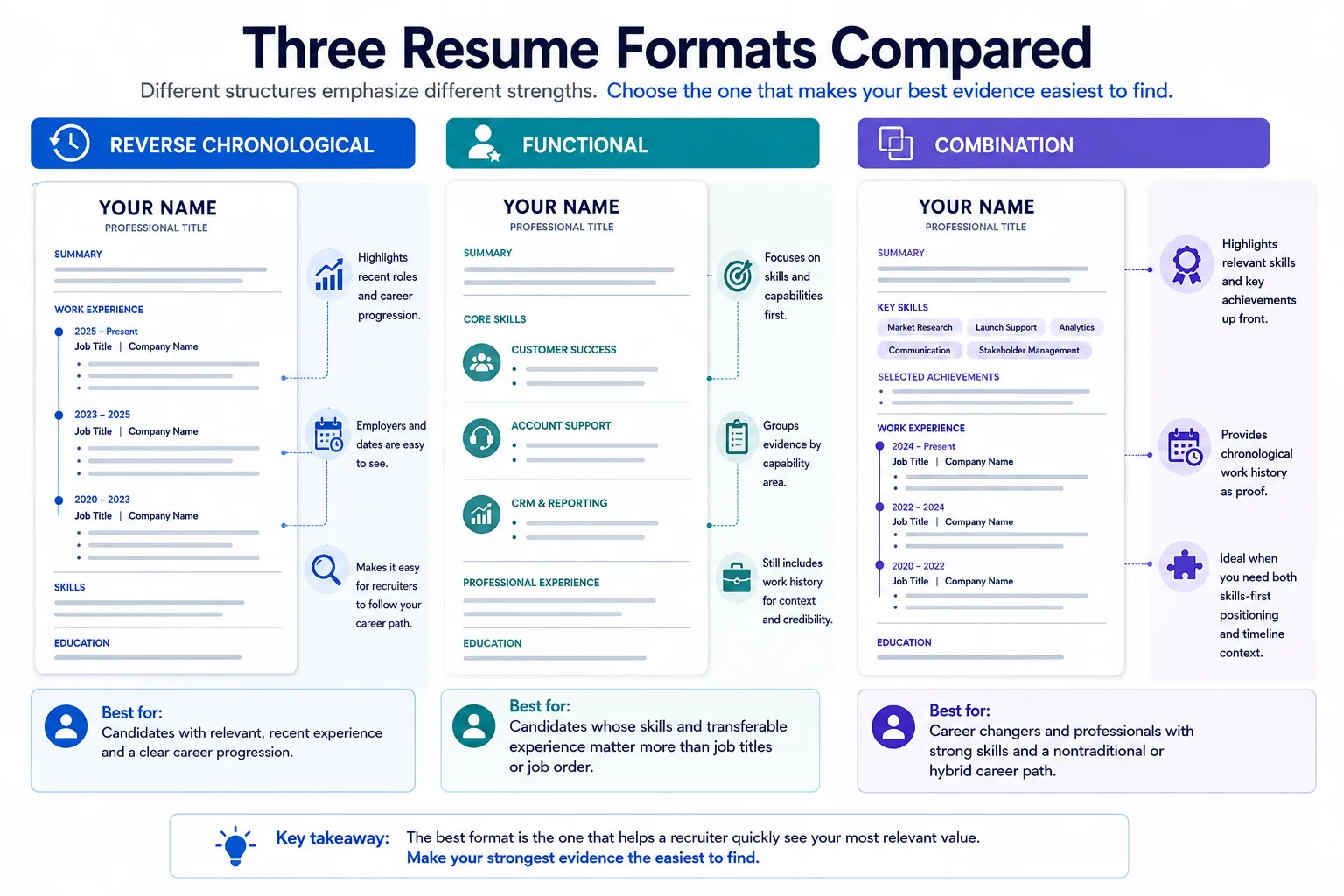
For most candidates, reverse chronological is the safest default. Consider functional or combination formats when your career history makes your relevant skills harder to see.
A useful way to choose is to ask: What should a recruiter understand about your background first?
Recent experience and career progression → Reverse chronological
Transferable skills across different roles → Functional
Relevant skills plus a nontraditional career history → Combination
Note: "Chronological resume" and "reverse chronological resume" are often used interchangeably. In modern resumes, the standard chronological format lists your most recent experience first and works backward.
Quick test: List your last three roles and mark the achievements that match your target job. Choose the format that makes those matches easiest to find near the top of page one.
Reverse Chronological Resume: Best for Stable Career Growth and Relevant Experience
The reverse chronological format places your most recent role first and works backward. It is the default choice for most candidates because recruiters can quickly see your latest responsibilities, progression, employers, and dates.
Use it when:
Your recent experience is relevant to the target role.
Your career shows reasonable progression.
Your job titles and achievements support your candidacy.
You want recruiters to understand your career path immediately.
A typical reverse chronological resume puts work experience near the center of the document, with each role showing the title, employer, dates, and achievement-focused bullets. Other sections such as skills, education, certifications, and projects can be positioned according to relevance. For a broader guide to building and structuring a resume, see our resume writing guide.
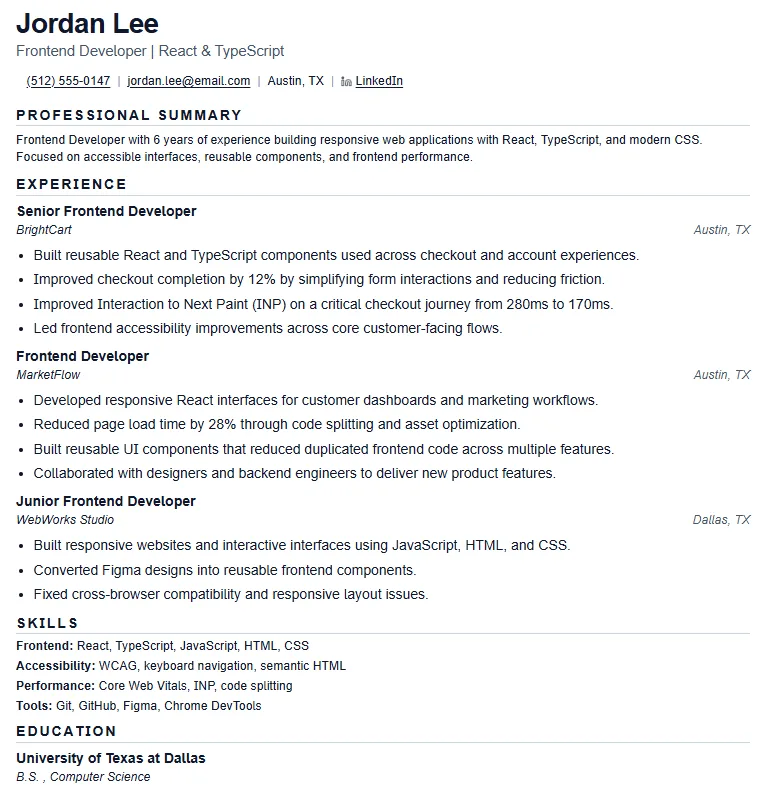
Chronological resume sample
When Not to Use a Chronological Resume
A chronological resume can become a disadvantage when the timeline raises more questions than your qualifications answer. Common examples include:
Large employment gaps
Several short stays
Older experience that is unrelated to the target role
A major career change
For example, someone moving from retail operations into IT support may not want older store-management responsibilities to dominate the page when recent IT training, help-desk projects, and technical skills are more relevant.
If the first thing a recruiter notices is the gap or unrelated experience rather than your qualifications, reconsider the structure.
In practice, a combination resume is usually the better alternative to a purely functional resume. If you need to emphasize transferable skills but still want recruiters to see where and when you developed them, keep the employment timeline visible and use the skills section to provide context. A functional format makes more sense only when the skill story genuinely matters more than the sequence of jobs.
Functional Resume: Best for Skills-First Positioning
A functional resume organizes the main evidence around capabilities rather than individual jobs. It should still include enough employment history for recruiters to understand where and when that experience was gained. Instead of creating a long skills list, group your strongest evidence into three or four categories directly related to the target role. For example:
Customer Success
Managed customer onboarding and reduced setup delays by 20%.
Account Support
Resolved escalated customer issues while maintaining service-level targets.
CRM & Reporting
Used Salesforce to track customer activity and report weekly retention metrics.
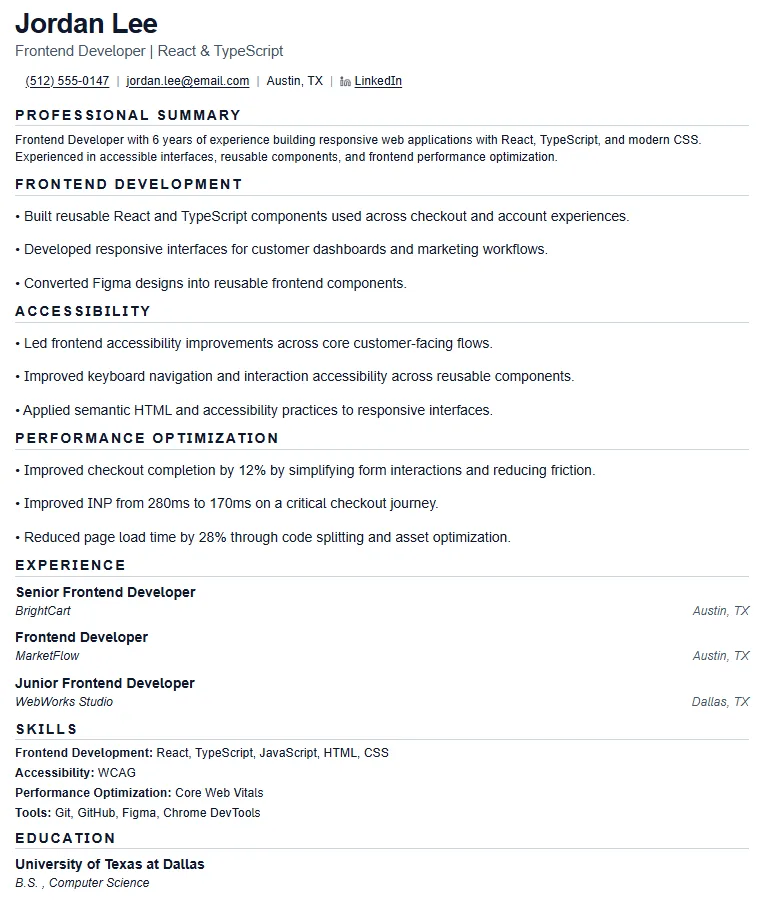
Functional resume sample
The important distinction is that a functional resume should organize evidence, not simply list skills. This can help candidates whose strongest qualifications were developed across different roles.
For example, a retail supervisor moving into customer success could emphasize account support, conflict resolution, KPI reporting, and Salesforce experience before presenting a short employment history.
Keep the categories limited to three or four that directly match the target role, and support each with specific accomplishments rather than generic claims such as "strong communication skills."
When Not to Use a Functional Resume
A functional resume is weaker when employers need to evaluate progression, scope, and recency. This is particularly important for senior roles, regulated fields, and careers where promotions demonstrate increasing responsibility.
Use this format only when your skills story is genuinely stronger than your career sequence, and provide enough dated context for the reader to verify it.
Combination Resume: Best for Career Changers and Hybrid Backgrounds
A combination resume blends a targeted skills section with a reverse chronological work history. It works particularly well for:
Career changers
Contractors and consultants
Candidates moving between related fields
Candidates with transferable skills and relevant experience
Hybrid or project-based careers
For example, a marketing coordinator moving into product marketing could highlight market research, launch support, and cross-functional communication at the top, then connect those skills to recent positions and measurable results.
The key is that the skills section should provide new context, not repeat the experience section.
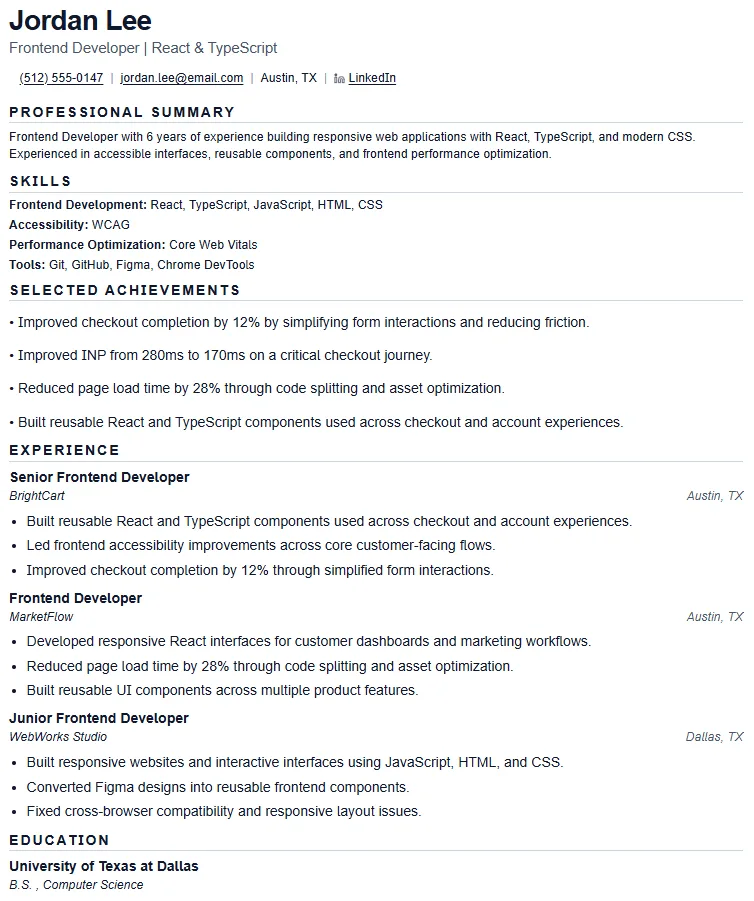
Combination resume sample
When Not to Use a Combination Resume
A combination resume adds unnecessary complexity when your work history already tells a clear story. If your recent roles show strong progression and direct relevance, a chronological resume is usually easier to scan.
Before using a combination format, remove any section that duplicates information. If the strongest version of the resume works as a straightforward timeline, keep it simple.
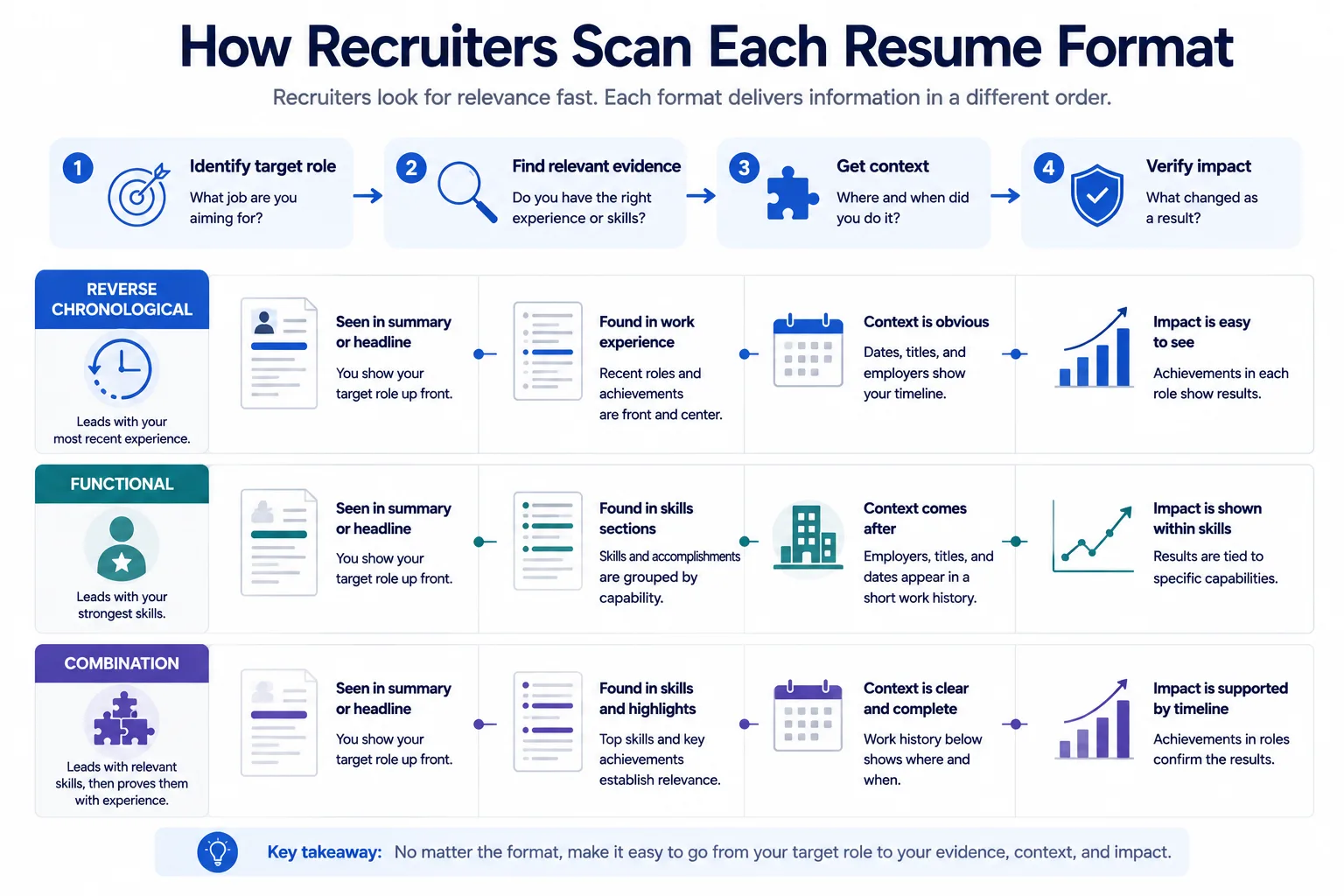
How Recruiters Scan Each Resume Format
Resume format affects how quickly a recruiter can confirm relevance. A reverse chronological resume makes recent titles, employers, dates, and progression immediately visible. A functional layout can require more interpretation because skills may lack clear context, while a combination resume can establish relevant skills first and support them with a work history.
Put your target job title or professional positioning, strongest matching skills, and most relevant experience where they can be seen quickly. The goal isn't to design for a literal stopwatch; it's to remove unnecessary searching.
Career Stage Guidance: Best Resume Formats for Students, Early-Career, Mid-Career, and Executives
Career stage can influence your resume structure, but it shouldn't determine the format by itself.
Students and recent graduates: Emphasize education, projects, internships, and relevant skills when formal experience is limited.
Mid-career professionals: Use reverse chronological formatting when recent experience demonstrates relevant progression.
Career changers: Consider a combination format when transferable skills need more emphasis.
Executives: Usually need a clear chronological record of leadership scope, progression, and outcomes.
If you're creating a resume without formal experience, see our guide to writing a resume with no experience.
When experience is thin, projects and specific accomplishments usually provide stronger evidence than a long list of capabilities.
How to Handle Employment Gaps Without Choosing the Wrong Format
Employment gaps do not automatically require a different resume format. The right choice depends on the gap's length, recency, and how strong the surrounding experience is.
For a mostly steady career with a short gap, a chronological resume can still work well. A concise explanation may be enough:
"Career break for caregiving"
"Full-time coursework in data analytics"
"Position eliminated in company restructuring"
A combination resume can help when you need to emphasize relevant skills while keeping the timeline visible.
Keep explanations brief and use the format that makes your relevant qualifications easiest to verify.
Transferable Skills: How to Highlight Them in Any Resume Format
Transferable skills are most valuable when they are supported by evidence.
For example:
Led a 6-person support team, cut response time by 18%, and trained new hires on a shared workflow tool.
This is more persuasive than simply listing "leadership" and "communication."
For career changers, translate previous responsibilities into outcomes relevant to the new role. Students can use projects, labs, internships, and campus roles in the same way. Returning workers can include recent training, volunteer work, or other relevant activity when it demonstrates current capability.
For more guidance on turning responsibilities into concise, achievement-focused bullets, see our resume bullet point best practices.
In a functional resume, group evidence by capability. In a combination resume, connect those capabilities to specific jobs and results.
Tailoring Your Resume Format to the Job Description
The job description should influence which information you emphasize, not the facts you include.
If the posting repeatedly emphasizes a skill or responsibility, make relevant evidence easy to find in your summary, skills section, and experience bullets.
Tailoring a resume does not mean changing its structure for every application. It means choosing the structure and emphasis that make your strongest relevant evidence easiest to verify.
If you're tailoring the same resume for several roles, a guided resume builder can help keep the underlying experience consistent while making role-specific adjustments more systematic.
ATS-Friendly Resume Formatting: What Actually Works
Your resume format should work for both human readers and applicant tracking systems. Regardless of whether you choose chronological, functional, or combination formatting, use:
Standard section headings such as Summary, Skills, Work Experience, and Education
A predictable reading order
Clearly labeled employers, job titles, and dates
Consistent bullets and spacing
Relevant keywords in context
The important distinction: ATS-friendly formatting does not determine which resume format you should choose. It determines how cleanly your chosen format can be read.
If you're unsure whether your chosen format is still easy for an ATS to interpret, an ATS analysis tool can help identify structural or job-alignment issues before you submit.
ATS-Safe Template Pitfalls
Design-heavy templates can create parsing problems when they rely on:
Tables
Text boxes
Decorative sidebars
Icons for contact information
Multiple columns
Unusual section headings
Resume Length: How Long Each Format Should Be
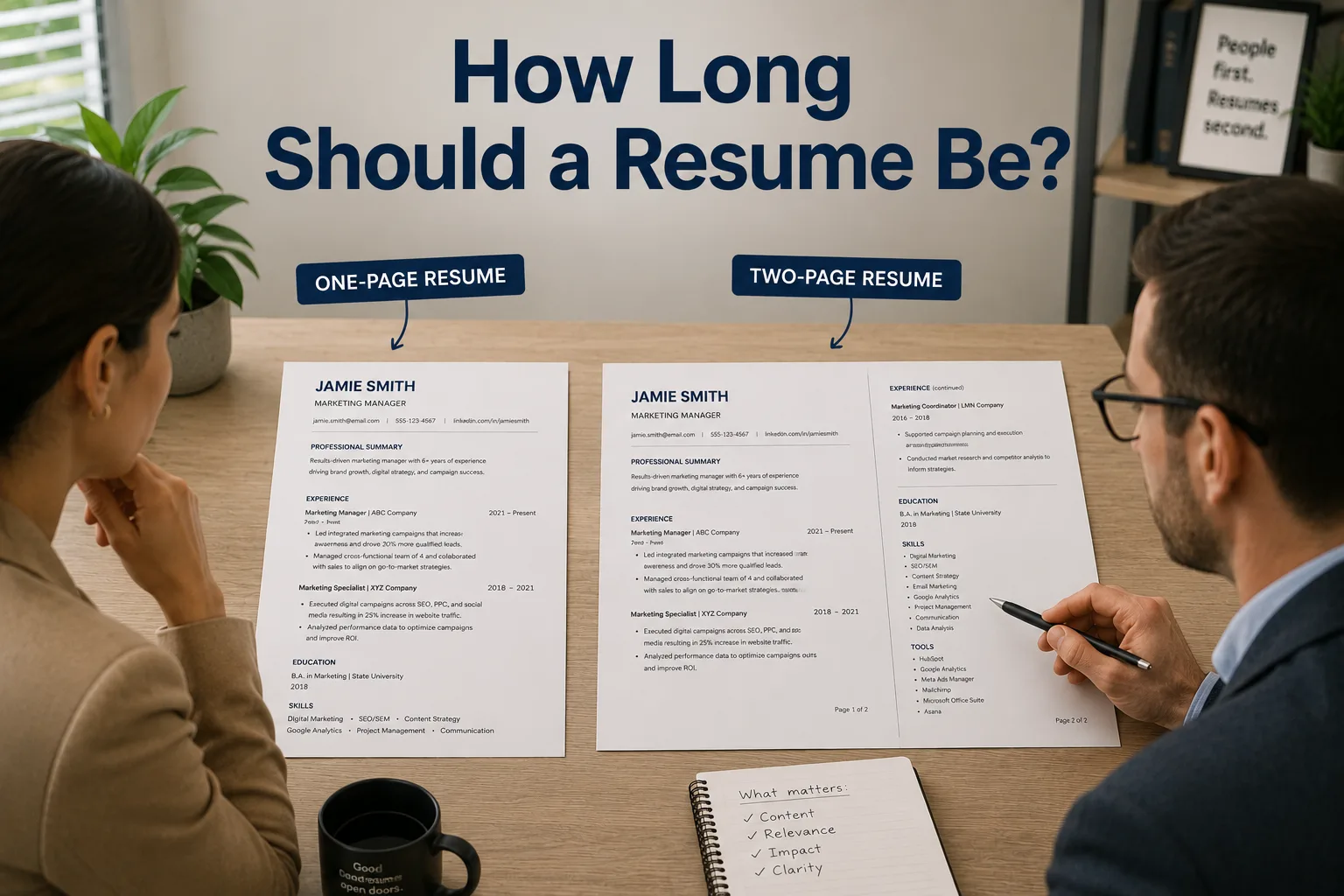
Resume length should reflect relevant experience, not an arbitrary page target. One page is often enough for students and early-career candidates, while two pages can be appropriate when relevant experience, measurable results, certifications, or leadership scope require additional space.
Regardless of format, remove outdated jobs, repeated bullets, and low-value details. If removing a line doesn't make it harder to understand your fit for the target role, remove it. For detailed guidance on how long a resume should be, see our dedicated guide.
Frequently Asked Questions
What is the best resume format?
For most candidates with relevant, recent work experience, reverse chronological format is the safest choice because it makes career progression and recent experience easy to evaluate.
Is a chronological or reverse chronological resume better?
They generally refer to the same format. Modern resumes typically list the most recent position first and work backward.
Is a functional resume good for career changers?
It can be useful when transferable skills are stronger evidence than job titles, but a combination resume is often a better compromise because it highlights skills while keeping the employment timeline visible.
Which resume format is best for ATS?
ATS compatibility depends more on how the resume is formatted and structured than whether it is chronological, functional, or combination. Use standard headings, predictable ordering, readable text, and clearly labeled experience.
Should I use a functional resume to hide an employment gap?
Usually, no. Hiding chronology can create questions about your background. A chronological or combination resume with a concise explanation is often more transparent.
Final Takeaway
Choose the format that makes your strongest evidence easiest to verify:
Reverse chronological when recent experience and progression are your strongest evidence.
Functional when transferable skills genuinely matter more than job sequence.
Combination when you need both skills-first positioning and a visible career timeline.
Once you choose the structure, keep the document simple, tailor the emphasis to the target job, and remove anything that doesn't strengthen your case.
The strongest resume format is not the most creative one. It is the one that makes your most relevant evidence easiest to find and verify.