How Long Should a Resume Be? By Experience Level and Industry
Discover the ideal resume length by experience level, industry, and ATS requirements, with practical examples and formatting guidance.
How Long Should a Resume Be? A Practical Guide by Experience, Industry, and ATS Rules
Confusion about resume length causes many candidates to either cut important accomplishments or pad their resume with low-value content. The right length depends on your experience, industry, and the amount of relevant evidence you need to show.
The simplest rule: your resume should be as short as possible while still proving you're qualified for the role.
Start Here: The Short Answer on Resume Length
If you're early in your career, a one-page resume is usually enough.
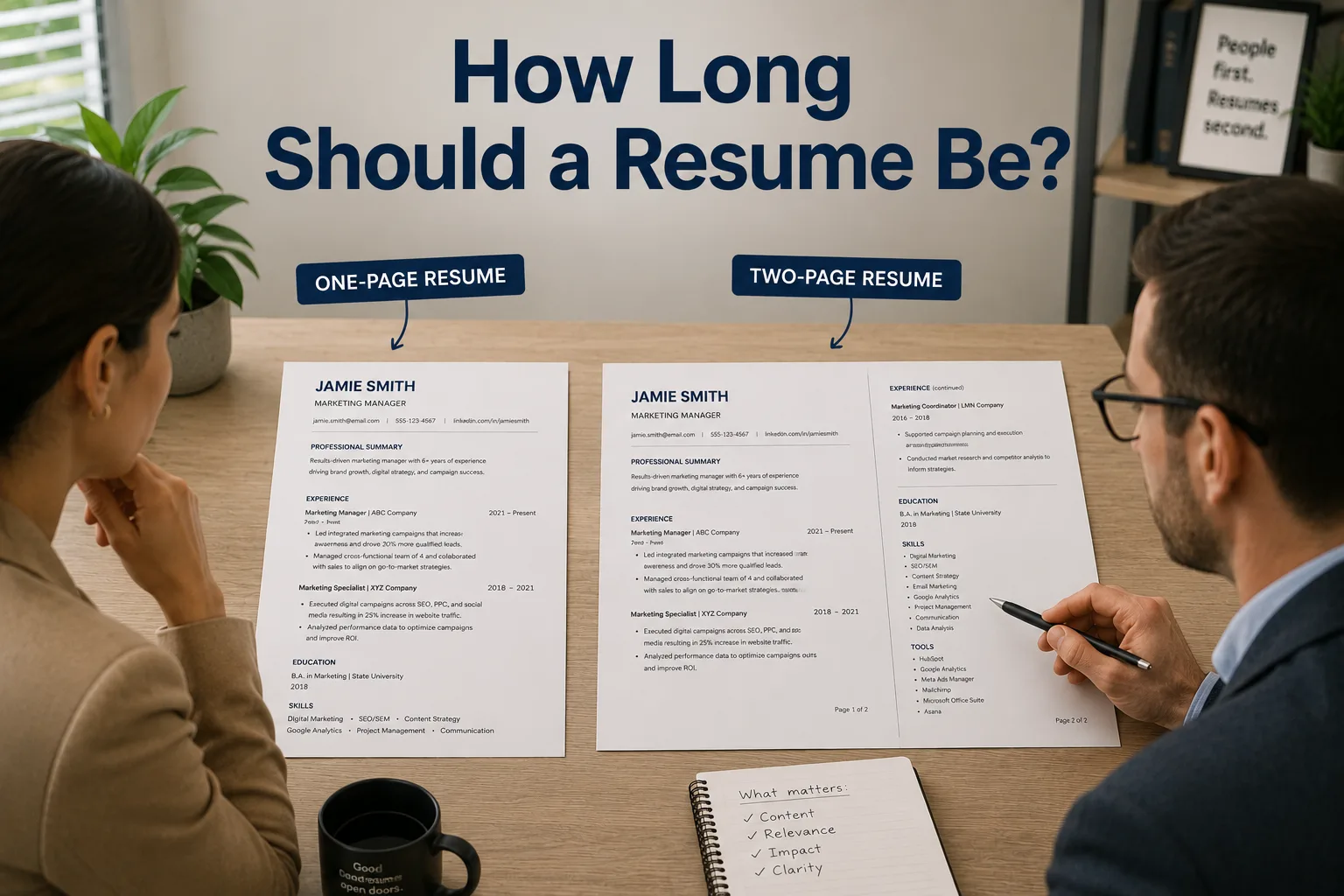
A two-page resume is appropriate when reducing it further would require removing meaningful achievements, leadership experience, certifications, or specialized expertise.
Use one page when:
- You have less than 5 years of relevant experience
- Your qualifications fit comfortably on one page
- You can demonstrate impact without sacrificing clarity
Use two pages when:
- You have multiple relevant roles, promotions, or leadership positions
- You need space for significant accomplishments, projects, or certifications
- Cutting content would weaken your candidacy
Common mistake: Adding a second page filled with duties rather than results.
Why Resume Length Is Often Misunderstood
Many job seekers treat resume length as a rule to follow rather than a decision to make. In practice, recruiters care far more about relevance and readability than whether a resume is exactly one page. A concise two-page resume with strong achievements will usually outperform a one-page resume that omits important evidence of impact.
Resume Length Rules That Actually Matter
The best resume length rule isn't based on page count—it's based on relevance.
Every line should help answer one question:
Why should this candidate be interviewed for this role?
A bullet like:
Built a Tableau dashboard that reduced reporting time by 6 hours per week
adds far more value than several bullets describing routine responsibilities.
Expert observation: Many candidates focus on fitting within a page limit while leaving weak content untouched. A stronger approach is to remove low-value content first and let the page count take care of itself.
One Page vs Two Pages: A Simple Decision Framework
When deciding between one page and two pages, consider:
- Relevant experience
- Role complexity
- Evidence of impact
A recent graduate, coordinator, or junior professional can usually stay on one page.
A senior engineer, manager, or specialist may need two pages to show:
- Leadership
- Major projects
- Technical depth
- Business impact
Before adding a second page, ask:
Does every section add new evidence that supports this role?
If not, trim it.
Common Mistake: Moving to Two Pages Too Early
Many professionals move to a two-page resume as soon as they accumulate several years of experience. However, additional experience does not automatically require additional space. Before expanding to a second page, consider whether older positions, routine responsibilities, or less relevant achievements can be condensed to make room for stronger evidence.
Second-Page Decision Checklist
Page two should earn its place.
Keep a second page only if it contains:
- Significant accomplishments
- Leadership experience
- Relevant certifications
- Specialized technical expertise
- Major projects tied to the role
Reduce or remove:
- Repetitive responsibilities
- Older unrelated jobs
- Generic soft-skill statements
- Excessive summaries
Practical recommendation: Delete your three weakest bullets. If the second page still adds meaningful value, it is probably justified.
Resume Length by Career Stage
Students and Recent Graduates
Most candidates with 0–2 years of experience should use one page.
Prioritize:
- Education
- Internships
- Projects
- Relevant skills
- Leadership activities
Candidates with limited professional experience can also benefit from reviewing resume strategies for students and first-time job seekers.
Remove:
- High school information (unless highly relevant)
- Unrelated activities
- Duplicate skills
Early- and Mid-Career Professionals
Professionals with roughly 3–10 years of experience often fall between one and two pages.
Factors that justify additional space include:
- Promotions
- Team leadership
- Budget ownership
- Certifications
- Technical specialization
Senior Professionals and Executives
Two pages are common when documenting:
- Strategic responsibilities
- Large teams
- Significant budgets
- Organizational impact
However, seniority alone does not require a longer resume.
Important exception: Seniority alone does not justify a longer resume. A director with fifteen years of experience may still fit comfortably on one page if their recent accomplishments clearly demonstrate leadership and business impact. Conversely, a specialist with fewer years of experience may need additional space to document complex projects, certifications, or technical expertise.
Common mistake: Giving equal space to every role instead of emphasizing recent, relevant experience.
Candidate Scenarios
Recent Graduate
A one-page resume typically includes:
- Education
- Internships
- Projects
- Relevant coursework
- Skills
Career Changer
Focus on transferable experience.
For example, a retail supervisor moving into HR should highlight:
- Hiring
- Training
- Scheduling
- Employee support
while minimizing unrelated operational duties.
Manager or Senior Specialist
Two pages may be justified when documenting:
- Team size
- Project scope
- Revenue impact
- Strategic initiatives
The deciding factor is not years worked—it's the amount of relevant evidence needed to prove fit.
Industry-Specific Resume Length Norms
Resume expectations vary by industry.
Private Sector
Most corporate, technology, sales, marketing, and operations roles prefer concise resumes focused on measurable results.
Healthcare
Additional space may be needed for:
- Licenses
- Certifications
- Clinical experience
Federal Jobs
Federal resumes often require significantly more detail than private-sector resumes.
Academia and Research
Academic CVs frequently exceed two pages because they include:
- Publications
- Grants
- Teaching experience
- Presentations
- Research projects
Important exception: Applying private-sector resume rules to academic or federal applications can hurt your chances.
💡 Worth Knowing
The one-page resume rule is largely a private-sector convention. Academic CVs, federal resumes, and some healthcare roles often require significantly more detail than corporate applications.
Why Industry Expectations Differ
Different industries evaluate candidates differently. A marketing manager may be judged primarily on business outcomes and campaign performance, while an academic researcher may be evaluated on publications, grants, and teaching history. Understanding what employers in your field expect is often more important than following a universal page-count rule.
Career Stage and Industry Matrix
One Page
Best for:
- Students
- Recent graduates
- Early-career professionals
- Most administrative, sales, and marketing roles
One and a Half Pages
Often appropriate for:
- Mid-career professionals
- Career changers
- Specialists with moderate experience
Two Pages
Common for:
- Managers
- Senior specialists
- Technical experts
- Executives
The right length depends on the complexity of your experience, not simply the number of years you've worked.
Federal Resumes, Academic CVs, and Other Exceptions
Some application types follow different standards.
Federal hiring systems may require:
- Detailed duties
- Hours worked
- Salary information
- Specialized experience
Academic CVs may require:
- Publications
- Research
- Teaching history
- Grants
- Presentations
In these cases, completeness is more important than brevity.
What to Include So Your Resume Earns Its Length
Most resumes need four core sections:
- Summary
- Experience
- Skills
- Education
Add only when relevant:
- Certifications
- Projects
- Publications
- Awards
Remove first:
- Unrelated coursework
- Outdated technical skills
- Older irrelevant experience
Expert observation: The strongest resumes are usually not missing information—they are missing prioritization.
How to Handle Nontraditional Experience Without Wasting Space
Nontraditional experience belongs on a resume when it demonstrates relevant skills or measurable results.
Examples include:
- Freelance work
- Volunteer projects
- Military service
- Internships
- Returnships
- Bootcamp projects
Focus on outcomes rather than descriptions.
Instead of:
Managed volunteer activities
Use:
Coordinated 25 volunteers for a community fundraising event that exceeded donation goals by 15%
ATS Resume Basics That Affect Length and Readability
Applicant Tracking Systems (ATS) work best with simple formatting.
Use standard headings:
- Summary
- Experience
- Education
- Skills
Avoid:
- Tables
- Text boxes
- Icons
- Complex graphics
Use keywords naturally when they accurately reflect your experience. For a deeper explanation of ATS-friendly keyword usage and optimization, see our guide on ATS-friendly resume techniques and keyword strategies.
Common mistake: Adding keywords repeatedly to improve ATS performance. This usually hurts readability without improving results.
ATS Myth: Shorter Resumes Always Perform Better
A common misconception is that ATS systems prefer shorter resumes. Modern ATS platforms do not rank candidates based on page count. What matters is whether your experience, skills, and qualifications align with the job requirements and can be accurately parsed by the system. In practice, ATS analysis tools that compare resumes against job descriptions can help identify whether important qualifications are missing or underrepresented. Reducing valuable content solely to achieve a one-page resume can weaken your application.
ATS-Safe Formatting Walkthrough
For maximum compatibility:
- Use a single-column layout
- Choose standard fonts such as Arial or Calibri
- Keep dates consistent
- Save as PDF or DOCX when accepted
Before applying, copy the resume into a plain-text editor. If the content remains organized and readable, it will usually parse correctly.
Resume Formatting Pitfalls That Make a Good Resume Too Long
A resume can feel longer than it actually is because of poor formatting.
Common issues:
- Dense paragraphs
- Tiny fonts
- Oversized summaries
- Repeated skills
- Keyword stuffing
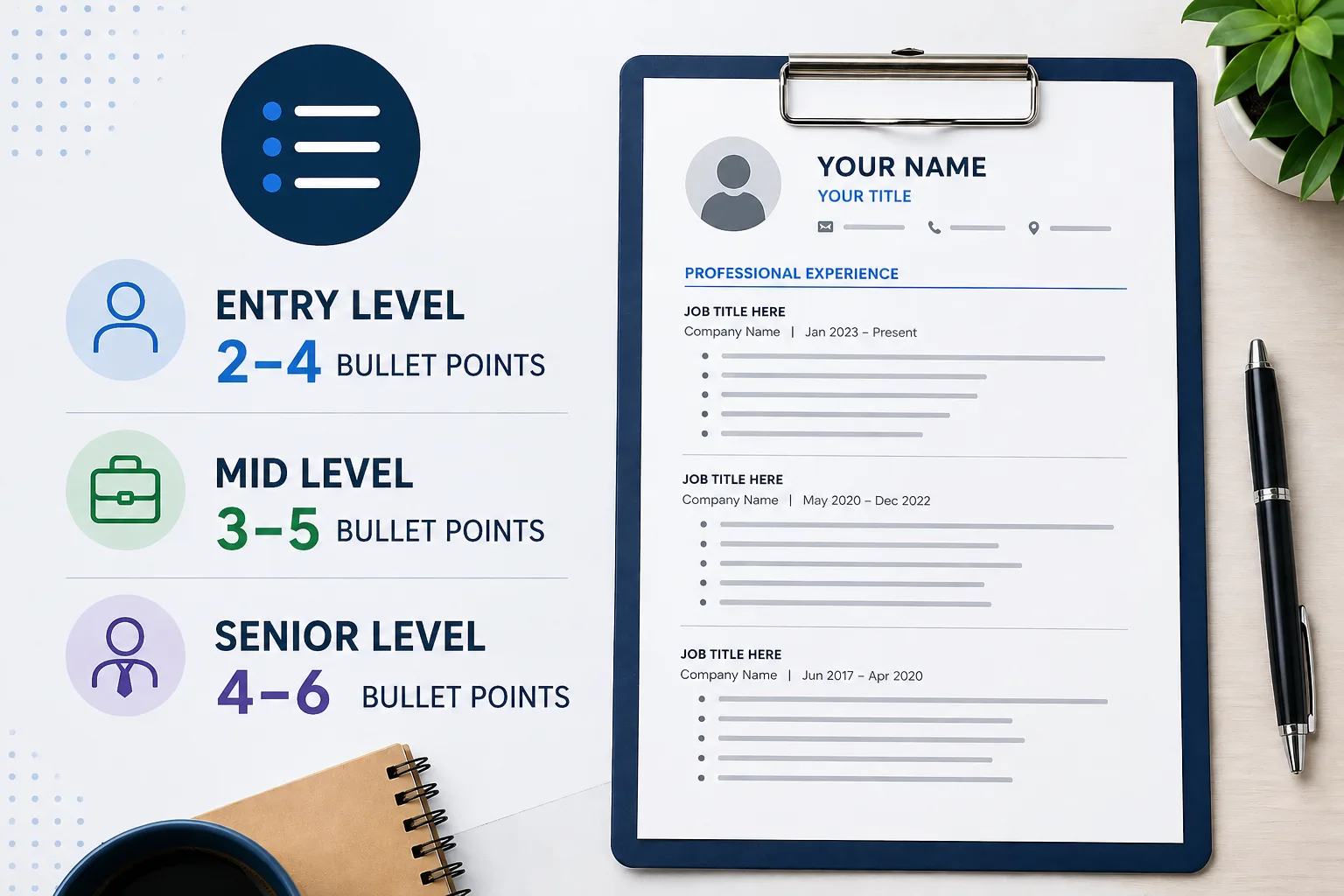
Recommended formatting:
- 10.5–12 pt font
- 0.5–1 inch margins
- 3–5 bullets per role
- Short summaries
The goal is not to fit more content onto the page. The goal is to make important information easier to find.
How to Edit a Resume Down Without Losing Value
When shortening a resume:
Cut
- Generic responsibilities
- Repeated software mentions
- Weak bullets without outcomes
Keep
- Measurable achievements
- Promotions
- Leadership experience
- Relevant certifications
Compress
- Older positions
- Unrelated experience
For example, replace:
- Managed reports
- Updated dashboards
- Shared metrics
with:
Automated dashboard reporting, reducing manual preparation by 6 hours per week.
Practical recommendation: Edit for evidence, not fairness. Recent, relevant accomplishments deserve more space than older positions. If restructuring and prioritizing content feels difficult, guided resume builders with contextual feedback can help surface stronger achievements and reduce repetitive editing work.
A Practical Editing Exercise
If you're unsure whether your resume is too long, highlight every bullet point that demonstrates measurable results, leadership, cost savings, revenue impact, efficiency gains, or technical expertise. Then review the remaining content. Most candidates discover that their strongest resume is created by removing low-value responsibilities rather than cutting meaningful accomplishments.
Before-and-After Resume Snippets: What Justifies Page Two
Weak bullets:
- Managed social media accounts
- Helped with campaigns
- Worked with sales
Strong bullets:
Strong bullets often follow the same principles discussed in our guide to achievement-focused resume bullet points.
- Increased qualified inbound leads by 32% through LinkedIn content strategy
- Improved demo bookings by 18% through HubSpot email campaigns
- Reduced lead-response time from two days to six hours through revised nurture workflows
Page two becomes justified when it contains stronger proof, not simply more content.
A Quick Tailoring Method for Every Application
Use a master resume and customize it for each role.
- Review the job description
- Highlight required skills and responsibilities
- Prioritize matching achievements
- Remove less relevant content
Update:
- Summary
- Skills
- Bullet order
before each application.
This improves both relevance and resume length.
Resume Length Examples by Candidate Type
Recent Graduate
One page:
- Education
- Internships
- Projects
- Skills
Career Changer
One to 1.5 pages:
- Transferable accomplishments
- Certifications
- Relevant projects
Manager
Two pages:
- Leadership scope
- Team size
- Business impact
- Strategic initiatives
Federal or Academic Candidate
Length varies based on application requirements and supporting documentation.
Final Rule of Thumb: How to Know Your Resume Is the Right Length
Your resume is the right length when:
- Every line supports your candidacy
- The document is easy to scan
- Important achievements are visible
- ATS systems can read it correctly
A one-page resume is not automatically better than a two-page resume.
A two-page resume is not automatically too long.
The most effective resumes focus on evidence, not page count. Recruiters are looking for proof that you can solve problems, create value, and succeed in the role. If additional space helps communicate that evidence, use it. If it does not, remove it.
When deciding between one page and two pages, prioritize relevance, clarity, and impact over arbitrary rules. The best resume length is the shortest version that still provides enough convincing evidence to earn an interview.