
Quantifiable Achievement
A quantifiable achievement connects a work contribution to a meaningful number such as volume, time, quality, revenue, cost, or reach.
A quantifiable achievement is a work contribution supported by a meaningful number. The number may describe revenue, cost, time, volume, quality, error rate, customer reach, team size, or another measure relevant to the result.
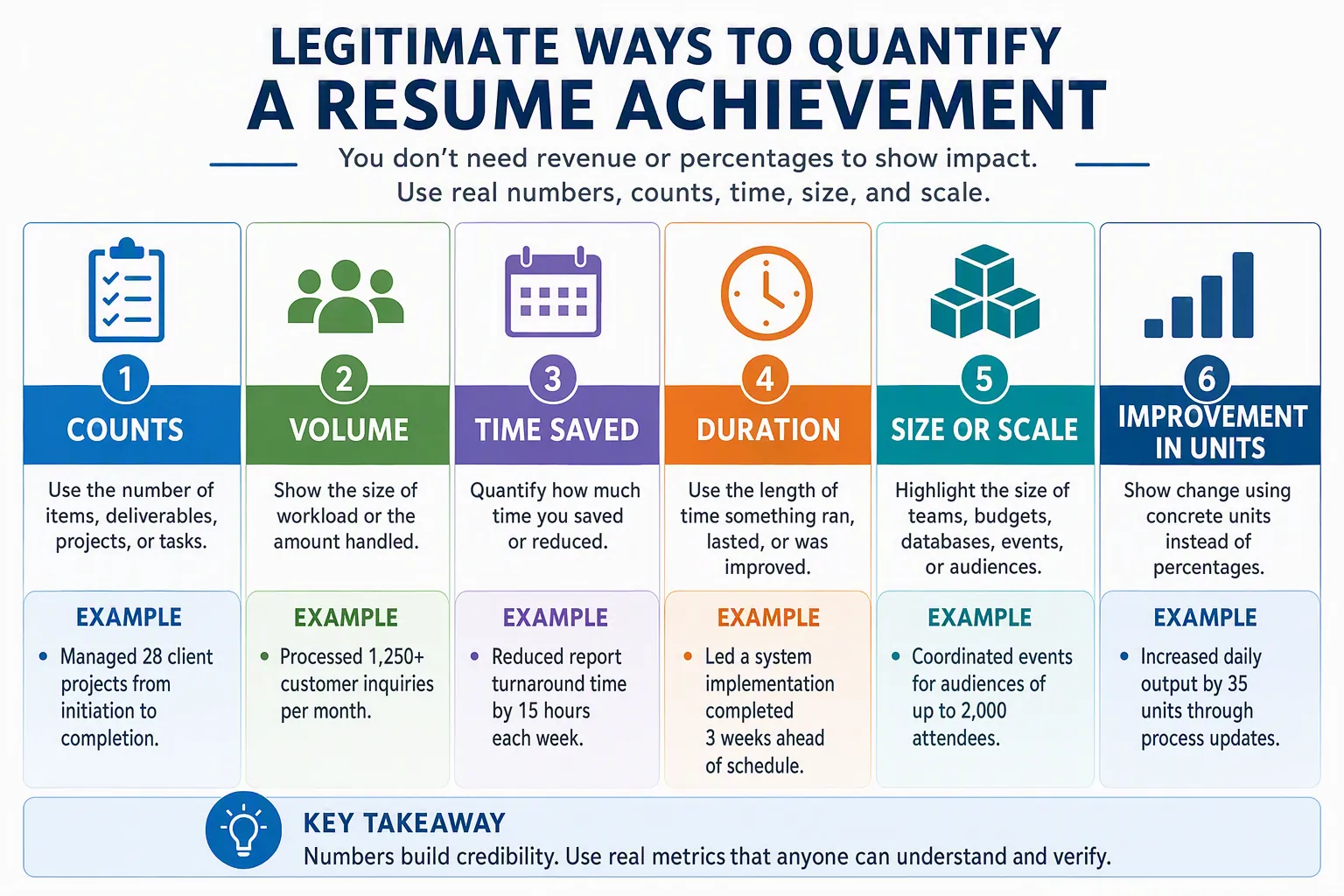
“Improved sales by 20%” is incomplete if the period, baseline, contribution, or scope is unclear; a stronger statement might say: “Reworked renewal outreach for a 120-account portfolio, contributing to a 20% increase in quarterly renewals compared with the previous quarter. ” Use “contributing to” when other people or factors influenced the result; do not claim full credit for a team outcome you only supported. Not every achievement needs a number; resolving a compliance issue, delivering a complex launch, improving a decision, or preventing a risk can be meaningful without a defensible metric; use a number only when its source and meaning can be explained, because an unsupported percentage is weaker than an observable result with honest context.
For example, “Reduced monthly closing time from eight days to five” gives a baseline, result, and scale that readers can verify.