How the STAR Method Works
Learn how Situation, Task, Action, and Result organize behavioral interview evidence without turning a true work example into a rigid script.
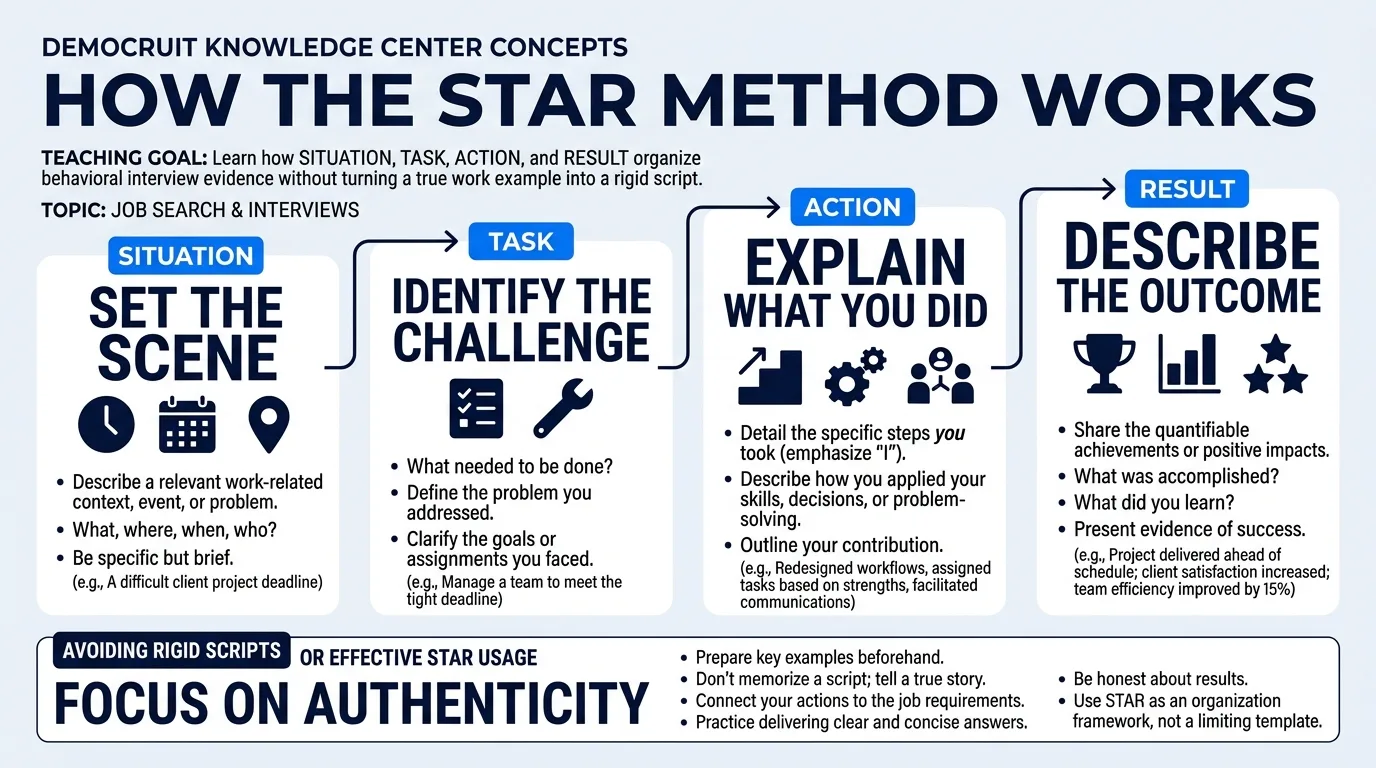
The STAR method organizes a work example into Situation, Task, Action, and Result. It gives an interviewer enough context to understand the problem while keeping the candidate's decisions and contribution central. STAR is most useful for behavioral questions, but it should guide a truthful conversation rather than turn every answer into four memorized sentences.
How it works
- Situation establishes the context. Name the setting and problem with only the details needed to understand what happened.
- Task defines the responsibility. Explain the goal, constraint, or decision you were personally responsible for handling.
- Action shows your reasoning and contribution. Describe the steps you took, the choices you made, and how you worked with other people. This is usually the longest part.
- Result closes the evidence loop. State what changed, what was delivered, what feedback followed, or what you learned when the outcome was mixed.
Why it matters
Behavioral interview questions ask for evidence from past experience, not only a claim about a skill. STAR helps the candidate connect a general statement such as “I improve processes” to a specific problem, decision, and outcome. The structure also helps the interviewer separate team results from the candidate's individual contribution.
Concrete example
Imagine a support operations specialist is asked, “Tell me about a time you improved a process.” A weak answer says the team created a checklist and communication improved. The interviewer cannot see the original problem, the candidate's role, or the evidence behind the conclusion.
A STAR answer could begin with the situation: technical reviewers were receiving incomplete escalations, which delayed responses. The task was to identify what information was missing and propose a practical fix.
The action explains the candidate's work in detail. The specialist reviewed 50 recent tickets, found four fields that were regularly absent, interviewed support and engineering leads, and tested a required intake checklist with one queue before wider use. This section reveals analysis, collaboration, and implementation rather than hiding everything behind “we.”
The result states that incomplete escalations fell from 18 to 6 in the following month and that the team adopted the checklist for all priority cases. If those numbers were not available, the candidate could describe another observable result, such as fewer clarification messages or formal adoption by the team, as long as it is accurate.
Before the interview, the candidate can test whether the story is suitable by checking three things: the example answers the exact question, the personal action is distinguishable from the team's work, and the result is supported by a fact or observation. If one part is missing, another true story may be stronger. A brief follow-up reflection can explain what the candidate would repeat or change.
Common misconception
STAR does not require a perfect outcome or a metric in every answer. A failed attempt can still demonstrate judgment when the candidate explains the decision, recognizes what went wrong, and shows what changed afterward. Likewise, forcing an unsupported percentage into the result makes the story less credible, not more persuasive.
The method also does not require candidates to announce every label aloud. In a natural answer, the four parts should be understandable without saying “my situation was” or “the result was.” Prepare several true stories, remember the key facts, and adapt the emphasis to the question instead of memorizing one script.
Not every interview question needs STAR. Questions about motivation, availability, or factual knowledge usually need a direct answer. Use the framework when the interviewer is asking for a past example, especially when the wording begins with “Tell me about a time” or “Give me an example.” Choosing the framework deliberately keeps it useful instead of making every response sound formulaic.
To apply this: Turn the same evidence into strong resume bullet points.
Last updated: August 19, 2026