
A frontend developer resume should prove that you can turn product requirements into an interface that works for real people, real data, and real browsers. A list of React hooks or CSS tools cannot show that. Hiring teams want evidence that you handled keyboard interaction, slow networks, translated copy, error states, rendering cost, and the shared components that keep those decisions consistent.
The strongest page is organized around outcomes. Name the product surface, explain the browser or interaction problem, show the technical choice, and report what changed. This lets a recruiter understand the impact while giving an engineer enough detail to ask a useful follow-up question.
Use this resume template for frontend developer applications
Give accessibility, performance, design-system work, and product outcomes enough space to be understood.

What frontend hiring managers scan first
The first scan asks three questions: Did you own a meaningful user flow? Can you measure browser quality? Did your work make the next feature easier to build? Checkout, onboarding, search, editors, and data-heavy dashboards communicate more scope than “built responsive pages.” Core Web Vitals, task completion, accessibility findings, and component adoption make the result verifiable.
Framework names help with routing, but they are not proof. “React” may satisfy an applicant tracking system (ATS) query. A bullet about preventing stale search results, reducing Interaction to Next Paint (INP), or migrating forms onto an accessible field primitive earns the interview.
Ownership beyond the happy path
- Hiring signal
- The candidate can ship and maintain a complete browser experience, including loading, empty, error, keyboard, and responsive states.
- Evidence to show
- Name the product flow, difficult state, implementation decision, validation method, and user or team result.
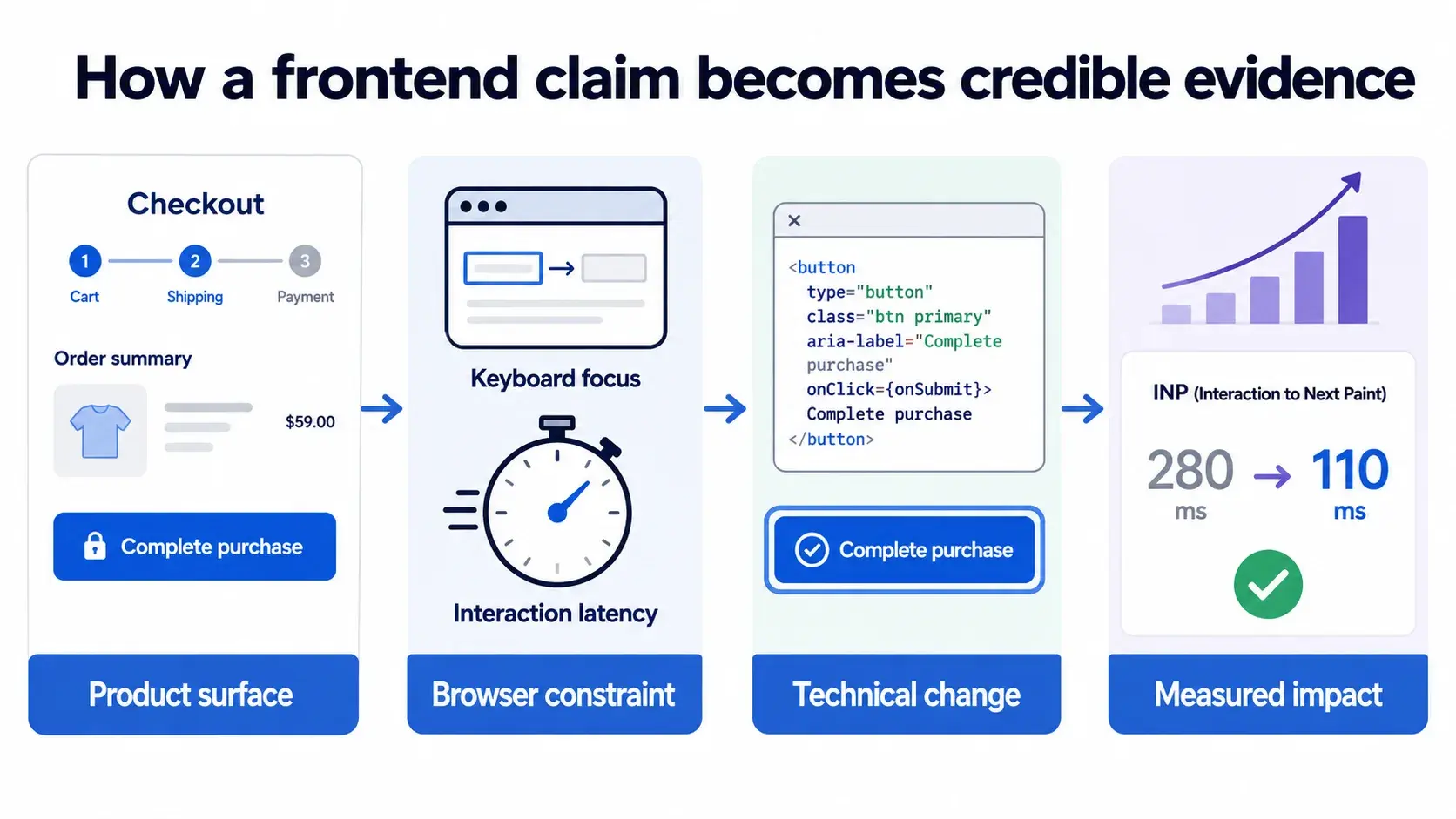
Skills that prove frontend engineering depth
Group skills by the problems they solve, then prove the important ones in experience bullets. Accessibility means semantic HTML, focus management, accessible names, and testing with both automated tools and a keyboard. Performance means diagnosing rendering, network, and JavaScript cost with field or lab data, not merely reporting a perfect Lighthouse score.
Design-system work should include adoption. Extracting a button is a code change. Defining states, documenting variants, migrating product teams, and removing duplicate implementations is engineering leverage. Testing should also reflect user behavior through role-based queries, critical interaction tests, and selective visual regression coverage.
Browser quality
- Semantic HTML and WCAG
- Keyboard and focus behavior
- Core Web Vitals and responsive layout
Product delivery
- Typed component APIs
- Server and client state handling
- Testing Library and visual regression
Team leverage
- Design tokens and reusable primitives
- Documentation and migration plans
- Performance and accessibility gates
Frontend achievement bullets with credible evidence
Lead with the change, then explain how you produced it. Include a baseline whenever possible. Performance numbers need a device, percentile, or data source. Accessibility claims need a standard and validation method. Design-system claims need a migration or adoption result.
Before
Improved the performance and accessibility of the checkout page.
After
Reduced checkout INP from 380ms to 170ms at the 75th percentile by isolating address validation from cart renders, then removed 12 keyboard and accessible-name failures verified with axe and manual tab testing.
Why it works
The rewrite names the flow, metric, baseline, technical intervention, accessibility scope, and verification method.
Action
Reduced checkout INP from 380ms to 170ms
Method
Separated address validation from cart renders
Result
Improved interaction speed while preserving an accessible keyboard path
Other useful evidence includes retiring duplicate components, reducing JavaScript transferred on a key route, preventing regressions in continuous integration, or increasing successful completion of a complex form. Do not invent business impact. An engineering metric you can explain is stronger than an unsupported conversion claim.
ATS keywords matched to frontend proof
Use the language from the posting when it accurately describes your work. Put core platform terms in Skills, then repeat the most important ones naturally in achievement bullets. Keep library versions and minor tools out unless the role explicitly depends on them.
Frontend terms worth supporting with evidence
- JavaScript
- TypeScript
- React
- semantic HTML
- responsive design
- accessibility
- WCAG
- Core Web Vitals
- design systems
- Testing Library
- ARIA
- Lighthouse
Translate the job description into evidence
| Job requirement | Matching evidence | Keyword |
|---|---|---|
| Build accessible, reusable UI components | Migrated 18 forms to a keyboard-tested field primitive and removed 9 duplicate implementations | design systems |
| Improve performance across critical journeys | Reduced product-list LCP from 3.7s to 2.2s at p75 using responsive images and route-level code splitting | Core Web Vitals |
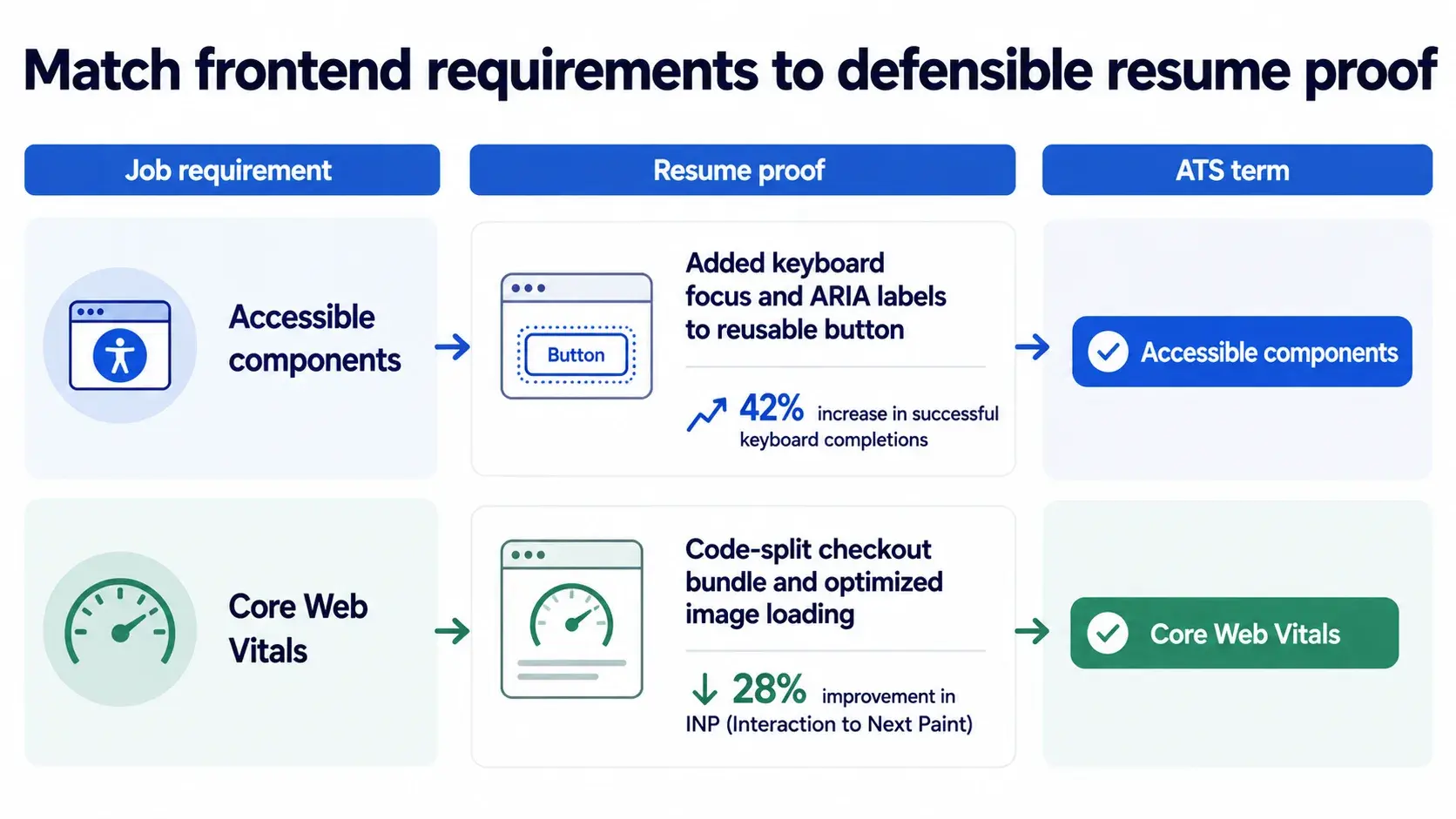
For a deeper matching process, read resume keywords and ATS-friendly resume structure.
How frontend resume evidence changes by seniority
Scope should grow without erasing technical depth. Junior candidates can use internships, substantial projects, and production fixes, but should explain the user and constraint. Mid-level candidates should show ownership of a feature area across release, monitoring, and maintenance. Senior candidates should show standards or systems that improve delivery across teams while retaining a few technically specific bullets.
- 1
Junior
- Focus
- Reliable execution on scoped interfaces
- Proof to show
- Shipped flows, semantic markup, interaction tests, and fixes based on review or user feedback
- 2
Mid-level
- Focus
- Ownership of a product surface
- Proof to show
- State design, performance measurement, accessibility follow-through, and production outcomes
- 3
Senior
- Focus
- Frontend leverage across teams
- Proof to show
- Shared architecture, migration leadership, quality budgets, and measurable adoption
Frontend resume mistakes that weaken strong work
Framework tourism is the most common mistake. A list of React, Vue, Angular, and Svelte suggests shallow exposure when no bullet connects them to a shipped interface. Another mistake is treating accessibility as a value statement. Hiring teams need the standard, defect, interaction, and verification method.
Performance claims without a measurement boundary
- Why it hurts
- Saying a page became faster gives no baseline, metric, device context, percentile, or explanation of what changed.
- Better approach
- Name the user journey and metric, report before and after values, identify the technical intervention, and state whether the data came from field monitoring or a controlled test.
Do not reduce CSS work to “matched Figma designs.” Responsive behavior, logical properties, content growth, stacking contexts, and dense data layouts are engineering constraints. Likewise, do not use a portfolio as a substitute for resume evidence. The resume must make your contribution clear before anyone follows a link.
Use strong resume bullet points to turn duties into evidence.

Turn frontend work into interview-ready evidence
Demi can help you identify the browser constraint, technical decision, validation method, and measurable result behind each frontend project.
Frequently asked questions
- How long should a frontend developer resume be?
- Use one page when you have fewer than about eight years of relevant experience. Add a second page only when it preserves distinct evidence, such as ownership of several product surfaces, a design-system migration, or a sustained performance program. Remove old tutorial projects before shrinking strong production bullets.
- What format works best for a frontend developer resume?
- Use a single-column, reverse-chronological layout with conventional headings such as Experience, Skills, Projects, and Education. Keep important evidence in selectable text rather than screenshots or graphics so applicant tracking systems and recruiters can read it reliably.
- Should a frontend developer include a portfolio link?
- Include a portfolio when it demonstrates production interfaces, accessible interactions, component systems, or performance investigations that support your resume claims. Put the link in the header, explain your contribution on collaborative work, and make sure every featured project loads correctly on mobile and with a keyboard.
- Which frontend metrics belong on a resume?
- Use metrics tied to user experience or engineering leverage. Strong examples include LCP, INP, CLS, conversion completion, accessibility defects removed, bundle size, component adoption, duplicate implementations retired, and test failures caught before release. Always include the baseline, your intervention, and the measured result.
Ready to build your Frontend Developer resume?
Use the skills, bullets, and keywords on this page as a starting point in the Democruit resume builder.