
How to Write Strong Resume Bullet Points
Write resume bullet points that show action, context, and credible results for the role you want.
Strong resume bullets make a specific claim about your contribution and give the reader enough context to understand why it mattered. Start with a precise action, name the work or audience, and add a credible outcome, scale, or method. The goal is not to make every line sound dramatic. It is to make your value easy to assess.
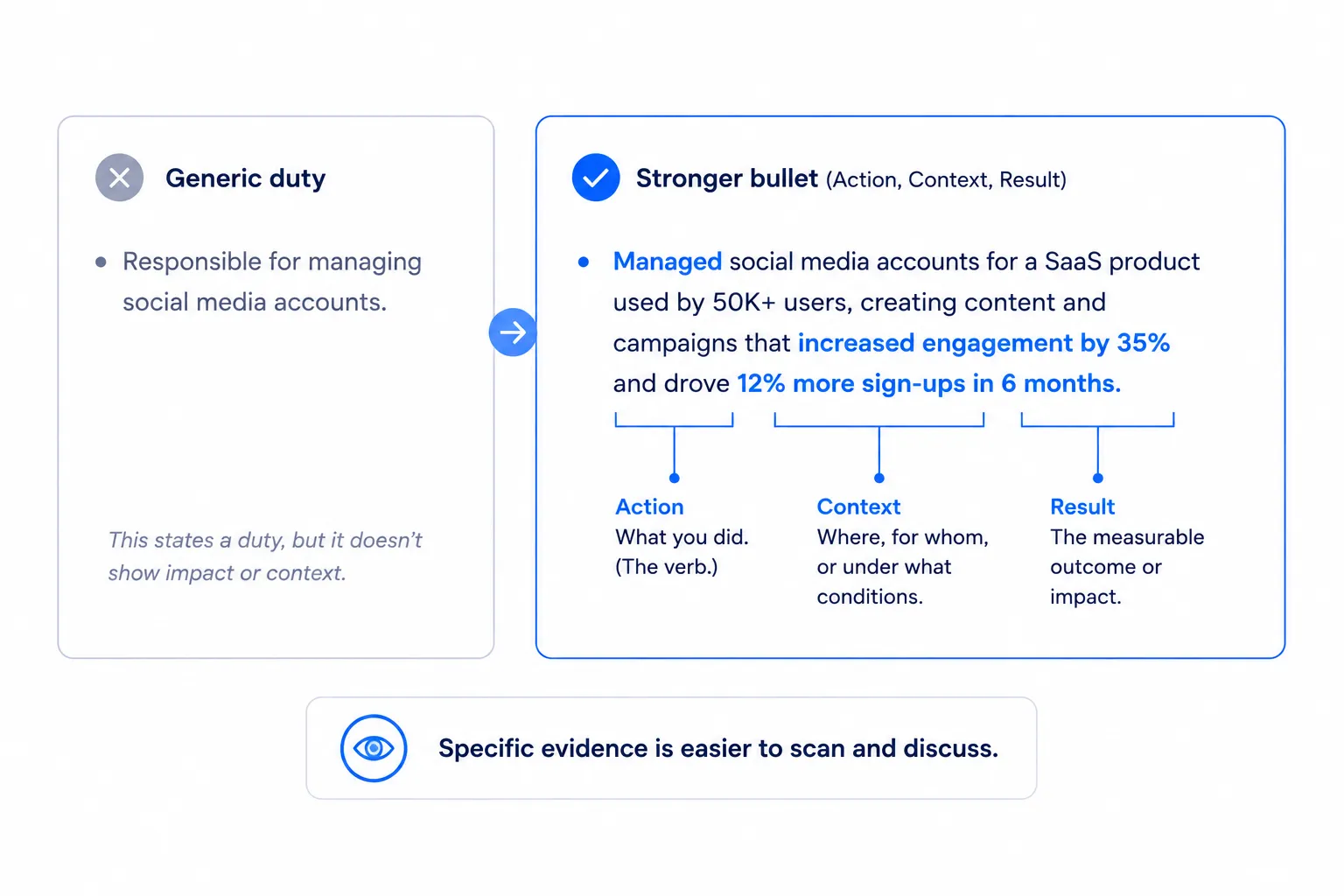
Use the action, context, result pattern
Draft each bullet with three questions: What did I do? Where or how did I do it? What changed because of it? The answer can be one sentence.
Improved [thing] by [action] for [scope], resulting in [outcome].
Not every result is a percentage. Quality, speed, volume, risk reduction, customer experience, and ownership can all be useful evidence.
Write bullets step by step
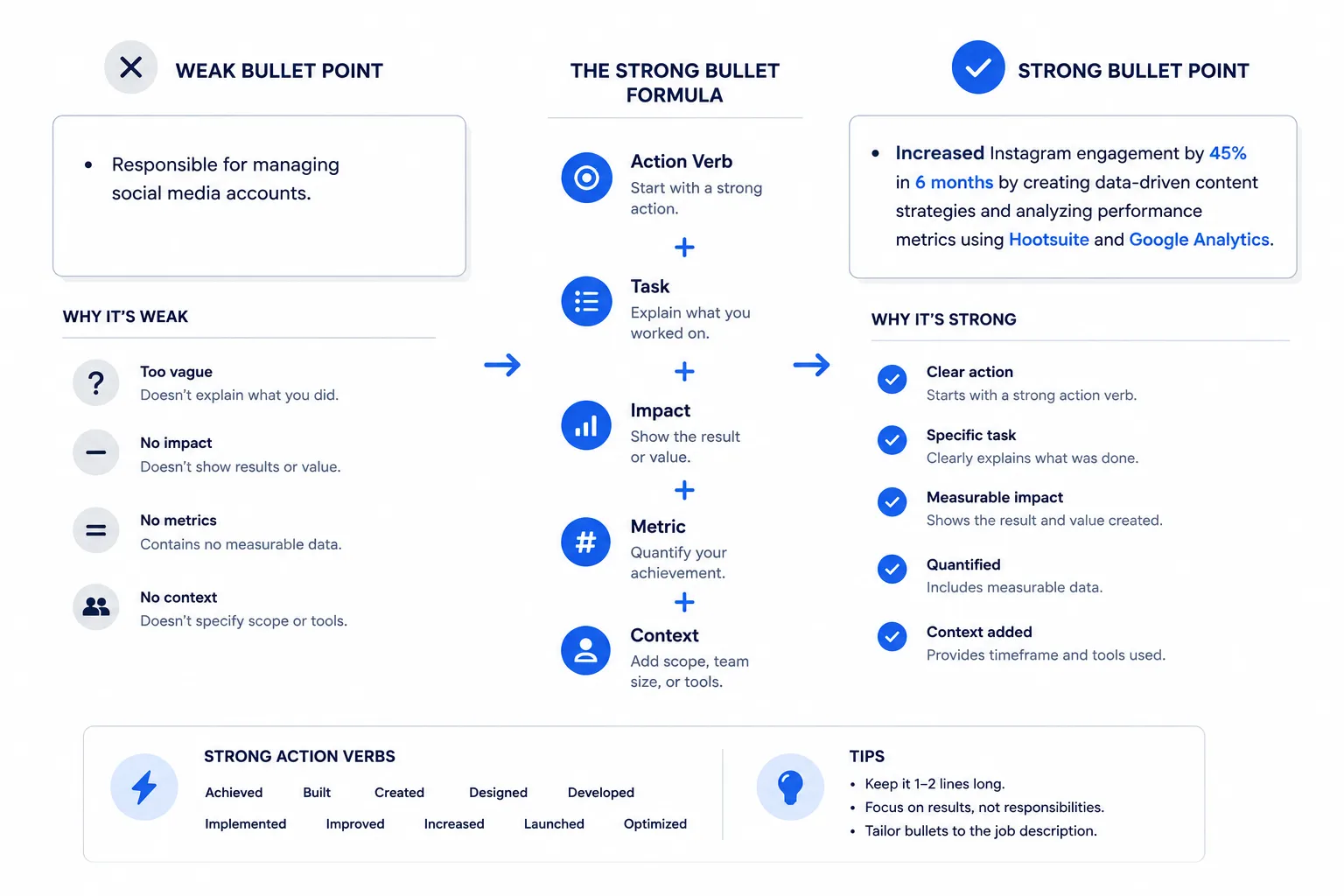
- List the work you did in the role without editing.
- Mark tasks related to the target job description.
- Add the tool, process, customer, team, or scale that makes each task concrete.
- Add a defensible result, or explain the decision you enabled.
- Cut filler such as
responsible forandworked on. - Put the most relevant bullets first.
Example: Operations coordinator
Weak: Responsible for scheduling deliveries.
Why it is weak: It names a duty but gives no scope, method, or outcome.
Improved: Coordinated weekly delivery schedules for 18 regional drivers, resolving route conflicts before dispatch and reducing missed delivery windows.
The improved bullet lets the reader infer planning, communication, and operational impact.
Example: Student project
Weak: Worked on social media for a campus event.
Why it is weak: It hides your contribution and the project goal.
Improved: Planned a four-week Instagram campaign for a campus career fair, creating 16 posts and increasing student registrations from 120 to 185.
This is valid experience even if it was not a paid role. It gives a hiring manager evidence they can discuss with you.
Choose action verbs that match the work
Use an action verb with a meaning you can defend. Led signals ownership. Supported signals a meaningful contribution without overstating authority. Analyzed, built, negotiated, trained, and streamlined each point to different work.
Avoid rotating synonyms only to avoid repetition. If you analyzed three related data sets, analyzed may be the clearest word each time.
Find the evidence before you write
Strong bullets start with an accurate inventory, not a thesaurus. Review your calendar, performance notes, project plans, dashboards, customer messages, and work samples. List the problems you handled, the decisions you influenced, the people you supported, the tools you used, and the outcomes you observed.
For each item, ask five questions:
- What was the goal or problem?
- What did I personally do?
- Who or what did the work affect?
- What tool, method, or constraint adds useful context?
- What changed, improved, or became possible?
You do not need a numeric answer to every question. For example, a compliance coordinator may not know a revenue figure, but can truthfully explain that they revised an intake process, reduced incomplete submissions, or gave teams a clearer audit trail.
Match bullet emphasis to the role
One role can produce several credible versions of the same experience. A business analyst applying for a product role may lead with research, prioritization, and stakeholder decisions. The same person applying for an operations role may lead with reporting accuracy, process design, and service levels. The facts stay the same. The sequence and context change.
Suppose your original bullet is: Created a dashboard for leadership. For a product analyst position, you could write: Analyzed feature-adoption data and built a weekly dashboard that helped product leaders prioritize onboarding improvements. For an operations role, the same work might become: Built a weekly dashboard that consolidated service-level metrics across three teams and reduced manual status reporting.
Both versions need to be true. The difference is the decision the target reader needs to make.
Use numbers with care
Numbers are useful when they give scale or make a result testable. They are not required in every bullet, and they should never be guessed. Choose a measure that a reader can understand without internal company context.
Useful measures include:
- volume, such as accounts managed, orders processed, or events supported
- time, such as a reporting cycle shortened or a deadline met
- quality, such as error rates, completion rates, or customer feedback
- financial scope, when you can share it appropriately
- reach, such as users trained, stakeholders supported, or regions covered
Avoid numbers that have no baseline. Increased engagement by 40% raises questions when the reader cannot tell which audience, time period, or measure changed. Increased monthly webinar registrations from 75 to 105 by testing reminder timing and subject lines is clearer and easier to defend.
Handle team achievements accurately
Most work is collaborative. A resume bullet should show ownership without taking credit for a team’s entire outcome. Use language that fits your contribution: led, owned, designed, partnered with, coordinated, supported, or contributed to.
For example, do not write Launched a new pricing model that increased revenue if you prepared customer research for a larger launch. Write Synthesized customer interview findings for a cross-functional pricing launch, helping the team identify objections before rollout. The second statement is still valuable. It is also credible when a hiring manager asks for details.
Edit for scanability
Draft without worrying about length, then edit. Remove opening phrases that only repeat the job title. Replace vague nouns such as various tasks and multiple projects with a relevant scope. Put the most meaningful noun and verb near the beginning of the bullet.
Read each bullet aloud. If you need to take a breath twice, it may contain two ideas. Split it, or keep the idea that best supports the target role. Consistent punctuation and tense make the whole section feel deliberate, even when the reader only scans it.
A recruiter review exercise
Print the page or view it at normal zoom. Cover the job titles and read only the bullets. Could a stranger identify your level of responsibility, main skills, and strongest outcomes? Then uncover the titles. Do the bullets support what the title suggests, or do they leave a mismatch?
This exercise catches both understatement and inflation. A senior title with only administrative task bullets may need clearer strategic evidence. An entry-level title with several claims of enterprise ownership may need more accurate contribution language.
More practical rewrites
Example: Customer service to customer success
Weak: Answered customer questions by email and phone.
Why it is weak: The bullet describes a channel, not the type of problem, service standard, or contribution.
Improved: Resolved billing and account-access questions through email and phone support, documenting recurring issues that informed updates to the self-service help center.
The improved bullet does not imply ownership of the entire customer strategy. It shows problem-solving, communication, documentation, and a connection to a broader customer experience improvement.
Example: Manager with people leadership
Weak: Managed a team and improved performance.
Why it is weak: The reader cannot tell the team size, management action, or performance measure.
Improved: Coached a six-person support team through weekly quality reviews and call calibration, improving first-response consistency during a period of increased ticket volume.
If you have a verified measure, add it. If you do not, the specific management practice and scope still show more than a generic performance claim.
Example: Technical contribution
Weak: Worked on the company website.
Why it is weak: It does not say which area of the site, technology, or user problem you addressed.
Improved: Built reusable React form components for account settings, reducing duplicate validation logic across three customer-facing flows.
The technical terms are useful because they appear with an outcome and scope. A reader can see what to ask about next.
Turn notes into final bullets
Keep a private evidence bank as you work. Add rough notes after a completed project, useful customer interaction, campaign, presentation, or improvement. Capture the goal, your action, collaborators, and any available result while the details are fresh. When you update your resume, you will have material to select and tailor rather than trying to reconstruct a year of work from memory.
Your evidence bank is not your resume. It can be detailed and messy. The resume is the edited version that selects the evidence most useful for one role.
Before you submit
Compare the final bullets with the rest of the document. The summary, skills, and experience section should tell the same truthful story. Check that you use terms consistently, that each metric has a clear meaning, and that no bullet makes a claim you could not explain with a specific example. This final pass prevents small wording changes from creating a misleading picture of your work.
Save a clean copy of the tailored version before starting the next application.
Keep the base evidence bank separate so future revisions remain accurate.
That habit also makes it easier to prepare confident interview examples later.
It also protects the accuracy of future tailored versions.
Common mistakes
- Starting with vague language.
Helped withmakes the reader guess. Replace it with your actual action. - Adding a number with no meaning.
Improved by 25%is weak when the reader cannot tell what changed. Name the measure and context. - Claiming a team result as an individual result. Be precise about your role:
partnered with,contributed to, orledas appropriate. - Listing every task. Repetition crowds out evidence. Select bullets that prove fit for the target role.
- Writing paragraphs. A bullet should scan quickly. Split a crowded idea into two bullets or remove secondary detail.
Best practices
- Keep most bullets to one or two lines in the final layout.
- Use present tense for a current role and past tense for previous roles.
- Quantify only information you can explain and defend.
- Use the employer’s terminology where it accurately matches your work.
- Review every bullet against the question, “Would this help decide whether to interview me?”
Final checklist
- Each bullet begins with a precise action verb.
- Each bullet explains the work, audience, tool, or scope when useful.
- Results are accurate and defensible in an interview.
- The most relevant evidence appears first in each role.
- Filler phrases and repeated duties have been removed.
Frequently asked questions
How many bullets should a resume have?
Use enough bullets to prove the relevance and impact of each recent role. Read How many bullets should a resume have? for a practical range.
What if I do not have numbers?
Use scope, frequency, complexity, quality, or the decision your work enabled. Do not invent metrics.
Can I use the STAR method for resume bullets?
Yes. A brief version of the STAR method helps you identify context and results, then you can remove background that does not fit the bullet.
Continue learning
Build bullets in Democruit’s resume builder and pair them with the ATS-friendly resume guide and resume keywords concept.
Related articles
How to Write an ATS-Friendly Resume
Learn how to format, tailor, and proofread a resume that applicant tracking systems and recruiters can read clearly.
What Are Resume Keywords?
Learn what resume keywords are, where to find them, and how to use them truthfully in a targeted job application.
Action Verb
An action verb is a precise verb that describes what a candidate did, such as analyzed, built, negotiated, trained, or streamlined. Learn how it matters when you prepare a clear, credible job application.