
Resume vs CV: What Is the Difference?
Understand the practical difference between a resume and a CV, when each is used, and how to choose the right document.
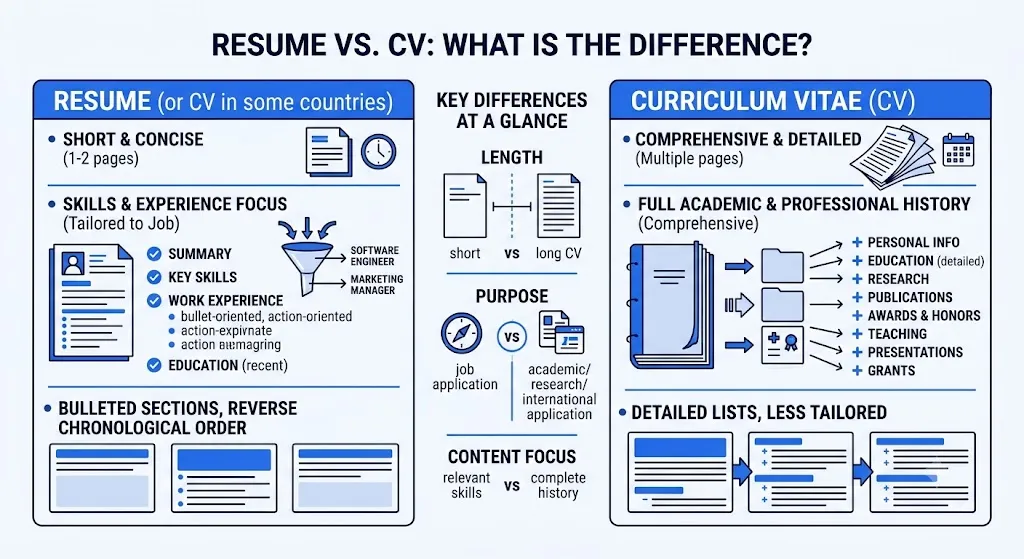
A resume is a concise, tailored overview of experience and qualifications for a specific role. A curriculum vitae, usually called a CV, is a fuller record of academic, research, clinical, or professional history. The meaning varies by country, so the employer’s instructions matter more than a universal rule.
The practical difference
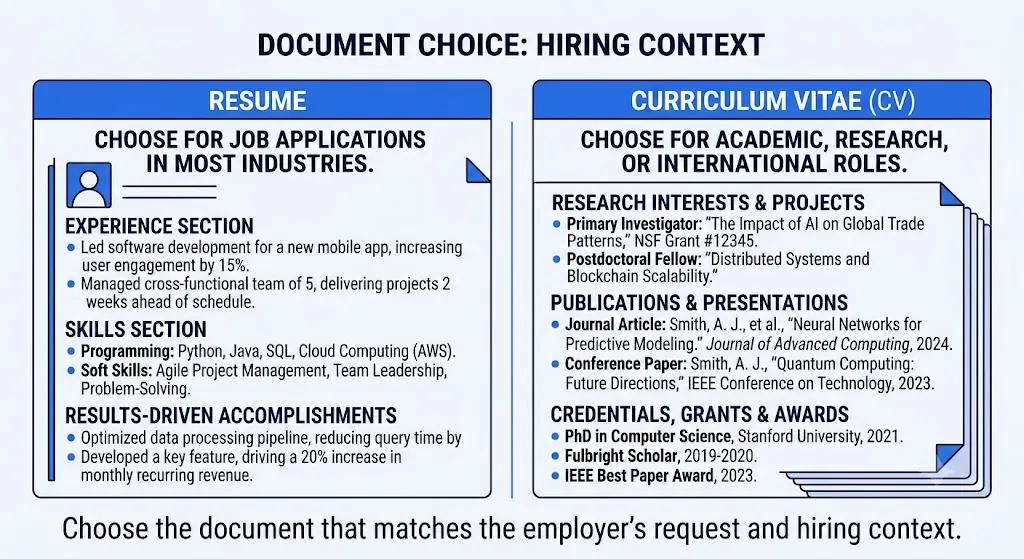
In the United States and many private-sector job searches, a resume is usually the expected document. It prioritizes relevant experience, skills, and results. A CV is commonly used for academic, research, medical, and grant-related roles, where publications, presentations, teaching, licenses, and research history matter.
In the United Kingdom, Europe, and other regions, CV can be the common name for the job-application document that Americans call a resume. Check the posting and local convention before deciding.
Compare the documents
| Resume | CV | | --- | --- | | Tailored to one target role | Comprehensive record of relevant career history | | Often one or two pages, depending on experience and local norms | Often longer when publications, research, and credentials require it | | Highlights results and role fit | Documents academic, research, clinical, or scholarly work in detail | | Common in private-sector hiring | Common in academia, research, medicine, and some international contexts |
How to choose
Read the employer’s language first. If they request a CV, provide the document they describe. For a research role, include publications and research outputs in a clearly organized CV. For a product manager role that requests a resume, focus on targeted work achievements instead of a complete career chronology.
How to adapt the same experience
The underlying facts should stay consistent across documents. The difference is the level of detail and the reader’s purpose. A researcher applying for a faculty position may list every relevant publication, conference presentation, grant, teaching appointment, and research method in a CV. The same person applying for an industry research role may prepare a resume that highlights a few projects, methods, outcomes, and cross-functional work most relevant to that employer.
Similarly, a clinician may need a detailed CV for licensure, hospital, or academic contexts, while a healthcare operations application may require a resume that emphasizes process improvement, team leadership, and results. Do not simply cut a CV down by deleting random lines. Reorganize the document around the decision the employer needs to make.
What to include in each document
A targeted resume often includes a headline or summary, selected skills, recent work experience, education, certifications, and relevant projects. It prioritizes evidence that supports one role. Older or unrelated information can be shortened if it does not change the hiring decision.
A CV often adds sections for research interests, publications, presentations, grants, teaching, professional memberships, clinical training, licenses, and service. Order the sections according to the field. A doctoral program may care most about research and publications, while a clinical appointment may care most about licensure, training, and patient-care experience.
International differences
In the United Kingdom and many other countries, employers commonly ask for a CV when they mean the concise application document used for most job searches. In that context, the expected document may resemble a resume more than an academic CV. The posting, local norm, and industry are more reliable guides than the label alone.
If you are applying across countries, research the convention for that location. Check whether a photo, personal details, references, or specific format are customary or discouraged. When instructions conflict with general advice, follow the employer’s instructions unless doing so would be unsafe or unlawful.
Common mistakes
- Sending an academic CV to a private-sector role without tailoring it. A long document can bury the achievements most relevant to the job.
- Calling a resume a CV without checking regional expectations. The label may affect what a recruiter expects to find.
- Leaving out required credentials. A targeted document can still include licensure, certifications, or publications when the role requires them.
- Changing factual details to fit the format. Titles, dates, and qualifications should remain accurate across versions.
A simple decision rule
Ask: Does the employer need a focused case for my fit in this role, or a comprehensive record of my academic, clinical, or scholarly history? The first usually calls for a resume. The second usually calls for a CV. When the answer remains unclear, use the term from the application instructions and confirm with the employer or an informed contact if possible.
Keep separate source documents so neither version has to compromise the other’s purpose.
Review both documents periodically as new work, credentials, and results become relevant.
Common misconceptions
- A CV is not automatically better because it is longer. Length should serve the hiring context.
- A resume is not a biography. Remove details that do not help the target role.
- One document cannot always serve both academic and private-sector applications well. Maintain separate versions.
Continue learning
Create a targeted resume in Democruit, then review How to Write an ATS-Friendly Resume and the definitions of Resume and Curriculum Vitae.
Related articles
How to Write an ATS-Friendly Resume
Learn how to format, tailor, and proofread a resume that applicant tracking systems and recruiters can read clearly.
What Is the Difference Between a Resume and a CV?
Learn the practical difference between a resume and CV, when employers expect each document, and how to choose the right format.
Curriculum Vitae (CV)
A curriculum vitae, or CV, is a detailed record of academic, research, clinical, or professional history, often including publications, presentations, credentials, and teaching experience. Learn how it matters when you prepare a clear, credible job application.