How to Write an Effective Resume Summary
Create a focused resume summary that explains your relevant experience, strengths, and next-role fit without empty claims.
An effective resume summary is a two- or three-sentence introduction that tells a recruiter why your background fits this role. It names your professional identity, the most relevant strengths, and evidence of scope or impact. Use one when it makes your fit clearer. Skip it when it would only repeat generic adjectives.
What separates a focused summary from a generic one?
| Element | Focused summary | Generic summary | | --- | --- | --- | | Identity | Names a role, specialty, or credible transition | Says only “professional” or “candidate” | | Relevance | Selects strengths needed for the target role | Lists unrelated skills | | Proof | Includes a result, scope, domain, or contribution | Relies on adjectives such as “motivated” |
The US Department of Labor's CareerOneStop resume guide recommends matching a resume to the job and supporting qualifications with relevant information. A summary can preview that match, but the experience and project sections still need to prove it.
Decide whether you need one
A summary is helpful when you have several years of relevant experience, a clear specialty, a career change to explain, or a background that needs a quick frame. For an early-career applicant with a focused education and internship section, the space may be better used for a project or skills section.
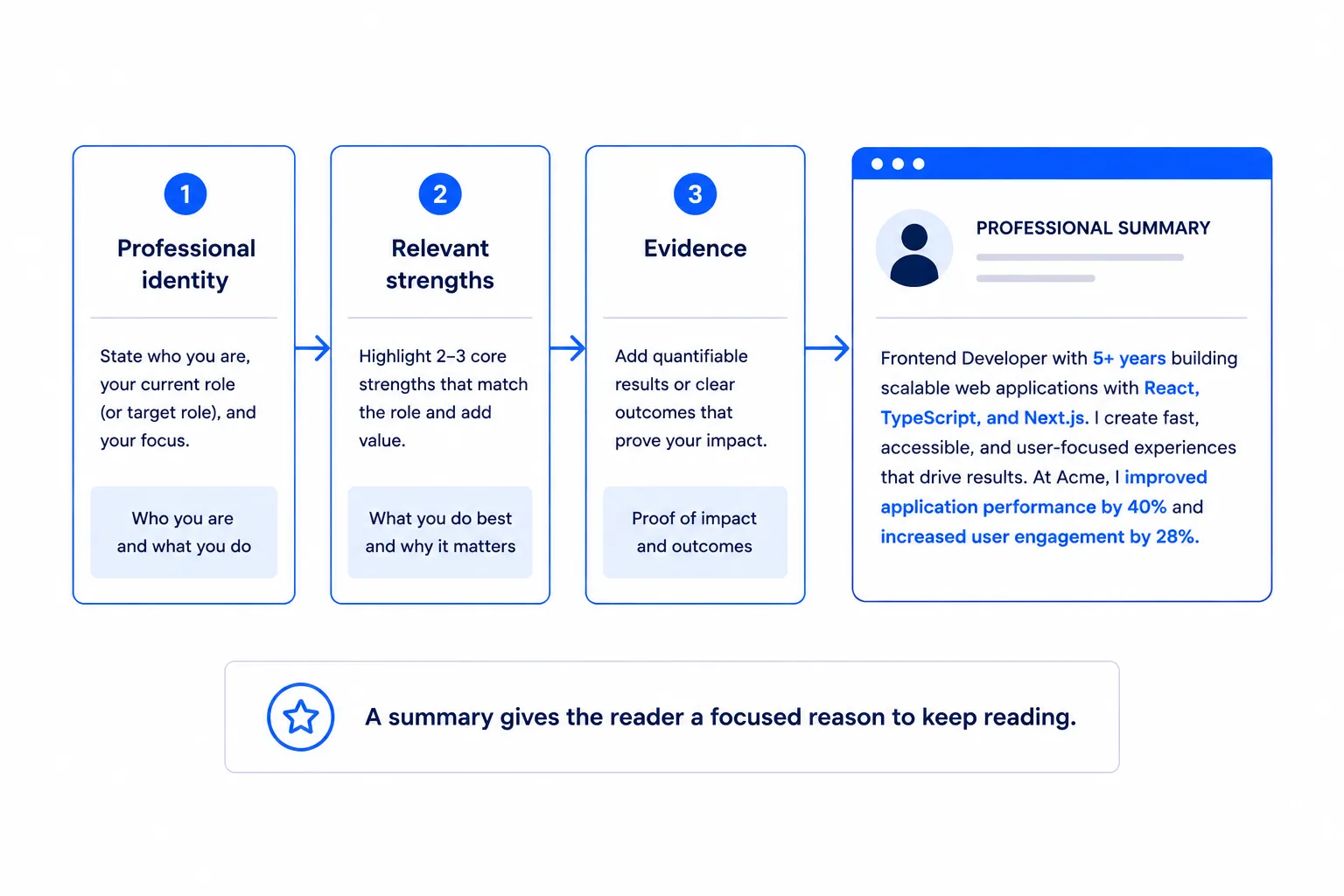
Write the summary in four steps
- Start with your current or target professional identity.
- Add two or three role-relevant strengths, tools, or domains.
- Include one concrete scope, achievement, or type of work.
- Remove claims that do not distinguish you, such as
motivatedorteam player.
Example: Experienced marketer
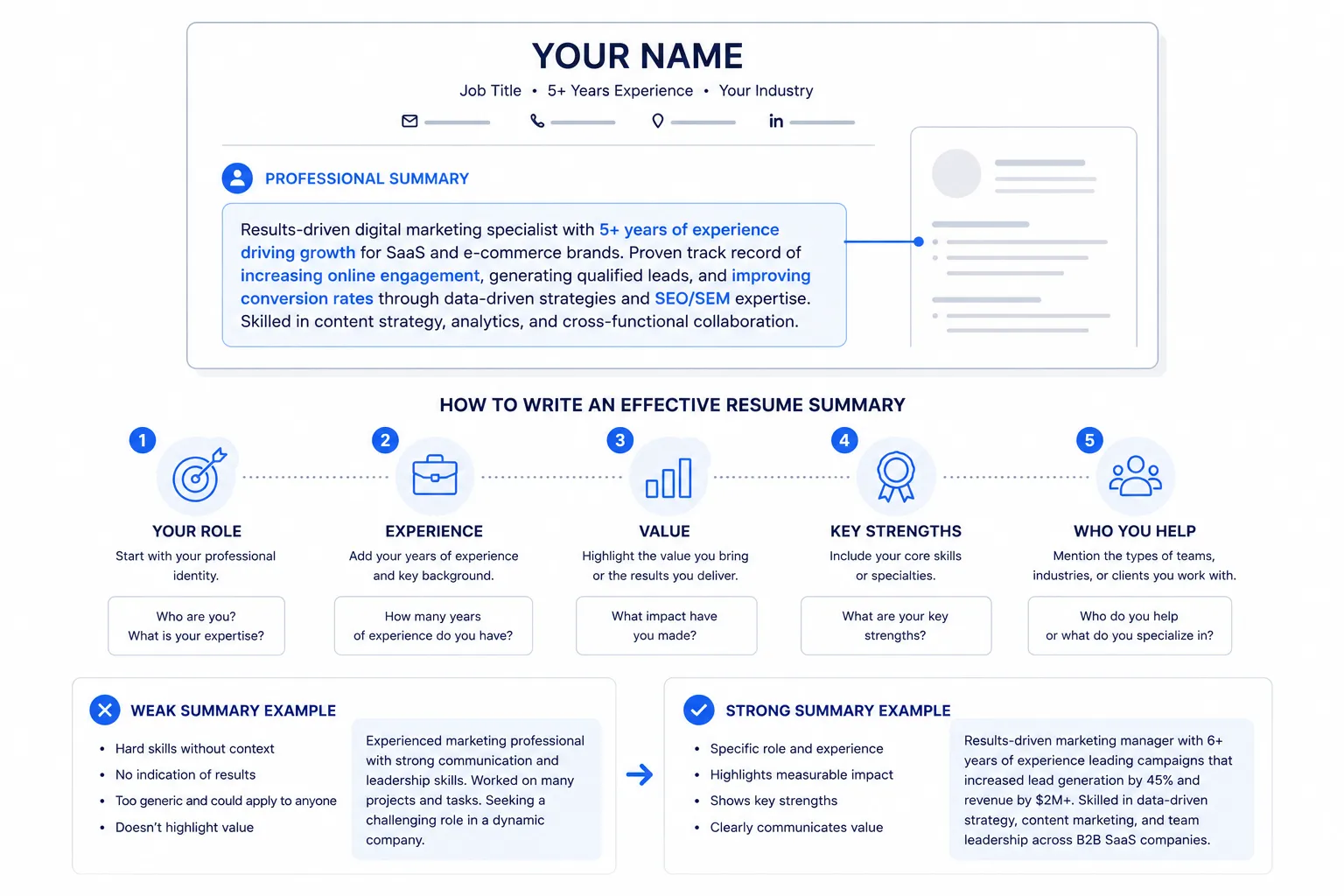
Weak: Results-driven marketing professional with great communication skills.
Improved: B2B content marketer with six years of experience planning SEO, customer story, and product education programs. Partnered with sales and product teams to turn customer research into campaigns that increased qualified demo requests.
Example: Career changer
Weak: Looking to transition into project management.
Improved: Operations coordinator transitioning to project management, with four years of experience organizing cross-functional schedules, vendor deliverables, and status reporting. Known for surfacing dependencies early and keeping stakeholders aligned during time-sensitive launches.
The second example does not pretend the applicant already held a project manager title. It translates transferable work into relevant evidence.
Make the summary match the job
Compare your draft with the job description. Adjust the professional label, relevant domain, and proof point, but keep the facts stable. A product marketing job and a content marketing job may need different emphasis even when you use the same work history.
Use resume keywords naturally. If go-to-market, positioning, and customer research are true parts of your work, they belong in a summary for a role that asks for them.
Build the summary from evidence, not adjectives
The best raw material for a summary is already in your experience section. Review your recent roles and highlight the repeated kinds of problems you solve, the tools or methods you use, the audiences you support, and the outcomes you have contributed to. Then decide which two or three ideas best match the target role.
Avoid beginning with a list of personality traits. Motivated, detail-oriented professional does not tell a recruiter what you do or why you fit. A reader can infer positive traits from specific work: a careful reporting process, a complex customer issue resolved, a project delivered across teams, or a measurable improvement.
Use this working structure:
[Professional identity] with [relevant experience or domain]. Strengths include [two or three relevant capabilities]. [One credible scope, result, or contribution].
The structure is a drafting tool, not a script. Remove any part that repeats the title, says nothing specific, or takes focus away from stronger evidence below.
Examples for different situations
Example: Early-career applicant
An early-career applicant may not need a summary, but it can help when their target is clear and their relevant experience is spread across internships, projects, and coursework.
Too broad: Recent graduate seeking an opportunity to use my skills.
More useful: Recent information systems graduate with internship experience supporting data cleanup, dashboard reporting, and user documentation. Built SQL and Excel skills through coursework and a capstone project that analyzed customer support trends.
The second version gives a recruiter a clear direction and points toward evidence in the education or projects section. It does not claim several years of professional analyst experience.
Example: Specialist applying for a broader role
A specialist can use the summary to make an adjacent capability visible without pretending to have held a different job title.
Too broad: Experienced designer looking for a product role.
More useful: Product designer with four years of experience researching user needs, prototyping workflows, and partnering with engineers on SaaS products. Brings a systems-focused approach to onboarding and account-management experiences, with experience translating customer feedback into prioritized interface improvements.
This summary keeps the truthful professional identity while showing why a broader product-oriented role may be a credible next step.
Example: Returning after a break
When returning to work, do not make the summary an explanation of private circumstances unless that context is necessary and you want to share it. Put the emphasis on current readiness and relevant background.
More useful: Finance operations professional returning to a full-time role, with seven years of experience in invoice controls, vendor reconciliation, and month-end reporting. Recently refreshed advanced Excel skills through an accounting systems course and is prepared to support high-volume finance operations.
The phrase about returning is optional. The important part is the accurate experience and the current evidence of readiness.
Place and format the summary well
Put the summary after your contact information and headline, before the detailed experience. Most readers should see it without scrolling or turning a page. Write it as a compact paragraph, not a large block of text or a list of disconnected keywords.
Keep the language concrete. The summary should not duplicate a skills section word for word. If your skills section lists SQL, Tableau, and data visualization, the summary can explain the kind of decisions that work supports: Turns customer and product data into reporting that helps teams prioritize retention work.
Common wording problems and repairs
Claiming a result without context
Drove major growth and transformation leaves too much unanswered. Which work changed? For whom? A better version is Led customer onboarding improvements for a mid-market SaaS portfolio, using adoption data to identify accounts that needed additional training.
Naming every tool
A summary overloaded with software reads like a search result rather than a professional introduction. Select the two or three tools that matter most for the target role, then put the rest in a skill section or relevant bullet.
Repeating the job posting
Copying employer language can make the summary feel generic. Keep the meaningful terms, but pair them with evidence from your own work. Cross-functional collaboration becomes clearer when you explain which teams and decision you supported.
Making the summary permanent
A summary should change when your target changes. Keep a base version, then adjust the emphasis for a related role. If you apply to both program manager and customer operations roles, the same history may need different first sentences and proof points.
Get a second-reader test
Ask a peer, mentor, or career adviser to read only your name, headline, and summary for 20 seconds. Then ask them three questions: What role do you think I am targeting? What are my strongest relevant capabilities? What evidence do you expect to see below? If their answers do not match your goal, revise the summary or make the supporting evidence easier to find.
Do not ask only whether the summary sounds impressive. A good summary is a navigation aid. It earns its space by directing a recruiter to the right evidence.
Keep the summary credible in an interview
Treat every phrase in the summary as a promise to explain more. If you write that you “specialize in stakeholder management,” prepare a specific example of the stakeholders, decision, communication approach, and result. If you name an industry, be ready to describe the type of work you did there. This does not mean your summary must be cautious or bland. It means the language should be precise enough to support a useful conversation.
Before exporting, compare the summary to your LinkedIn headline and About section. They do not need to be identical, but their titles, dates, and major claims should not conflict. A consistent professional story makes it easier for a recruiter to trust the details.
A concise revision process
Write the first draft without trying to make it perfect. Then run three edits. First, underline every phrase that names a real capability, scope, tool, or outcome. Second, delete generic claims and details that are repeated elsewhere. Third, compare the remaining sentences with the target job description and move the most relevant evidence to the front.
If the summary still feels crowded, remove the least useful tool or adjective before cutting evidence. A concise summary is not a compressed biography. It is a deliberate preview of the experience that makes you a credible candidate for this particular role.
Summary review checklist
Before you send the application, check each statement against the experience below it. Can you point to a bullet, project, credential, or work sample that supports it? Does the first sentence make the target role clear? Are the final sentences more specific than words such as “results-driven” or “passionate”? Finally, read the summary once after a short break. If it sounds like it could belong to anyone, add a concrete domain, scope, or contribution. If it sounds like a long list, cut until the reader can identify the central message in one scan.
The finished summary should make the reader curious to examine the evidence that follows.
It should never compete with that evidence for attention or space.
When it does its job well, the summary makes the next section easier to read, not easier to skip.
Common mistakes
- Writing an objective instead of a summary. Employers need evidence of fit, not only what you want.
- Using generic adjectives. Replace
dynamicandhardworkingwith a specific capability or result. - Repeating the entire resume. The summary should guide the reader to your strongest evidence, not list every skill.
- Making it too long. A dense paragraph delays the work experience section. Keep it concise.
- Overstating a career transition. Name transferable experience accurately instead of claiming a title you did not hold.
Best practices
- Write the summary after your experience bullets, when the evidence is clear.
- Tailor the focus, not the facts, for each target role.
- Use the same professional terms that appear in your LinkedIn profile when they are accurate.
- Omit a summary that cannot say more than the headline under your name.
Final checklist
- The first phrase accurately names my professional identity or transition.
- The strengths match the target role and are supported below.
- At least one detail shows real scope, domain, or contribution.
- The summary is two or three concise sentences.
- I removed generic adjectives and unsupported claims.
Frequently asked questions
Do I need a resume summary?
No. Use one only when it makes your fit clearer. See Do I need a resume summary?.
Is a summary the same as an objective?
No. A summary emphasizes what you offer. An objective primarily states what you want.
Where does a resume summary go?
Place it near the top, after your contact information and before detailed experience.
Continue learning
Draft a targeted summary in Democruit, then strengthen the proof with resume bullet points and an ATS-friendly format.
Related articles
How to Write an ATS-Friendly Resume
Learn how to format, tailor, and proofread a resume that applicant tracking systems and recruiters can read clearly.
How to Write Strong Resume Bullet Points
Write resume bullet points that connect specific actions, useful context, and credible results to the skills and outcomes employers need.
Do I need a resume summary?
Decide whether a resume summary clarifies your fit, learn when to skip it, and test whether the section earns space above your work experience.