
What should I put in a cover letter?
Build a focused cover letter with an employer-specific opening, relevant evidence, useful context, and a concise close that complements your resume.
A cover letter should explain why your background fits the role and support that claim with one or two relevant examples. It should complement the resume rather than repeat it. Follow the employer's instructions.
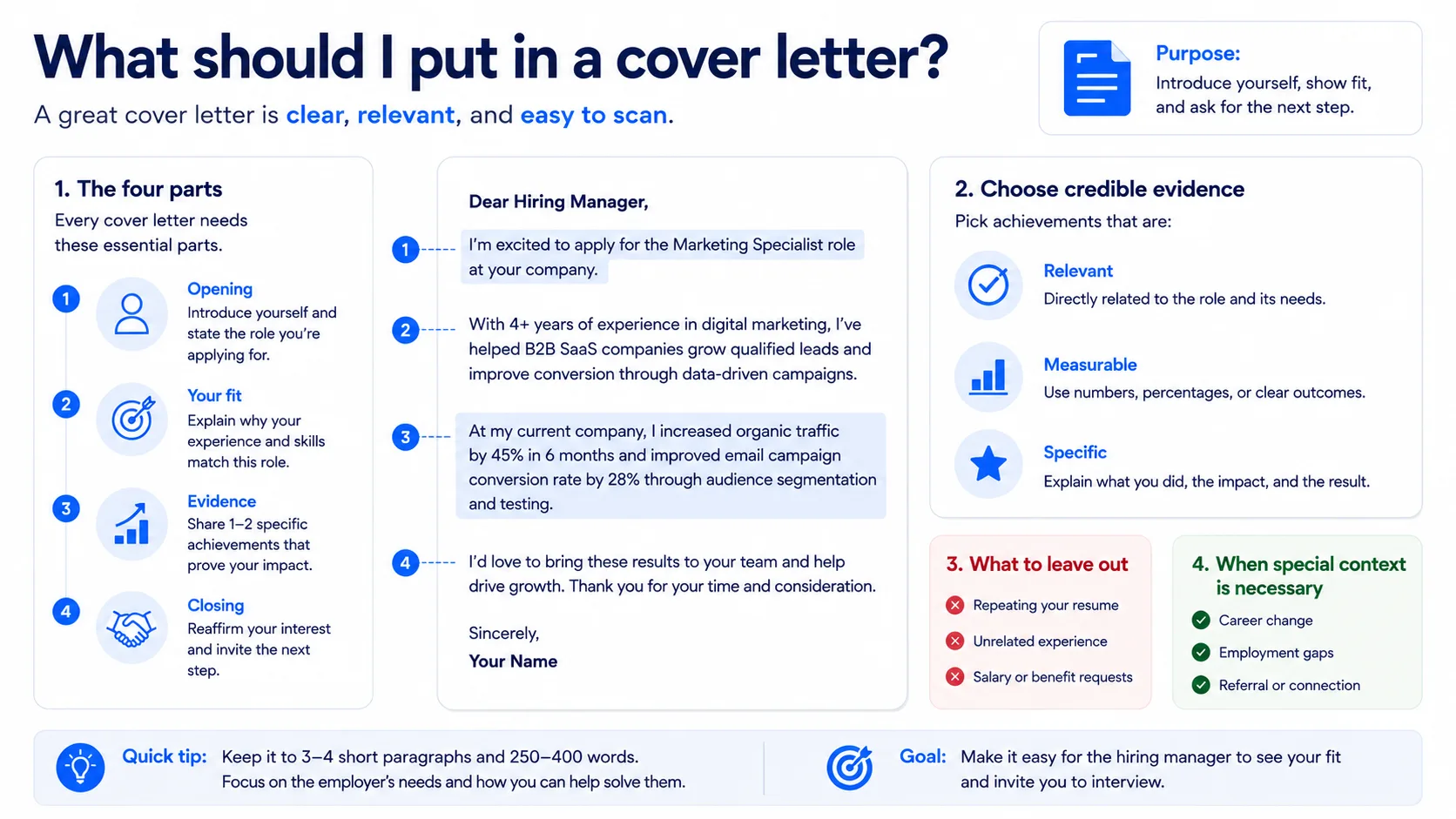
Include a focused opening, a specific reason for this employer, one or two evidence paragraphs, and a concise close. Name the role, connect your experience to an actual priority, and invite a conversation. “I'm excited to apply” is not harmful, but it should not be the main reason in the opening. Give the reader specific information quickly. Select evidence for two or three central responsibilities. Briefly explain the situation, your action, and the outcome. Generic: “I have excellent stakeholder management skills.” Specific: “I coordinated product, support, and engineering owners through a customer migration, using a shared risk log to resolve dependencies before each release.” The specific version gives the employer a contribution to evaluate. A result can be clearer decisions, completed delivery, fewer errors, or useful customer feedback when a percentage would be misleading. A cover letter can briefly explain a career change, relocation, employment gap, or return to work. Keep it proportionate, move to current evidence, and omit private details. For a major transition, the career-change cover letter guide provides a scenario-specific structure. Avoid retelling your full work history, generic praise, copied skills without evidence, negative comments about employers, unrelated personal details, and claims you cannot explain.
Read the letter aloud, confirm every name and fact, and remove any sentence that does not explain fit or evidence. Then review whether employers read cover letters and how to use AI responsibly if a writing tool supported your draft.
Related articles
Do employers read cover letters?
Understand when employers are likely to read a cover letter, when an optional letter adds value, and when a generic submission can work against you.
Can I use AI to write a cover letter?
Use AI to plan or revise a cover letter without inventing experience, exposing private data, or submitting generic language that weakens your application.
Can an ATS read a PDF resume?
Learn when applicant tracking systems can parse PDF resumes, which PDF features cause problems, and how to test your file before applying.