
Should I list every job on my resume?
Choose which jobs belong on a resume by balancing relevance, career continuity, transferable evidence, and any complete-history requirements.
No. A resume should include the roles that best demonstrate relevant experience, explain your recent career, or provide important transferable evidence. It is not required to be a complete employment record unless the employer or application instructions explicitly ask for one.
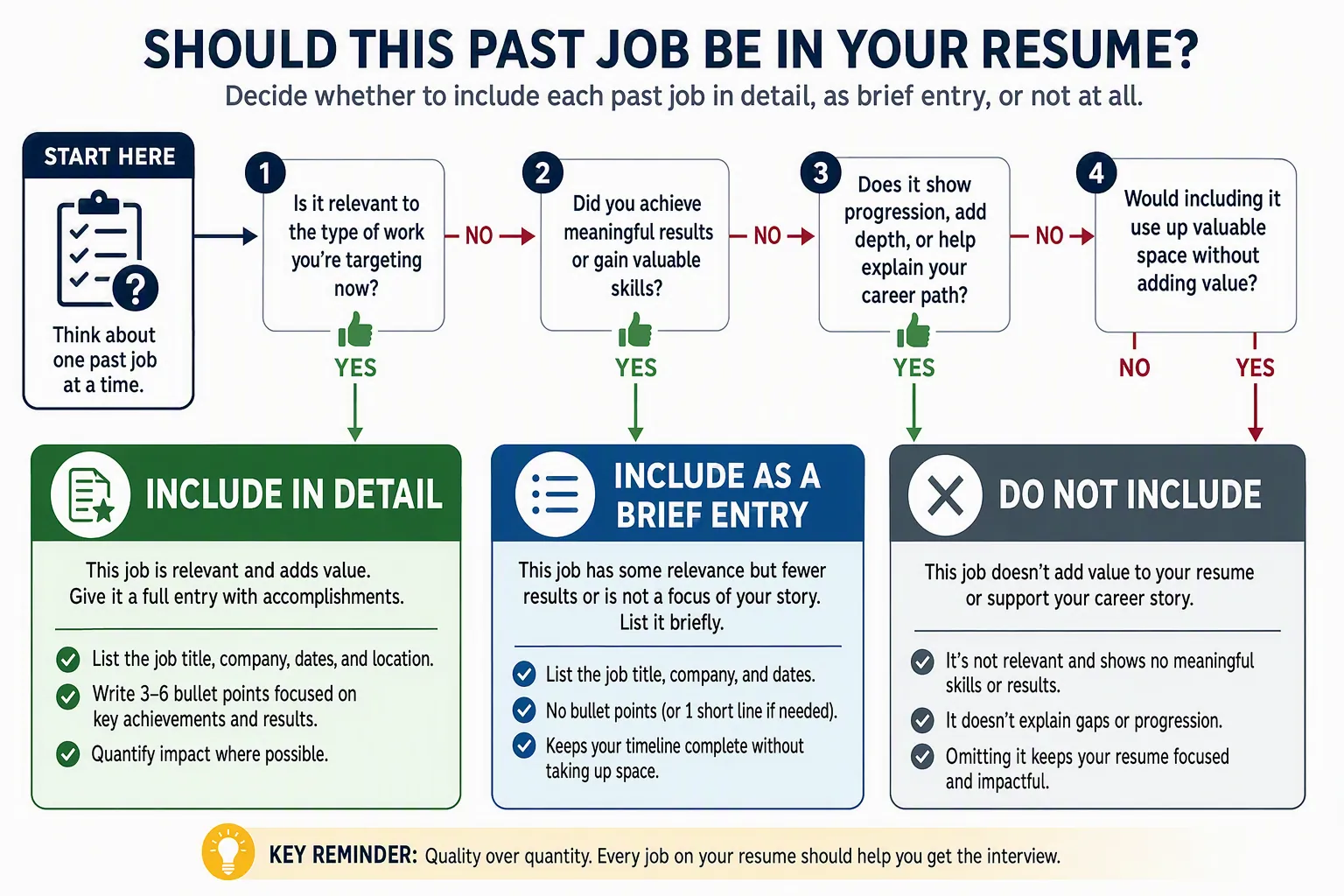
A job belongs when it: proves a target requirement, shows progression or useful industry knowledge, prevents a confusing recent gap, contains unique transferable evidence, or is required by the application. Shorten or omit a role when it is old, unrelated, and adds no evidence. For example, an experienced data analyst may omit a brief retail job from college. A recent graduate may keep the same job because it demonstrates reliability, customer communication, and team responsibility. You can reduce an older role to the employer, title, and dates. You can also group early positions under “Additional Experience.” This preserves continuity without giving every job equal space. Do not hide a role because it ended badly if removing it makes your timeline misleading. The resume does not need to explain why every job ended, but titles and dates should remain accurate. Prepare a brief, professional explanation for relevant questions. Background-check forms, government applications, or employer systems may request a complete history for a specific number of years. Provide the full information there even when the resume is selective. Differences caused by targeting are normal; contradictions in employer names, titles, or dates are not.
Review what belongs in a work experience section, then use the ATS-friendly resume guide to keep the selected history easy to follow.
Related articles
How to Write an ATS-Friendly Resume
Learn how to format, tailor, and proofread a resume that applicant tracking systems and recruiters can read clearly.
Work Experience
Work experience is the resume section that connects roles, dates, responsibilities, and achievements to evidence relevant for a target job.
How far back should a resume go?
Decide how many years of work history to show based on relevance, seniority, career continuity, and the evidence required for your target role.