
How far back should a resume go?
Decide how many years of work history to show based on relevance, seniority, career continuity, and the evidence required for your target role.
Include enough history to prove your fit and explain your career, not every job you have held. Many applicants describe roughly the last 10 to 15 years in detail, but that is a guideline rather than a rule. Relevance, seniority, and industry expectations matter more than a fixed cutoff.
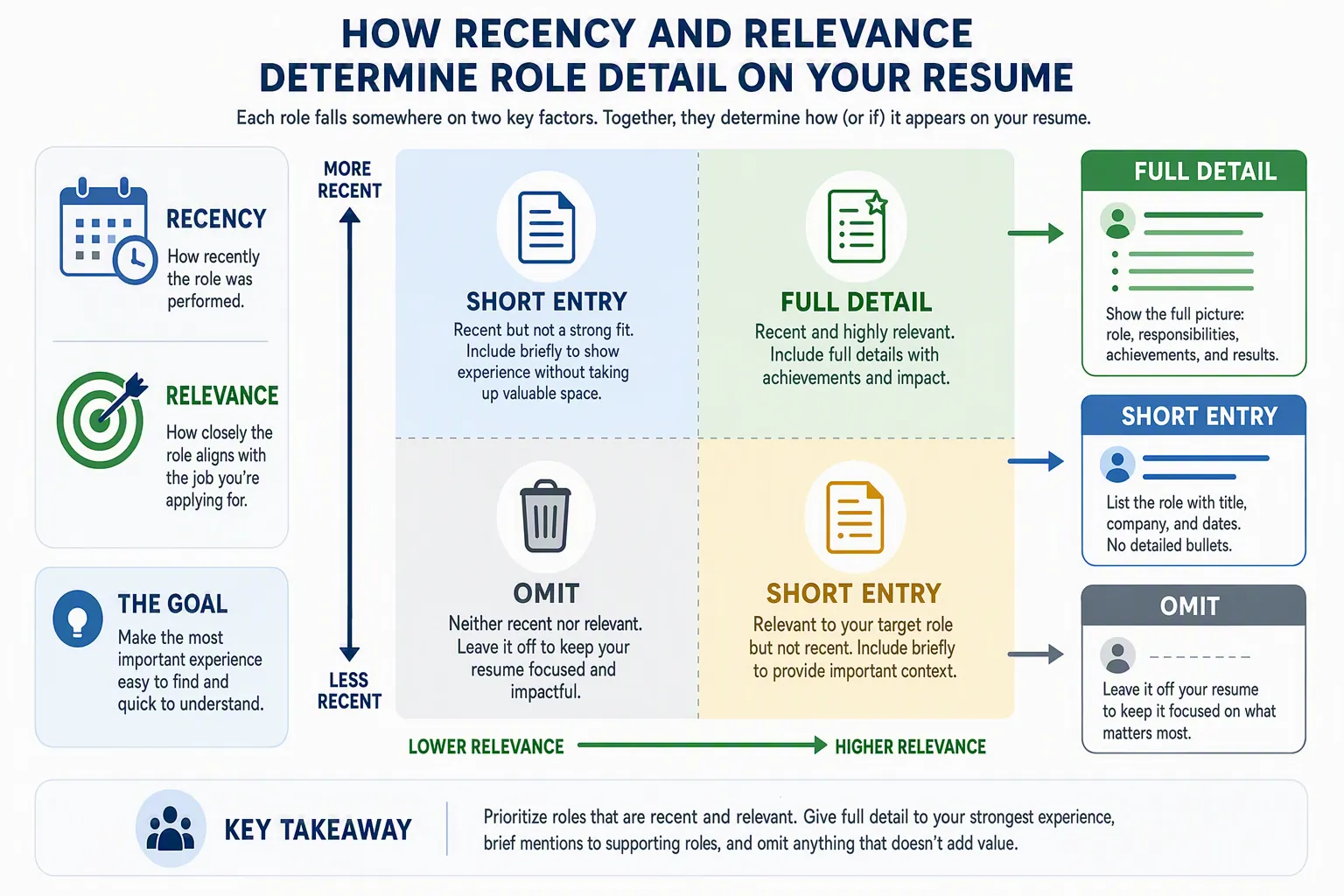
Keep an older role when it provides evidence that is still important, such as a required specialty, leadership scope, industry background, license, or major achievement. Shorten or omit it when the same capability is demonstrated more recently or the work distracts from your target. For example, a product leader may retain a 14-year-old engineering role in a one-line “Earlier Experience” section because it explains technical depth. A marketing applicant usually does not need several bullets about an unrelated retail job from the same period when newer work proves communication and customer skills. Give recent, relevant roles the most space. Reduce older roles to a title, employer, and dates when context matters but details do not. Group several early positions under “Additional Experience” when individual bullets add little. Keep legally or professionally required history when the application specifically asks for it. Do not remove an older role if doing so creates a confusing story that a short entry would solve. Also do not change dates to make experience appear newer. A resume is a targeted marketing document. An employer's application or background-check form may request a complete history for a defined period. Answer those forms fully and accurately even if the resume is shorter.
Review each role against one question: Would removing this information make it harder to understand or trust my fit? If not, use the space for stronger evidence. See Work Experience for what belongs in the section and the ATS-friendly resume guide for clear formatting.
Related articles
How to Write an ATS-Friendly Resume
Learn how to format, tailor, and proofread a resume that applicant tracking systems and recruiters can read clearly.
Work Experience
Work experience is the resume section that connects roles, dates, responsibilities, and achievements to evidence relevant for a target job.
Should I list every job on my resume?
Choose which jobs belong on a resume by balancing relevance, career continuity, transferable evidence, and any complete-history requirements.