
Introduction
A hiring manager reading a career change application is not only asking whether you can do the work. They are also judging whether your move is deliberate, whether your previous experience will transfer in practice, and whether you understand what the new role actually requires. An unexplained shift can look like uncertainty. An overexplained shift can make the letter sound defensive. Your task is to remove both concerns without treating your past as something to escape.
The strongest career change letter creates a clear bridge. It names the direction of the move, shows why that direction is credible, and translates selected achievements into evidence that matters in the target role. The reader should finish with three conclusions: you know why you are changing, you bring useful experience rather than starting from zero, and you have taken concrete steps to close any genuine gaps. That is a different argument from a standard cover letter, which can usually assume the resume already tells a familiar career story.
What to address directly
Is this move intentional?
- Hiring manager concern
- A sudden change can make the reviewer wonder whether you are reacting to a bad job, testing an idea, or applying without a clear direction.
- What your letter should prove
- Give one forward-looking reason for the move and connect it to a pattern in your experience. Focus on what draws you toward the work, not what you want to leave behind.
Will the previous experience transfer?
- Hiring manager concern
- The reader cannot be expected to translate achievements from [Previous Field] into the needs of [Job Title] on your behalf.
- What your letter should prove
- Select two or three requirements from the job description and show how you have already used the underlying capabilities in another context. Explain the connection in plain language.
How much ramp-up will be required?
- Hiring manager concern
- Even when your transferable skills are strong, the employer may see missing terminology, tools, or context as additional training risk.
- What your letter should prove
- Acknowledge the most relevant gap through action. Mention a completed project, course, credential, volunteer assignment, or other practical step that demonstrates progress.
Do you understand the new role?
- Hiring manager concern
- Enthusiasm alone does not prove that your picture of the day-to-day work is accurate. The manager wants evidence that your interest survived real exposure.
- What your letter should prove
- Reference a specific responsibility or problem from the posting and explain why your experience prepares you to contribute to it. Avoid broad claims about pursuing a dream.
Are you comfortable with the level of the move?
- Hiring manager concern
- A change may involve a different title, scope, or compensation path, which can raise questions about expectations and retention.
- What your letter should prove
- Show that you evaluated the move on its actual responsibilities. Emphasize the contribution you are ready to make without demanding that your previous title map directly onto the new structure.
Structural approach for a career change
Open with the target role and the strongest point of continuity between your background and the employer’s need. State the change in one confident sentence, but do not make your transition the entire opening. The first paragraph should give the reader a reason to keep evaluating you as a candidate, not merely an explanation of why your resume looks different.
Use the middle of the letter to translate evidence. Choose one or two past achievements whose underlying actions demonstrate transferable skills, then make the match explicit. A result from [Previous Role/Industry] becomes relevant only after you explain the comparable problem, decision, stakeholder, or outcome. Follow that proof with one concise paragraph showing how you have prepared for the parts that are genuinely new.
Close by returning to the value you can bring to [Company Name]. Reinforce your readiness to contribute and your interest in discussing the role. Do not end by asking the employer to take a chance on you. That framing turns your change into a favor. The order matters because it moves the reader from initial uncertainty, through credible evidence, to a practical picture of you doing the work.
- 01
Establish the bridge
Name the target and lead with a capability that already connects your background to the role.
- 02
Translate the proof
Use selected achievements to show how familiar strengths apply in the new context.
- 03
Demonstrate readiness
Show concrete preparation, then close on the contribution you can make now.
Use this cover letter template for a career change
Give your career-change reason, transferable evidence, and preparation a clear order.
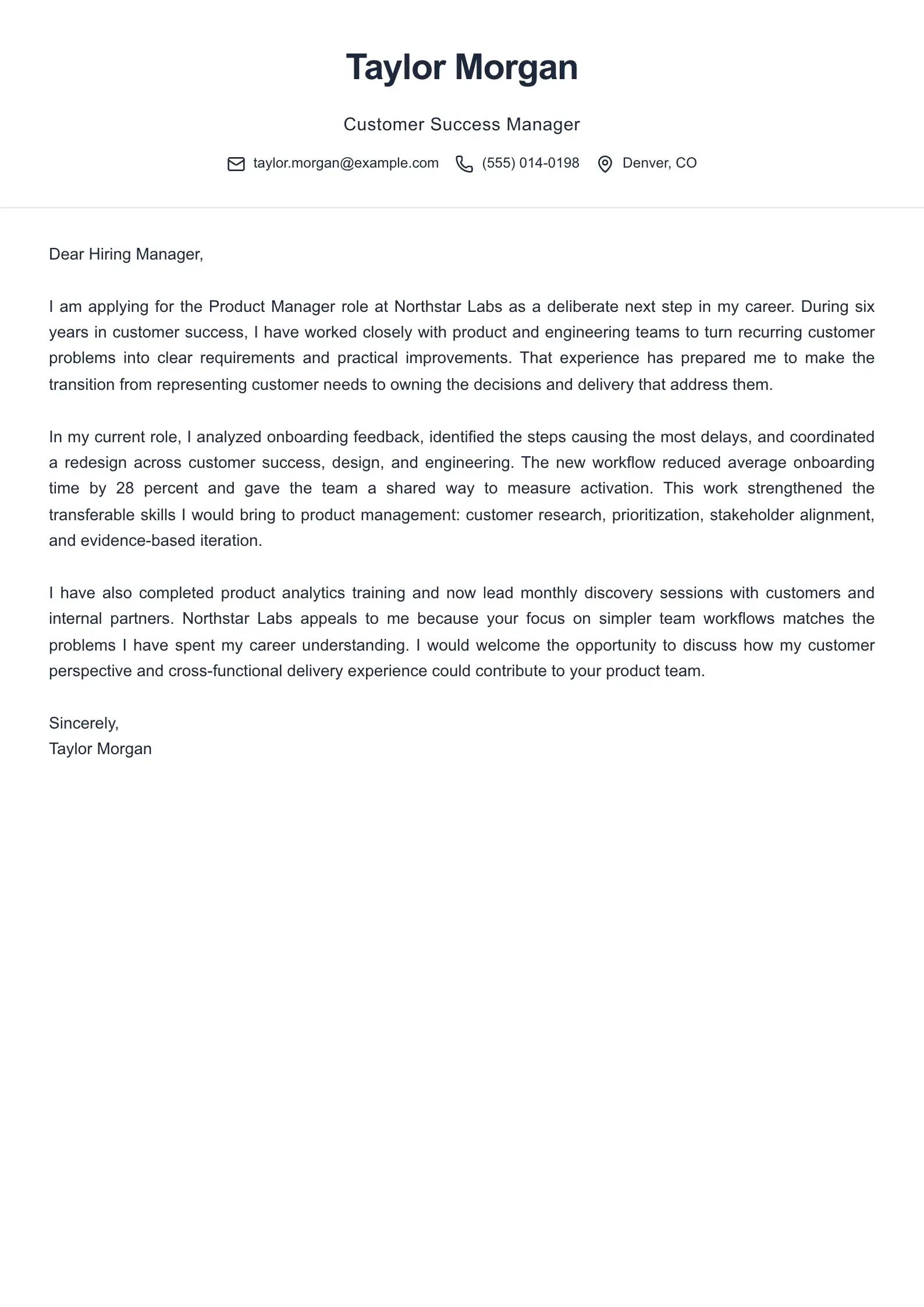
Example paragraphs
These excerpts show how to address the transition without turning the letter into a biography. Replace every bracketed detail with evidence you can defend.
“I am applying for the [Job Title] position at [Company Name] after making a deliberate transition from [Previous Field] into [New Field]. Across my work in [Previous Role/Industry], I repeatedly took responsibility for [Transferable Responsibility], including [Brief Achievement or Scope]. That experience aligns closely with your need for someone who can [Requirement From Job Description], and it is the foundation I would bring to this role.”
“Although the setting was different, the problem behind one of my strongest results is directly relevant to this position. When [Situation or Constraint], I [Action], coordinated with [Stakeholders], and achieved [Verified Result]. The work required me to [Transferable Skill], which is the same capability your posting emphasizes in relation to [Target Responsibility].”
“I have also treated the gaps in my background as a practical learning plan. Over the past [Time Period], I completed [Relevant Course, Project, or Experience] and applied that learning by [Concrete Action]. This did not replace professional experience in [New Field], but it gave me direct exposure to [Relevant Task or Tool] and confirmed that I want to build long-term depth in this work.”
Notice what these paragraphs do not claim. They do not pretend the transition has no learning curve, and they do not label every past skill as transferable. Each excerpt narrows the argument to evidence that the employer can evaluate. That restraint makes the connection more credible.
Common mistakes in a career change cover letter
Apologizing for the transition
- What goes wrong
- Phrases such as ‘I know I am not the typical candidate’ ask the reader to focus on your deficit before considering your evidence.
- Better approach
- State the move directly, then shift to the relevant capabilities and preparation that make your candidacy reasonable. Confidence should come from proof, not bravado.
Writing a long origin story
- What goes wrong
- A detailed account of dissatisfaction, personal discovery, or every step behind the decision uses space without answering whether you can perform the role.
- Better approach
- Keep the motivation to one or two sentences. Spend the remaining space connecting your record to the employer’s problems and expectations.
Calling soft skills transferable without evidence
- What goes wrong
- Listing communication, leadership, or problem-solving does not show how those abilities would operate in a different setting.
- Better approach
- Attach each important capability to an action, relevant constraint, and result. Then explain which responsibility in the target role calls for the same capability.
Claiming the change removes the learning curve
- What goes wrong
- Overstating readiness can signal that you do not understand the new field, especially when the resume shows limited direct exposure.
- Better approach
- Separate what already transfers from what you are actively learning. Concrete preparation and realistic self-assessment make your commitment more believable.
Frequently asked questions
- How do I explain a career change in a cover letter?
- Explain the change as a deliberate move toward work that fits your strengths and sustained interests. Then connect two or three requirements from the new role to evidence from your previous work, so the reader sees continuity rather than a reset.
- Should I say I am changing careers in my cover letter?
- Yes, if the change will be obvious from your resume. Address it briefly and confidently near the opening, then spend most of the letter proving how your experience transfers to the target role.
- What transferable skills should I include in a career change cover letter?
- Choose skills that the job description requires and that you can support with a concrete example. Prioritize capabilities such as solving a relevant problem, managing stakeholders, analyzing information, improving a process, or communicating decisions, but only when they genuinely match the role.
- How can I prove commitment to a new career?
- Point to actions that required time or effort, such as relevant coursework, projects, volunteer work, independent practice, or sustained exposure to the new field. A completed action is stronger evidence than saying you have always been passionate about the work.

Put this career change approach into practice
Start your cover letter with the evidence and structure you identified in this guide.