
A strong Welder resume shows more than the ability to run a bead. It documents how you selected and controlled a welding process, prepared material, interpreted drawings, fit components, followed a WPS, and delivered joints that passed inspection. Employers need evidence that you can produce safe, repeatable work under the requirements of their fabrication shop, structural project, piping crew, repair operation, or manufacturing line.
What Welding Employers Inspect First
A hiring manager often scans a Welder resume for process, position, material, and quality evidence in seconds. Put the combinations you actually performed near the top: GMAW on carbon steel in flat and horizontal positions, FCAW on structural assemblies, GTAW root passes on stainless tubing, or SMAW repairs on heavy equipment. Do not claim every process simply because you recognize the acronyms.
Your summary and first experience bullets should also show that you can read fabrication drawings, identify weld symbols, verify joint preparation, and work to the applicable WPS. A useful resume makes the sequence visible: review drawing, confirm materials and fit-up, weld within procedure variables, complete visual checks, and address nonconformance before the part moves forward.
What makes a Welder immediately credible
- Hiring signal
- Specific process, material, position, procedure, and inspection language
- Evidence to show
- State the welding process and joint type, name the material or thickness range when relevant, cite WPS or traveler use, and report an actual inspection, rework, or throughput outcome.
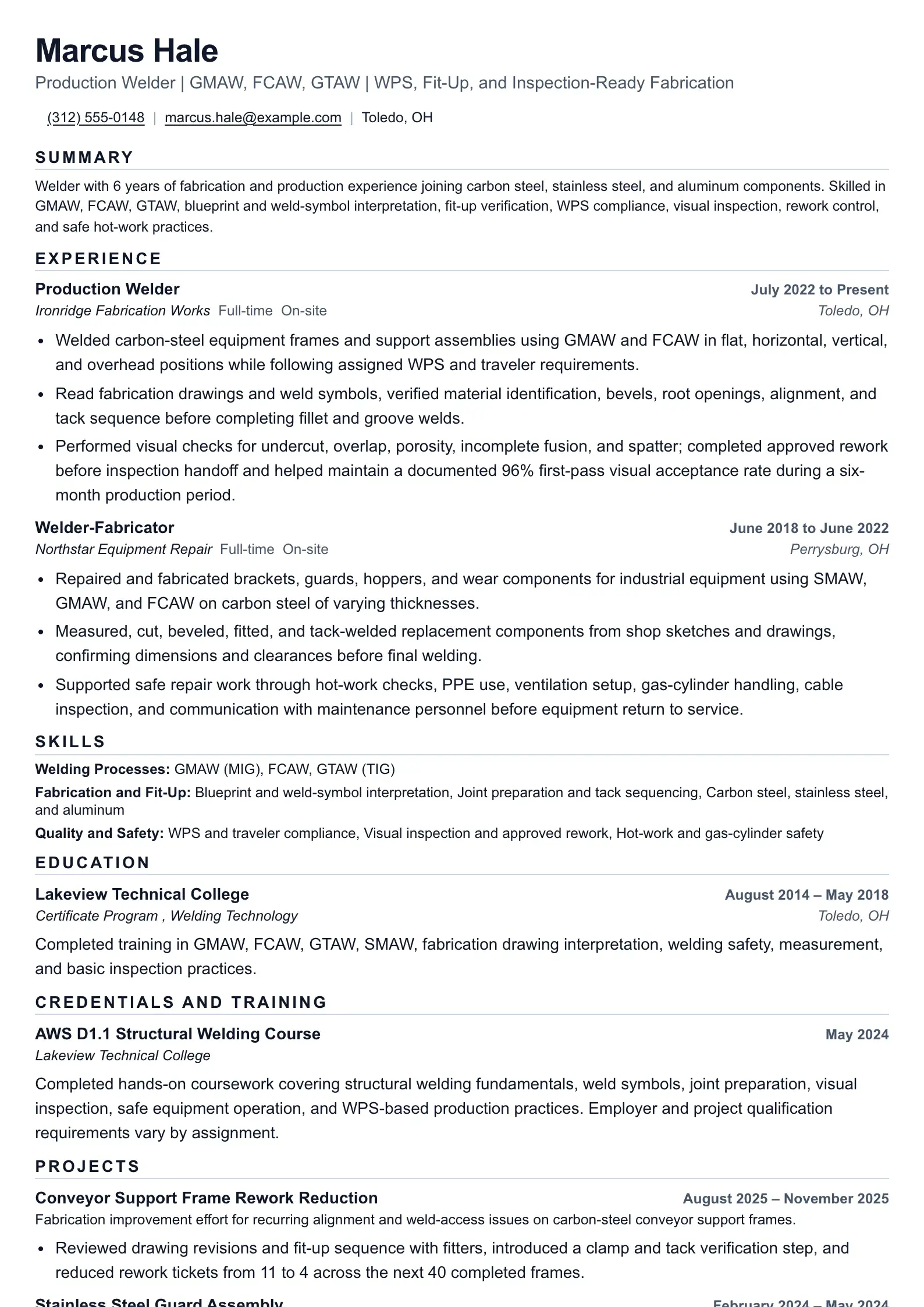
Meridian Welder resume
Use a focused structure to surface welding processes, fit-up, inspection, safety, and fabrication results.
Welding Skills to Back With Process Evidence
Organize skills by production capability rather than placing a long undifferentiated list under one heading. Welding employers need to distinguish between processes you can perform independently, positions you have practiced, materials you have joined, and inspection steps you understand. Include equipment only when it relates to the work, such as pulse MIG systems, wire feeders, positioners, plasma cutters, grinders, or oxy-fuel cutting equipment.
Drawing interpretation is a distinctive Welder skill. State that you read dimensions, fabrication drawings, weld symbols, bill of materials details, and revision notes if that is part of your work. Add fit-up capabilities such as bevel preparation, root opening verification, tack sequencing, squareness, alignment, and distortion control. Safety skills should be practical, including PPE, hot-work controls, ventilation, cylinder handling, lockout procedures, and housekeeping.
Welding processes and positions
- GMAW and FCAW
- GTAW root and finish passes
- SMAW repair welding
- Flat, horizontal, vertical, and overhead positions
Fabrication and fit-up
- Blueprint and weld-symbol interpretation
- Joint preparation and tack sequencing
- Carbon steel, stainless steel, and aluminum
- Fixtures, clamps, grinders, and thermal cutting
Quality and safe work
- WPS and traveler compliance
- Visual inspection and defect recognition
- Rework documentation
- Hot-work, PPE, and gas-cylinder safety
Write Bullets Around Quality and Throughput
Effective Welder bullets connect a technical action to a verified result. Replace statements such as “performed welding duties” with a description of what you welded, how you controlled the work, and what happened at inspection or production handoff. The result can be a first-pass visual acceptance rate, reduced rework, fewer fit-up delays, completed assemblies, or a documented safe-work contribution. Numbers should always be your real results, not industry benchmarks.
Write bullets around a complete fabrication cycle. For example, mention reviewing weld symbols and WPS requirements before setting up, verifying root gap and alignment with the fitter, then completing specified weld passes and conducting visual checks. If an inspector found undercut, porosity, lack of fusion, or dimensional misalignment, explain your role in correcting the issue and preventing recurrence. This evidence demonstrates ownership without overstating authority over final acceptance.
For additional structure, use the action, method, result approach in the guide to strong resume bullet points. A production bullet might state that you welded FCAW fillet joints on carbon-steel frames, checked fit-up against drawings and weld symbols, and helped improve first-pass visual acceptance from an actual baseline to an actual recorded result. If you do not have a metric, use a concrete scope such as assembly type, shift volume, joint category, or inspection outcome.
ATS Keywords for Welding Jobs
Applicant tracking systems cannot infer that “metal work” means GMAW, WPS compliance, or visual inspection. Mirror exact terms from the target posting where they truthfully describe your experience. A structural fabrication employer may prioritize FCAW, fillet welds, gussets, blueprints, and OSHA-aligned hot-work practices. A stainless process-equipment shop may prioritize GTAW, purge practices, sanitary welds, tubing, and inspection documentation. A repair role may emphasize SMAW, hardfacing, field safety, and equipment downtime.
Use the posting language in your headline, skills, and bullets, but keep each keyword attached to evidence. The practical method is explained in this guide to resume keywords, while the formatting principles in an ATS-friendly resume guide help scanners read your process and quality terms reliably.
How Welding Evidence Changes by Seniority
As a Welder advances, the resume should shift from supervised execution to increasingly complex work control. An entry-level candidate can show dependable preparation, safe equipment setup, basic process practice, accurate measurement, and responsiveness to coaching. A production Welder should show independent WPS use, repeatable fit-up verification, multiple positions, drawing interpretation, and inspection-ready output.
Experienced Welders can emphasize complex assemblies, difficult access, material-specific technique, repair troubleshooting, distortion control, mentoring, and communication with fitters, inspectors, and supervisors. Lead or specialist candidates should only claim procedure development, qualification oversight, code interpretation, or final acceptance authority when those duties were formally assigned. Certification and code-related responsibilities vary by customer specification, employer policy, and governing code.
- 1
Entry-level Welder
- Focus
- Safe setup, joint preparation, basic process execution, and coachable quality habits.
- Proof to show
- Documented training, supervised production welds, measurements, PPE use, and visual-check participation.
- 2
Production Welder
- Focus
- Independent WPS execution, drawing interpretation, repeatable fit-up, and first-pass quality.
- Proof to show
- Named processes, positions, materials, assemblies, inspection outcomes, and rework reduction.
- 3
Senior or Lead Welder
- Focus
- Complex joints, troubleshooting, distortion control, crew support, and cross-functional coordination.
- Proof to show
- Difficult fabrication scope, mentoring, repair resolution, production continuity, and assigned leadership duties.
Welder Resume Mistakes That Fail Inspection
A common Welder resume mistake is listing processes without context. “MIG, TIG, stick” does not tell an employer whether you worked on thin stainless, structural carbon steel, aluminum components, root passes, repair welds, or production fixtures. Another mistake is claiming “AWS certified” without naming a verifiable credential, employer qualification, training record, or the limited scope of the claim. Requirements and qualification records differ across jobs, so accuracy matters.
Avoid vague safety statements such as “followed all safety rules.” Instead, describe the relevant controls: completed hot-work checks, used required respiratory or ventilation measures, maintained cable and cylinder safety, or followed lockout procedures before repair work. Also avoid presenting repaired defects as failures without context. A strong bullet shows that you identified the defect, performed approved rework, and documented or communicated the correction according to shop practice.
Turn process lists into welding evidence
- Why it hurts
- A resume says only: Experienced in MIG, TIG, stick welding and fabrication.
- Better approach
- Write: Completed GMAW and FCAW welds on carbon-steel frame assemblies, interpreted weld symbols, verified fit-up and joint preparation, and corrected visual defects before inspection handoff.
Frequently asked questions
- What should a Welder put at the top of a resume?
- Lead with welding processes, material groups, positions, drawing and weld-symbol reading, WPS adherence, and the inspection evidence most relevant to the target shop or field assignment.
- How can a Welder quantify resume achievements?
- Use clear examples such as joints completed, first-pass inspection acceptance, rework reduction, production throughput, dimensional fit-up results, or safe work hours, while labeling numbers as results from your actual work.
- Should a Welder list certifications on a resume?
- List verified employer qualifications, documented training, or active certifications accurately. Qualification requirements, code acceptance, and testing records vary by employer, customer, welding code, and job scope.
- Which keywords matter most for a Welder resume?
- Match the posting with exact process, position, material, code, inspection, blueprint, weld-symbol, WPS, safety, and equipment terms that you can support with real hands-on experience.

Ready to build your Welder resume?
Choose sample data or build your own resume, then personalize it before you download.