
A warehouse worker resume should make three things easy to verify: what you handled, how safely and accurately you worked, and whether you could sustain the required pace. Name the operation, such as retail distribution, manufacturing, cold storage, parts, wholesale, or third-party logistics, because the same title can cover very different work.
Do not build the page around one retailer or fulfillment company. Warehouse jobs also exist with manufacturers, distributors, hospitals, wholesalers, carriers, food operations, and local employers. Some hourly applications skip resumes, while others use them to screen equipment experience, reliability, and progression.
What warehouse hiring managers scan first
The first review checks shift and schedule fit, relevant equipment, safe work habits, recent attendance, and experience with the operation's inventory flow. Show whether you received, put away, replenished, picked, packed, staged, loaded, counted, or processed returns. Add product conditions such as refrigerated, fragile, oversized, regulated, or high-value only when true.
Safe output with accurate handoffs
- Hiring signal
- The worker maintains pace while scanning the correct item, quantity, location, label, and destination and follows equipment and pedestrian-safety rules.
- Evidence to show
- Connect an order or inventory measure to the system, check, exception process, and shift context that produced it.
Reliability matters, but avoid unsupported claims. Use documented attendance recognition, cross-shift coverage, completed training, or consistent assignment scope when available. Physical requirements belong on a resume only when relevant and accurate. Never make a medical claim or promise unsafe lifting.
Skills that prove warehouse readiness
Group skills by inventory flow, equipment, and quality. Inventory work can include receiving, putaway, replenishment, picking, packing, cycle counting, returns, and shipping. Systems may include a warehouse management system, handheld radio-frequency scanner, pick-to-light, voice picking, or shipping software.
Inventory flow
- Receiving and putaway
- Order picking and packing
- Cycle counting
Systems and equipment
- RF scanners
- Warehouse management systems
- Pallet jacks
Safety and quality
- Pre-use inspections
- Damage prevention
- Shipment verification
Name powered equipment only when trained and evaluated for it at work. Distinguish sit-down forklift, reach truck, order picker, walkie rider, and manual or powered pallet jack. Add hazardous-material or food-safety duties only when they match your actual training and assignment.
Warehouse achievement bullets with credible evidence
Strong bullets pair volume with accuracy, safety, or problem solving. A high number without the shift length, product mix, zone, or quality check can mislead. Useful evidence includes verified pick rate, order accuracy, inventory variance, damage reduction, dock turnaround, on-time staging, cross-training, and recordable safety performance.
Before
Picked and packed customer orders quickly.
After
Picked, scanned, packed, and staged an average of 135 mixed-item orders per shift across three zones while meeting the site's documented accuracy standard and escalating location discrepancies.
Why it works
The rewrite defines the workflow and scale, then connects speed to scanning, quality, and exception handling.
Before
Helped with inventory.
After
Completed weekly cycle counts for 1,200 assigned locations, researched scanner and bin discrepancies in the WMS, and submitted verified adjustments to the inventory lead.
Why it works
The stronger version identifies scope, system use, investigation, and the approval boundary for inventory changes.
Action
Reduced preventable packing damage
Method
Matched carton size and protective material to the item guide and flagged recurring inbound packaging defects
Result
Lowered documented repacks in the assigned line during an eight-week team review
Use your own records and explain team results honestly. The strong resume bullet points guide helps separate contribution from unsupported credit.
ATS keywords matched to warehouse proof
Mirror the vacancy's language where it fits. Relevant terms may include warehouse associate, material handler, stocker, order filler, picker packer, receiving, putaway, replenishment, RF scanner, warehouse management system, cycle counts, inventory control, shipping, loading, returns, pallet jack, forklift, order accuracy, and safety inspection.
Warehouse terms to support with evidence
- Receiving
- Putaway
- Replenishment
- RF scanner
- Order picking
- Cycle counting
- Inventory control
- Shipping and receiving
- Powered industrial truck
- Damage prevention
Use the exact equipment and process names in your experience bullets. The resume keywords guide explains matching without stuffing, while the ATS-friendly resume guide covers simple, readable structure.
How warehouse evidence changes by seniority
An entry-level worker can emphasize dependable attendance, safety orientation, scanner use, and learning across zones. An experienced associate should show stable output, accuracy, exception handling, and equipment range. A lead can show labor coordination, training, dock or wave planning, and root-cause work without claiming management authority they did not hold.
- 1
Entry-level associate
- Focus
- Safe fundamentals, attendance, and process learning
- Proof to show
- Shift availability, training, scanning, packing checks, housekeeping, and clear handoffs
- 2
Experienced warehouse worker
- Focus
- Consistent output and accurate exception handling
- Proof to show
- Verified volume, accuracy, inventory research, equipment, cross-training, and product range
- 3
Lead or coordinator
- Focus
- Team flow and operational control
- Proof to show
- Work allocation, onboarding, dock coordination, count reviews, safety observations, and process improvements
Warehouse resume mistakes that weaken credibility
Avoid a responsibility list that could belong to any facility. Add operation type, equipment, products, shift, systems, and evidence. Do not copy a productivity metric from a coworker or job advertisement. Do not suggest that speed justified bypassing a safety control.
Treating one employer as the whole market
- Why it hurts
- A resume written only in one company's internal vocabulary can hide transferable receiving, inventory, equipment, and shipping skills.
- Better approach
- Translate internal terms into standard warehouse language, keep the real system or process name in context, and target manufacturers, distributors, logistics providers, and local operations as well as major retailers.
Check whether the application requests a resume before spending time on a highly designed document. A clean file is useful, but the employer's form, schedule questions, assessments, or work-history fields may control the initial screen.
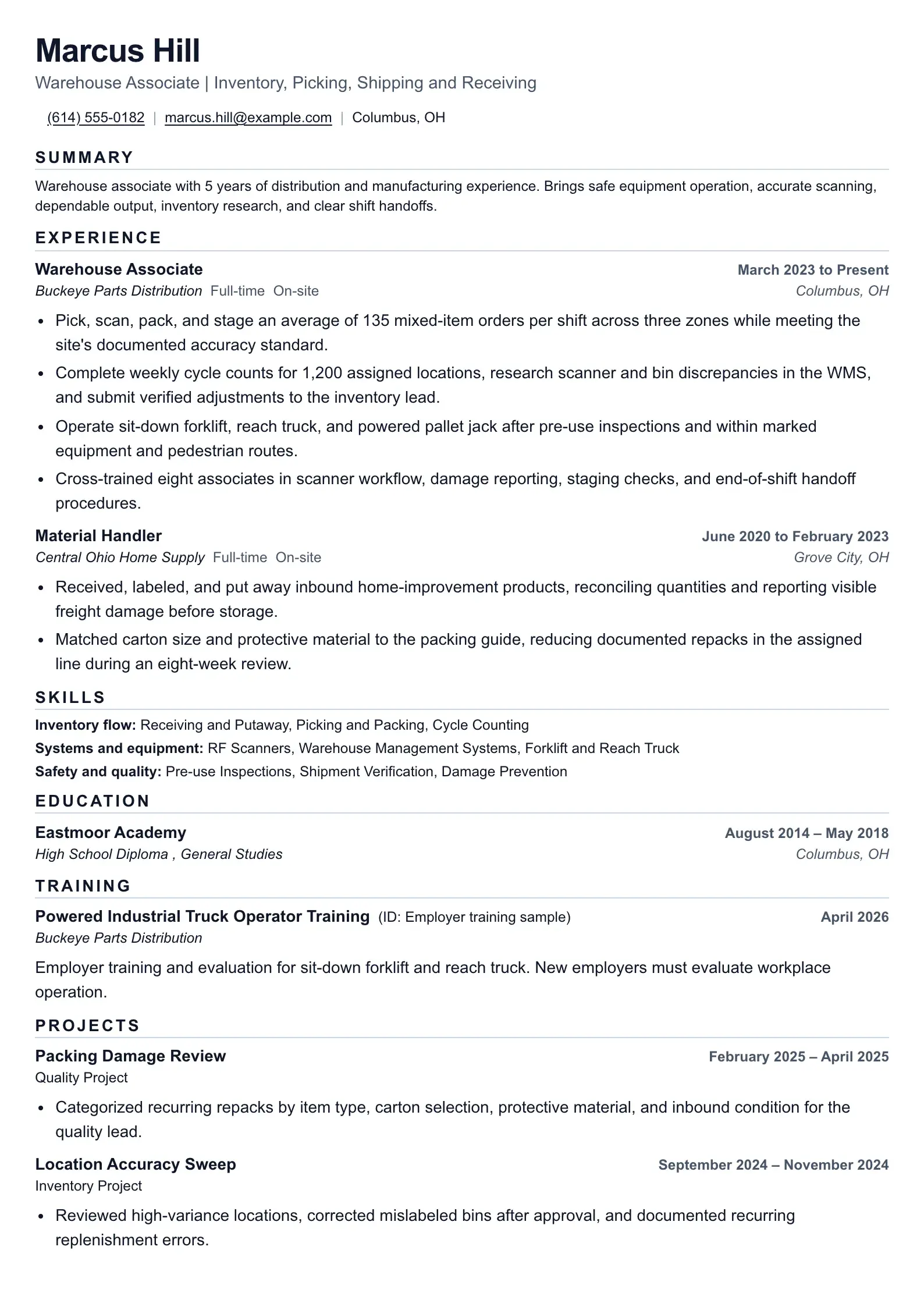
Use this resume template for warehouse applications
Present shift fit, equipment, inventory flow, safety, accuracy, and dependable output in a fast-scanning format.
Frequently asked questions
- What should a warehouse worker put on a resume?
- Show the operation type, products handled, shift, equipment, warehouse systems, safety practices, and results you can verify. Useful measures include units or orders handled, accuracy, inventory variance, loading time, attendance, and training, but only when they reflect your real work.
- Do I need a resume for an hourly warehouse job?
- Some employers use short applications or do not request a resume, but many warehouses, staffing firms, manufacturers, distributors, and logistics providers accept or require one. Keep a concise resume ready, then follow each employer’s stated application process rather than assuming every hourly employer works the same way.
- Should I list forklift certification?
- List employer-provided powered industrial truck training or evaluation accurately, including equipment type and date when useful. OSHA requires employers to train and evaluate operators for the workplace and equipment, so avoid presenting a generic card as permission to operate every forklift in any facility.
- How can I write a warehouse resume without metrics?
- Describe the products, zones, systems, equipment, safety checks, exception handling, and handoffs you completed. A specific example of correcting a location error, preventing damage, or resolving a shipment discrepancy is stronger than an invented productivity percentage.

Ready to build your Warehouse Worker resume?
Choose sample data or build your own resume, then personalize it before you download.