
A strong Teacher resume makes the daily work of teaching visible: how you translate standards into lessons, build a safe classroom culture, respond to assessment evidence, and communicate with families. It should read like a focused record of instruction for the grade level, subject, and school setting you are targeting, not a list of broad traits such as caring or organized. Use the job posting to select the standards, instructional routines, student supports, and credentials that belong in your evidence.
What School Hiring Committees Look For First
Show the instructional cycle in your bullets. A useful Teacher bullet names the standard or skill, the learning experience, the evidence collected, and the instructional response. This is more credible than claiming to have improved every outcome. If you include numbers, label them through the surrounding context as results from a class, term, or assessment, not as universal expectations or industry benchmarks.
What school leaders look for first
- Hiring signal
- A resume that connects standards, daily instruction, student evidence, and family partnership.
- Evidence to show
- Name the grade or subject, cite the planning or assessment routine, and describe observed class-level evidence without claiming unsupported causation.
Teacher resume for standards-based instruction
Use a targeted Teacher resume to connect classroom planning, assessment routines, student supports, and family communication.
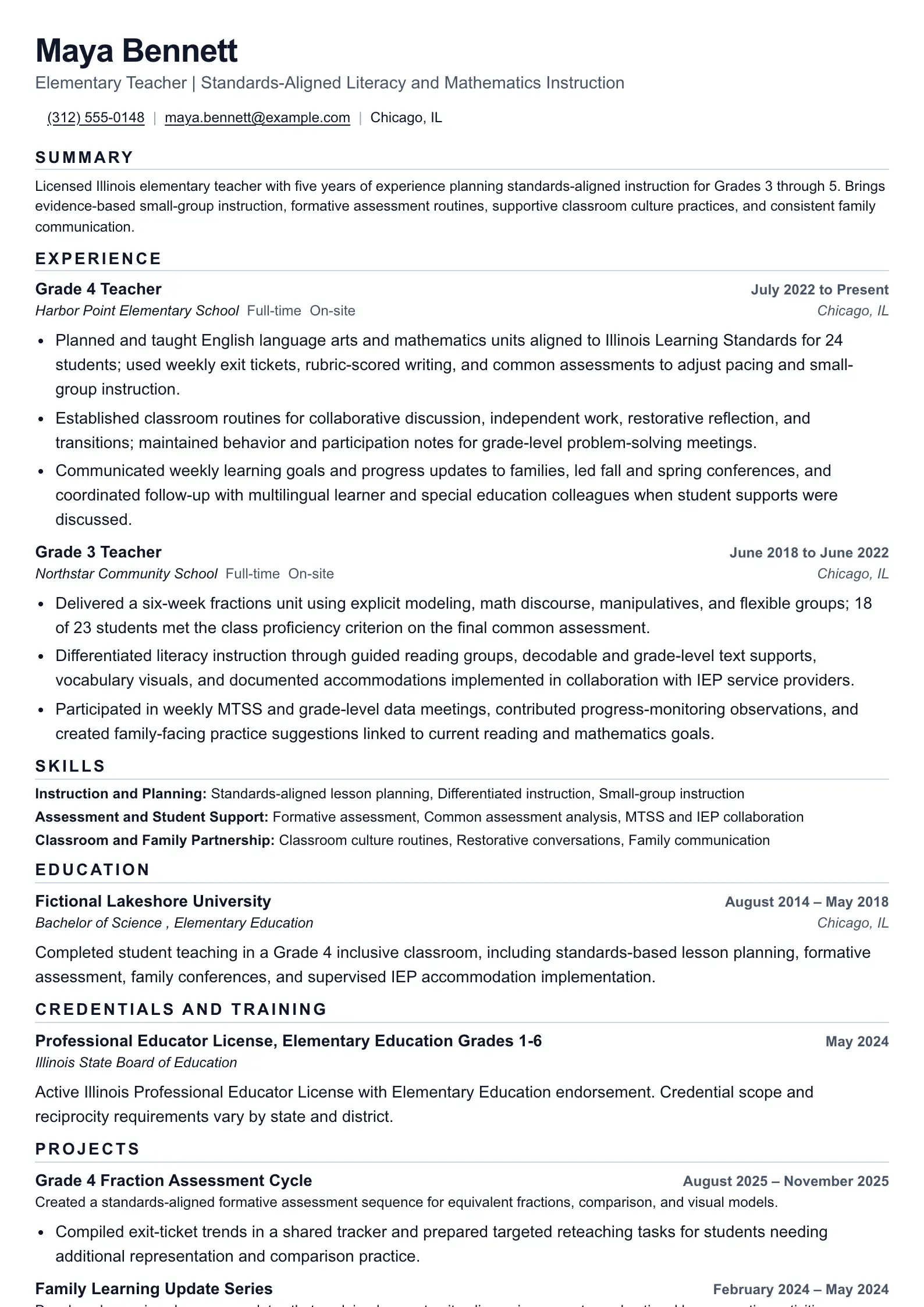
For a quick screening pass, review your document against an ATS-friendly resume guide. Use conventional section names such as Experience, Education, Licensure, and Skills so school systems and applicant tracking software can identify the information easily.
Teaching Skills to Demonstrate With Evidence
Teacher skills should be organized around work a school can verify. Curriculum planning includes unpacking state or district standards, sequencing lessons, preparing materials, and adapting pacing from formative evidence. Instruction includes explicit modeling, questioning, small-group teaching, academic discourse, and scaffolds for multilingual learners and students receiving specialized services.
Classroom culture deserves concrete language. Instead of writing "classroom management," identify routines such as restorative conversations, positive behavior supports, arrival procedures, collaborative norms, or calm transitions. For differentiated instruction, name the method: flexible groups, leveled texts, visual supports, choice boards, modified tasks, or accommodations implemented with an IEP team. Do not imply that a classroom teacher independently determines special education services or legal accommodations.
Assessment skills include exit tickets, rubric-scored writing, running records, common assessments, progress-monitoring tools, and data meetings. Family communication can include bilingual outreach when applicable, conferences, progress updates, curriculum nights, and documented follow-up. Only list platforms, curricula, and intervention programs you have actually used.
Write Bullets Around Learning and Classroom Practice
The strongest Teacher bullets begin with an instructional action and contain enough context for a committee to understand the evidence. They do not need inflated outcomes. A class-level result can be meaningful when the assessment, baseline, and observation period are clear. See additional structure in this guide to strong resume bullet points.
Write bullets that connect planning to responsive instruction. For example: "Planned a six-week Grade 4 fraction sequence aligned to Illinois Learning Standards; used weekly exit tickets and small-group reteaching, with 19 of 24 students meeting the unit proficiency criterion on the final common assessment." This is an illustrative example, not a benchmark. It reports what was observed in one class and does not claim the teacher alone caused the result.
A classroom culture bullet can say: "Established entry routines, student discussion norms, and restorative check-ins; maintained weekly behavior reflection logs and shared patterns with the grade-level team." A family communication bullet can say: "Provided weekly learning updates and scheduled conferences after progress-monitoring reviews, documenting agreed next steps for families." These statements show process, scope, and professional judgment.
When possible, include collaboration: co-planning with specialists, participating in MTSS or grade-level data meetings, supporting IEP implementation, or coordinating with counselors. State your role accurately. Teachers contribute observations and instructional evidence; eligibility, service decisions, and legal processes follow district and state procedures.
ATS Keywords for Teaching Positions
Match keywords to the specific vacancy rather than pasting every education term into a skills list. A K-5 posting may prioritize phonics, guided reading, mathematics workshop, MTSS, SEL, and family engagement. A middle school posting may prioritize content standards, advisory, common formative assessments, project-based learning, and team collaboration. Include the grade, subject, curriculum, assessment tools, and student-support terms that genuinely reflect your experience.
Read the posting alongside this overview of resume keywords. Repeat important terms naturally across the headline, summary, skills, and experience bullets. For licensure, use the official credential name, endorsement, and state when known. If you are pending, eligible, or pursuing reciprocity, state that status plainly rather than presenting a license as active.
Teacher ATS keywords to tailor
- standards-aligned lesson planning
- differentiated instruction
- formative assessment
- classroom culture
- small-group instruction
- IEP collaboration
- MTSS
- family communication
- grade-level data meetings
- state licensure
How Teaching Evidence Changes With Seniority
As teachers gain experience, the resume should show a broader instructional scope, not simply more years in the classroom. An early-career Teacher can emphasize supervised teaching, clear lesson planning, mentor feedback, and accurate use of formative assessment. A more experienced classroom Teacher can show curriculum ownership, consistent data routines, family partnership, and collaboration across a grade-level team.
Teacher leaders can add mentoring, curriculum mapping, professional learning facilitation, committee work, or implementation support. These roles still need evidence. Name the audience, deliverable, and observed result, such as facilitating a planning cycle for four teachers or creating a shared rubric used in a grade-level unit. Avoid implying formal evaluation authority, administrative scope, or districtwide outcomes unless those responsibilities were assigned.
- 1
Early-career Teacher
- Focus
- Reliable lesson planning, classroom routines, feedback use, and supervised instructional practice.
- Proof to show
- Standards-based unit plans, mentor observations, formative assessment records, and family updates.
- 2
Classroom Teacher
- Focus
- Independent instructional cycles, differentiated supports, team collaboration, and documented student evidence.
- Proof to show
- Common assessment analysis, small-group plans, IEP collaboration, and conference communication.
- 3
Teacher Leader
- Focus
- Curriculum collaboration, mentoring, and professional learning within assigned responsibilities.
- Proof to show
- Shared planning tools, coaching artifacts, committee contributions, and facilitator feedback.
Teacher Resume Mistakes That Hide Classroom Impact
Do not submit a Teacher resume built only from duties such as "taught lessons" or "managed classroom." Those phrases omit the standards, instructional choices, and evidence that distinguish your practice. Also avoid listing every curriculum program you have encountered. Select tools relevant to the target classroom and be prepared to discuss how you used them.
Be precise with credentials. State licensure, endorsements, reciprocity rules, substitute credentials, and emergency permits vary. List an active credential only if it is current and relevant, and use "eligible," "pending," or "in progress" when that is the accurate status. Do not claim that test scores, attendance, behavior, or graduation results were caused solely by your instruction when the available evidence shows association or classroom-level observations.
Replacing unsupported student-growth claims
- Why it hurts
- Improved test scores by 30% through excellent teaching.
- Better approach
- Used exit-ticket patterns and small-group reteaching during a six-week unit; the share of students meeting the class proficiency criterion rose from 12 of 24 on the pre-assessment to 19 of 24 on the final common assessment.
Frequently asked questions
- What should a teacher resume emphasize?
- Emphasize standards-aligned planning, classroom culture, differentiated instruction, assessment evidence, family communication, and the licensure or endorsement required for the target role.
- How should teachers show student growth without overclaiming?
- Describe the assessment used, the learning target, the time period, and the observed result. Avoid claiming that one instructional action alone caused growth unless the evidence supports that conclusion.
- Should a teacher include a license on a resume?
- Yes. List the license, endorsement area, issuing state, and current status when applicable. Requirements and reciprocity rules vary by state and district.
- Which keywords help a teacher resume pass an ATS?
- Use terms from the posting such as curriculum standards, differentiated instruction, formative assessment, IEP collaboration, family communication, and the grade level or subject area.

Ready to build your Teacher resume?
Choose sample data or build your own resume, then personalize it before you download.