
A Product Manager resume should make the reader trust your judgment before they trust your job title. Show how you learned what customers needed, selected a problem worth solving, chose what not to build, and led a team toward a measurable outcome. The strongest evidence connects product decisions to customer behavior rather than listing ceremonies, tools, or delivery tasks.
What Product Leaders Look For First
Hiring managers scan for a Product Manager who can turn ambiguous customer and business signals into a focused product bet. Lead with a headline that names your product area and level, then use your summary to establish the type of decisions you own: discovery, prioritization, roadmap direction, experiments, and outcome measurement. Your first experience bullet should usually state a customer problem, the decision you made, and the result.
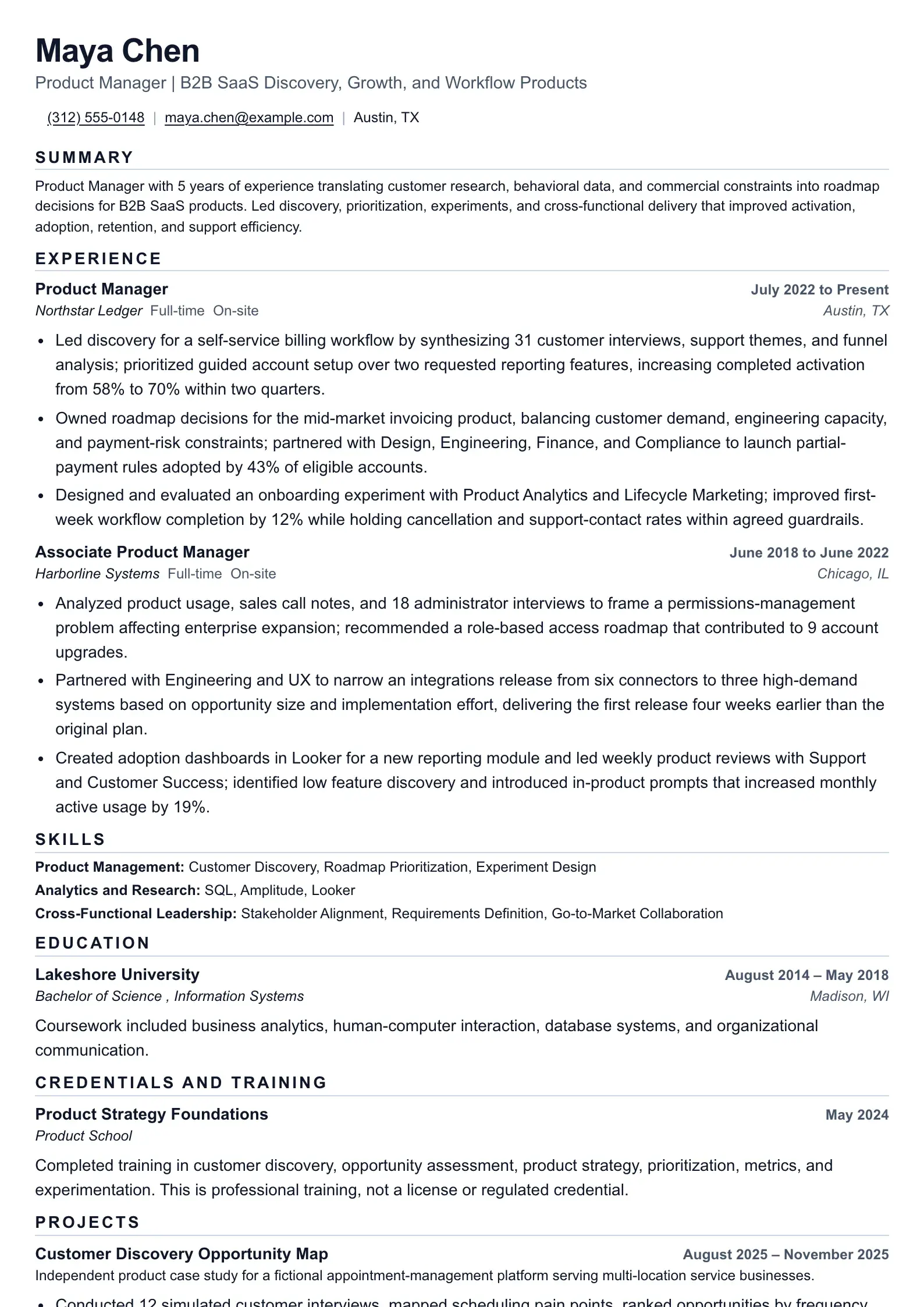
Product Manager resume example
Use a Product Manager resume structure that foregrounds discovery evidence, roadmap judgment, experiments, and customer outcomes.
What signals product judgment
- Hiring signal
- A candidate can explain why a roadmap item earned priority over alternatives.
- Evidence to show
- Show the customer insight, business constraint, decision criteria, cross-functional partners, and outcome. For example, explain that interview findings and funnel data redirected a planned feature into an activation improvement that increased completed setup.
Do not position yourself as only the person who ran standups, tracked tickets, or chased dates. Those activities support delivery, but they do not prove product management. A Product Manager owns the problem definition and product tradeoffs. A Project Manager may own execution planning, dependency coordination, schedules, and risk governance. If both roles existed on your team, clarify your distinct contribution.
Product Management Skills to Prove Through Decisions
Organize skills around the work a Product Manager performs, not a long list of software. Include customer discovery methods such as interviews, usability testing, survey design, journey mapping, and support-ticket synthesis. Add product decision skills: opportunity sizing, segmentation, prioritization frameworks, roadmap planning, requirements definition, pricing or packaging analysis where relevant, and experiment design.
Then name the analytical and collaboration tools that supported those decisions, such as SQL, Amplitude, Mixpanel, Looker, Tableau, Jira, Figma, or user research repositories. Only list tools you can discuss in context. For regulated products, describe collaboration with legal, privacy, security, compliance, or clinical partners accurately. Product Managers do not provide legal or regulatory approval unless their employer has formally assigned that authority.
For a fuller structure, review an ATS-friendly resume guide after selecting the skills that match the target product role.
Write Bullets Around Discovery, Tradeoffs, and Outcomes
Every Product Manager bullet should answer four questions: what customer or business problem existed, what evidence informed your choice, what product decision did you lead, and what changed afterward. Use past tense for completed work and preserve the scope of your ownership. If a result was shared across design, engineering, marketing, sales, or data teams, state that collaboration rather than claiming sole credit.
The numbers below are illustrative examples, not industry benchmarks: "Synthesized 28 customer interviews, onboarding recordings, and funnel analysis to identify account-setup confusion; prioritized guided setup over two lower-impact roadmap requests, increasing completed activation by 14% in one quarter." This bullet demonstrates discovery, prioritization, a tradeoff, and an adoption outcome.
A weaker bullet says, "Managed the roadmap and worked with engineering on new features." It does not reveal who the feature served, why it mattered, or whether the work changed customer behavior. Use the principles in strong resume bullet points to replace activity statements with decision-and-outcome evidence.
For experiments, name the hypothesis and guardrail when possible. For example, describe an A/B test that improved first-week adoption while monitoring cancellation rate, support contacts, or conversion quality. A positive click-through rate alone may not prove a useful product outcome.
ATS Keywords for Product Manager Roles
Match keywords to the target Product Manager job description, especially the product domain and customer type. A B2B platform role may call for workflow design, account expansion, integrations, admin experience, and retention. A consumer role may emphasize activation, engagement, lifecycle, experimentation, subscription, and conversion. A platform role may require APIs, developer experience, reliability, or internal stakeholder management.
Use exact relevant terms in your headline, summary, skill groups, and experience bullets, but only where supported by your work. An explanation of resume keywords can help you distinguish useful matching language from keyword stuffing. Include product strategy, customer discovery, roadmap, prioritization, experimentation, analytics, adoption, retention, stakeholder management, and cross-functional leadership when they accurately describe your experience.
How Product Scope Changes With Seniority
An Associate Product Manager resume can emphasize structured discovery, analysis, feature ownership, clear requirements, and learning from experiments. Show how you contributed to decisions while identifying the manager or product lead who held final scope authority. Early-career candidates can also include a strong product project that demonstrates research, prioritization, and a testable recommendation.
A Product Manager resume should show independent ownership of a problem area, a roadmap sequence, measurable outcomes, and tradeoffs across customer value, effort, risk, and commercial goals. Senior Product Managers should demonstrate portfolio thinking, longer-horizon strategy, influence across multiple teams, and decisions made under uncertainty. Group Product Managers and product leaders should show how they developed product talent, aligned teams around strategy, and improved the operating system for product decisions.
Certifications can be included as completed training, especially when they add a relevant method or domain foundation. They are supplementary evidence, not a substitute for product outcomes. Hiring practices vary by employer, and no universal Product Manager certification is required.
Product Manager Resume Mistakes That Blur Ownership
Confusing delivery coordination with product ownership
- Why it hurts
- The resume lists sprint planning, backlog grooming, release notes, Jira updates, and stakeholder meetings without explaining the customer problem or product decision behind them.
- Better approach
- Keep delivery details only when they establish how you led a product bet. Pair them with discovery evidence, priority choices, a rejected alternative, and a measurable adoption, retention, conversion, or efficiency result.
Another frequent mistake is treating every shipped feature as an achievement. Shipping is an output. Explain whether customers adopted the feature, whether it reduced a friction point, or whether discovery invalidated the idea before costly development. A well-supported decision to stop, narrow, delay, or redesign work can be strong Product Manager evidence because it shows judgment.
Avoid inflated ownership claims. If analytics identified an opportunity, design tested a prototype, engineering estimated complexity, and leadership approved investment, describe your role in aligning those inputs and recommending the decision. This makes your cross-functional leadership credible and distinguishes it from administrative project tracking.
Frequently asked questions
- What should a Product Manager resume emphasize?
- A Product Manager resume should emphasize how you identified customer problems, made prioritization decisions, aligned cross-functional teams, and improved measurable product outcomes such as activation, adoption, retention, or revenue.
- How is a Product Manager resume different from a Project Manager resume?
- Product Managers should show ownership of customer problems, product strategy, tradeoffs, roadmap choices, experiments, and business outcomes. Project Managers typically emphasize delivery plans, timelines, dependencies, budgets, and execution governance.
- Which metrics belong on a Product Manager resume?
- Use metrics connected to product decisions, including activation rate, feature adoption, retention, conversion, task completion, time saved, support contact rate, experiment lift, revenue impact, or discovery insights that changed scope.
- Do Product Managers need a certification?
- Product management has no universal licensing requirement. A relevant completed course can support an early-career resume, but employers usually place more weight on evidence of discovery, prioritization, delivery decisions, and product outcomes.

Ready to build your Product Manager resume?
Choose sample data or build your own resume, then personalize it before you download.