
Police Officer resume guide
A Police Officer resume should show more than patrol volume. It should demonstrate constitutional judgment, calm communication, accurate documentation, secure evidence practices, and service that earns public confidence. Use only information you may lawfully share, protect victim and juvenile privacy, and describe authority, certifications, and assignments exactly as they apply in your jurisdiction.
Police Officer resume example
A focused structure for documenting patrol, investigations, reporting, community engagement, and accountable decision-making.
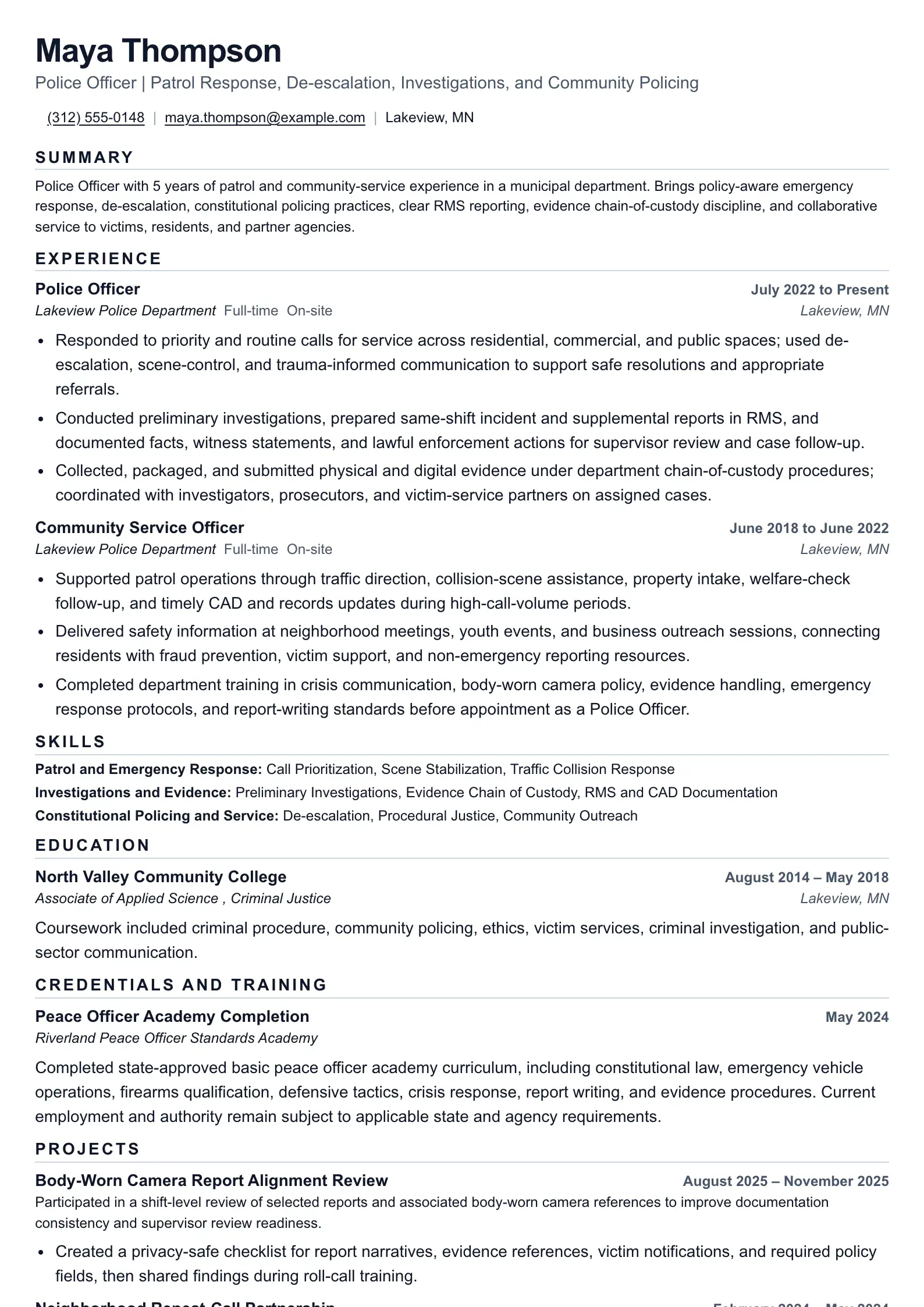
What Police Hiring Panels Review First
Police chiefs, command staff, and public-sector recruiters scan first for readiness to perform sworn duties within policy and state or agency standards. Make your opening summary establish your patrol environment, years of service, academy or POST status where applicable, key assignments, and the population or call types you serve. Then make each role prove safe field judgment. A reader should quickly find evidence of dispatch response, scene stabilization, constitutional searches or seizures within your authorized scope, report completion, evidence continuity, and respectful treatment of residents.
What police hiring panels look for
- Hiring signal
- A candidate who pairs decisive emergency response with procedural justice and dependable documentation.
- Evidence to show
- Show a specific call, the de-escalation or investigative steps used, policy-aware decisions, completed reports, and an outcome such as a safe resolution, case referral, or improved evidence package.
Do not rely on claims such as dependable officer or strong communicator. Replace them with evidence from calls for service, preliminary investigations, victim assistance, traffic safety, crisis intervention, court preparation, or neighborhood problem-solving. If you are moving agencies, distinguish transferable skills from local legal authority. Policies, collective bargaining rules, certification requirements, and specialized-unit selection practices vary by employer.
Public Safety Skills to Document Carefully
Organize skills around police work that can be verified through records, training files, supervisor evaluations, case outcomes, or operational assignments. Include systems only if you used them, such as CAD, RMS, digital evidence platforms, body-worn camera systems, records databases, or citation software. Name legally sensitive capabilities carefully: write conducted searches under policy and lawful authority, not expert search authority. If a course is completed but a certification has expired or requires agency authorization, label it accurately.
Patrol and emergency response
- Call prioritization
- Scene stabilization
- Traffic collision response
Constitutional and investigative practice
- De-escalation
- Preliminary investigations
- Evidence chain of custody
Documentation and public service
- Incident report writing
- Victim communication
- Community outreach
Training belongs near your credentials when it is relevant to the target agency. Examples include crisis intervention, active threat response, domestic violence investigation, emergency vehicle operations, body-worn camera policy, procedural justice, or field training officer coursework. State academy completion, firearms qualification, and POST-related status should be described only in the form recognized by the issuing jurisdiction or hiring agency.
Write Bullets Around Judgment and Service
Strong Police Officer bullets connect a public-safety task to the tactics, documentation, and accountable result. They avoid sensational detail, confidential identifiers, and unsupported arrest counts. A patrol bullet can show how you assessed a volatile domestic disturbance, separated parties, used communication techniques, documented probable cause, safeguarded evidence, and connected a victim with services. An investigations bullet can show timely follow-up, digital or physical evidence handling, and a complete case submission.
Before
Responded to many calls and wrote police reports.
After
Responded to priority patrol calls, used de-escalation and scene-control techniques, and completed same-shift RMS reports that supported supervisor review and follow-up investigations.
Why it works
The revised bullet identifies operational work, constitutional and safety-minded methods, and documentation that made the work accountable.
Action
Responded, investigated, documented, coached, or coordinated
Method
Identify the call type, policy-aware tactics, systems used, and partner agencies involved
Result
State an illustrative outcome such as safe stabilization, a complete case file, a referral, reduced repeat calls, or timely court-ready documentation
Use metrics only when you can explain their meaning. Illustrative examples include average report turnaround, number of community events supported, percentage of assigned evidence audits completed on time, or reduction in repeat calls after a problem-oriented patrol plan. Do not present illustrative figures as industry benchmarks. Enforcement totals alone can create the wrong impression unless they are paired with legality, victim support, case quality, and community impact.
ATS Keywords for Police Officer Roles
Police agencies and civil-service systems may search for exact language from the posting. Mirror the terms that accurately match your experience, including patrol operations, calls for service, emergency response, criminal investigations, traffic enforcement, collision investigation, report writing, records management system, computer-aided dispatch, evidence handling, chain of custody, courtroom testimony, community policing, crisis intervention, de-escalation, constitutional policing, procedural justice, victim services, and field training.
Read the posting alongside an ATS-friendly resume guide before submitting. Use the agency name, unit terminology, and required qualifications where truthful, but do not copy requirements you have not performed. For example, include school resource officer, detective, marine patrol, or crime scene duties only when your assignment, training, and authorization support the claim.
For sharper placement and repetition, review resume keywords. Put essential terms in your headline, summary, skills, and relevant accomplishment bullets rather than building an isolated keyword block with no supporting evidence.
How Law Enforcement Responsibility Progresses With Seniority
An entry-level Police Officer resume should foreground academy completion, supervised field training, report accuracy, safe response, policy learning, and coached performance. Candidates with several years of patrol experience should add independent call management, preliminary investigations, evidence quality, court participation, mentoring, and recurring community partnerships. Senior officers, corporals, detectives, or specialized-unit candidates should show leadership through case coordination, training delivery, audits, briefing contributions, interagency work, and public accountability.
As responsibility rises, the evidence must shift from activity to stewardship. A field training officer can describe coaching recruits on report standards and de-escalation. A supervisor candidate can describe reviewing use-of-force documentation, identifying training trends, or improving shift readiness while respecting agency policy and labor rules. A detective candidate can emphasize case-file integrity, victim communication, warrant preparation within local practice, and coordinated follow-up.
Police Officer Resume Mistakes That Undermine Trust
A frequent Police Officer resume mistake is treating public safety work as a list of dramatic incidents. Hiring panels need judgment, not spectacle. Remove confidential names, addresses, case numbers, tactical details, protected health information, and descriptions that could compromise an investigation. Replace vague phrases such as handled difficult situations with clear but privacy-safe evidence of decisions, communication, reporting, and referrals.
Listing enforcement without accountability
- Why it hurts
- A bullet says made arrests and issued citations but gives no indication of legal process, report quality, victim care, or policy compliance.
- Better approach
- Describe the call context, lawful investigative steps, accurate documentation, evidence handling, and the operational or service outcome without disclosing protected facts.
Another mistake is overstating legal scope or credentials. Do not imply statewide authority, instructor status, specialized certification, or independent investigative authority unless it is current and recognized by the relevant agency. Use strong resume bullet points to revise each line into an accountable record of what you did, how you did it, and what the work enabled.
Frequently asked questions
- What should a Police Officer resume emphasize?
- Emphasize lawful decision-making, de-escalation, report quality, emergency response, evidence control, training, and measurable community service outcomes.
- Should Police Officers include arrest totals on a resume?
- Include enforcement activity only when it has context, such as lawful case outcomes, investigative quality, victim support, or compliance with agency policy.
- How should a Police Officer describe de-escalation?
- Describe the call type, tactics used, safety considerations, and outcome without disclosing protected personal information or overstating authority.
- Do Police Officer credentials vary by state?
- Yes. State POST requirements, academy credentials, firearms qualification, and agency-specific training standards vary by jurisdiction and employer.

Ready to build your Police Officer resume?
Choose sample data or build your own resume, then personalize it before you download.