
A museum curator resume should connect subject expertise to responsible collections and meaningful public interpretation. Hiring committees need to see more than exhibition titles. They assess the quality of your research, the clarity of your curatorial argument, your handling of provenance and ethics, and your ability to collaborate across registration, conservation, design, education, development, and community partners.
Select evidence that fits the museum and collection. An art museum role may prioritize connoisseurship, scholarship, acquisitions, and loans. A history, science, or community museum may emphasize material culture, interdisciplinary research, co-curation, or public programs. Keep your claims precise about your role in collaborative work.
What museum curator hiring committees scan first
The first review usually looks for collection fit, research depth, and completed curatorial work. State your subject areas, object or source expertise, languages when relevant, and the scale of exhibitions or acquisitions. Show how a research question became an interpretive plan that audiences could understand.
Provenance, rights, cultural sensitivity, and consultation may be central to a project. Describe these responsibilities without implying that one process applies to every institution or collection. When work involved source communities or external scholars, name the partnership structure and the decision it informed.
A clear curatorial argument grounded in collections
- Hiring signal
- The candidate can turn original research and responsible consultation into interpretation that serves the institution and its audiences.
- Evidence to show
- Connect the research question, objects or sources, collaborators, ethical review, interpretive choice, and audience result.
Skills that show curatorial range
Organize capabilities around curatorial work rather than presenting a long inventory. Research may cover object study, archives, provenance, fieldwork, language expertise, and scholarly writing. Collections work can include acquisitions, cataloging, loans, rights, and collaboration on conservation priorities. Public-facing work includes interpretation, labels, catalogs, lectures, media, and programs.
Research and collections
- Object and archival research
- Provenance and acquisition research
- Cataloging and collection development
Exhibitions and interpretation
- Curatorial narratives
- Label and catalog writing
- Loan and installation coordination
Public and institutional work
- Community consultation
- Lectures and public programs
- Donor and partner communication
List collection-management systems or digital publishing tools only when relevant. The strongest technical detail supports a curatorial result, such as improving catalog records before an online collection launch.
Museum curator achievement bullets with credible evidence
Curatorial bullets should name your contribution, not absorb the work of the entire project team. Lead curator, co-curator, assistant curator, researcher, editor, and project manager communicate different responsibilities. State the exhibition or acquisition scope and follow it with the research, interpretive, partnership, or audience outcome you personally influenced.
Before
Curated a successful exhibition about regional migration history.
After
Co-curated a migration-history exhibition featuring 42 objects from three lenders, led provenance research and community review of label text, and used exit-survey findings to refine two interpretation stations.
Why it works
The revision defines the candidate's role, collection scope, responsible process, and a documented response to visitor evidence without claiming the whole exhibition's success.
Useful measures may include objects researched, lenders coordinated, catalog records improved, programs delivered, publication reach, or audience-study results. Attendance can add context, but it rarely proves curatorial quality by itself. Use only figures you can verify. See strong resume bullet points for ways to keep contribution and outcome connected.
ATS keywords matched to museum curator proof
Applicant tracking system (ATS) language should match the institution's discipline and responsibilities. Useful terms may include curatorial research, exhibition development, interpretation, acquisitions, provenance research, collection development, scholarly publishing, public programs, loans, donor relations, community engagement, cataloging, and rights clearance.
Curatorial terms to support with evidence
- curatorial research
- exhibition development
- provenance research
- collection development
- interpretive planning
- scholarly publishing
- public programs
- community consultation
Do not insert every term. Use resume keywords where the same capability appears in your work, and follow an ATS-friendly resume structure so publications, exhibitions, and experience remain easy to parse.
Use this resume template for museum curator applications
Balance curatorial experience, selected exhibitions, scholarship, and collection expertise in a readable professional hierarchy.
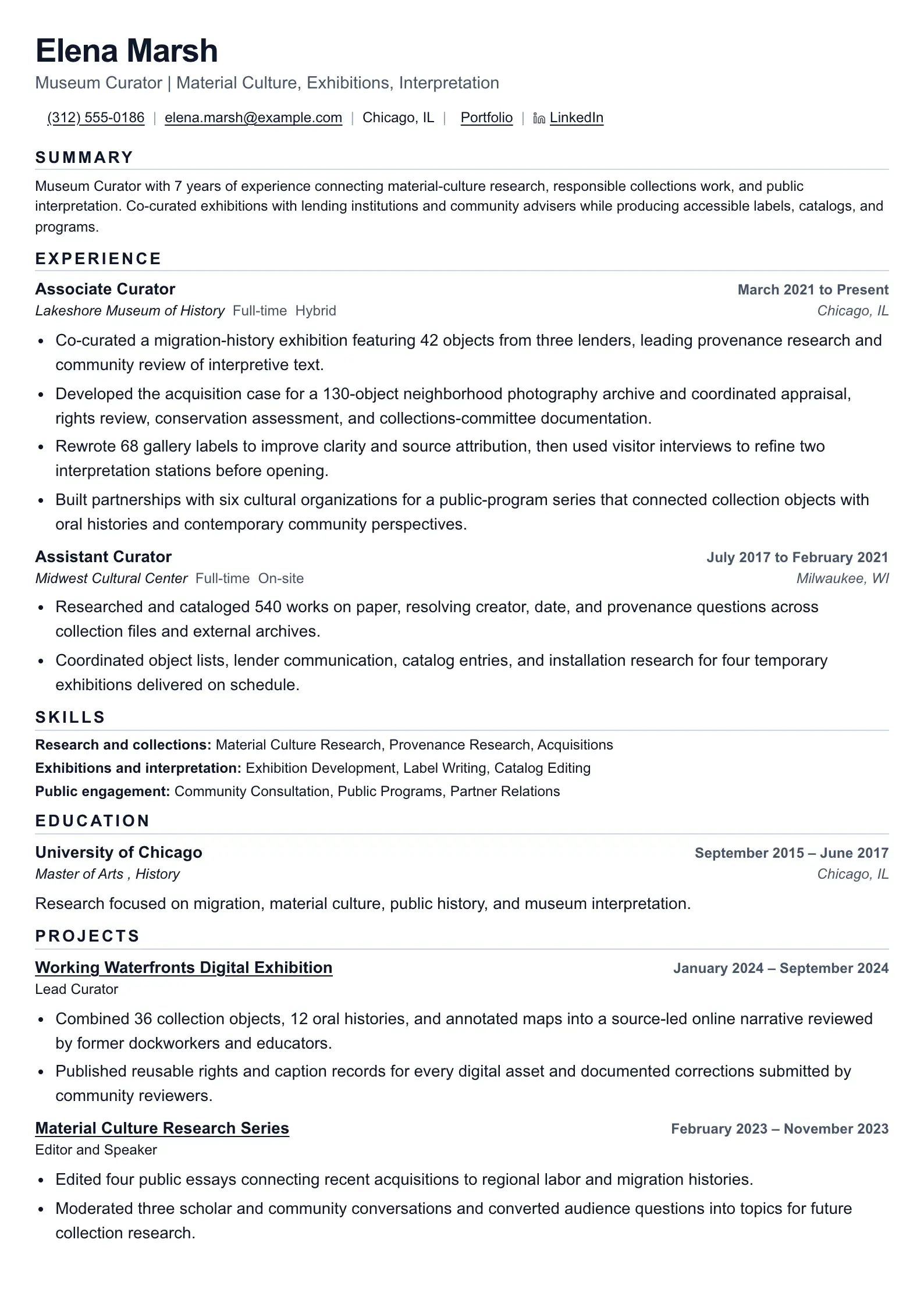
How museum curator evidence changes by seniority
Early-career candidates can prove research, cataloging, writing, and project coordination through assistantships, fellowships, internships, and focused exhibitions. Mid-level curators should show independent research, exhibition or acquisition ownership, external partnerships, and a developing publication record. Senior roles may require collection strategy, institutional leadership, budgets, fundraising collaboration, major partnerships, and mentorship.
- 1
Early career
- Focus
- Reliable research and curatorial support
- Proof to show
- Accurate cataloging, source-based writing, object research, and well-defined project contributions
- 2
Mid-level
- Focus
- Independent curatorial ownership
- Proof to show
- Exhibitions, acquisitions, publications, partnerships, and audience-centered interpretation
- 3
Senior
- Focus
- Collection and institutional direction
- Proof to show
- Long-range strategy, major scholarship, ethical leadership, budgets, partnerships, and team development
Museum curator resume mistakes that blur your contribution
Avoid a chronological exhibition list with no roles or context. Do not call every project “curated” when your responsibility was research, coordination, editing, or education. Accurate credit strengthens trust and makes collaboration visible.
Separate a targeted resume from a full academic CV. The resume should foreground work relevant to the vacancy. A selected exhibitions and publications section is often more useful than an exhaustive record unless the institution specifically requests the full list.
Do not treat visitor attendance as your only impact measure or make unsupported claims about community representation. Explain the research, consultation, interpretive decisions, and evaluation methods within your control.
Frequently asked questions
- What belongs on a museum curator resume?
- Prioritize collections research, exhibitions, acquisitions, interpretation, publications, public programs, and partnerships relevant to the institution. Explain your curatorial question, the objects or sources examined, collaborators, ethical or logistical constraints, and the result for audiences or the collection.
- How should a curator list exhibitions?
- Create a selected exhibitions section when the work is substantial and relevant. Include the exhibition title, institution, date, your exact role, and a concise scope or outcome. Distinguish lead curator, co-curator, assistant curator, researcher, and contributor rather than flattening collaborative credit.
- Does a museum curator need an advanced degree?
- Requirements vary by institution, collection, and seniority. Many curator postings prefer or require graduate study in a relevant discipline, while some roles value equivalent professional and community expertise. State your education and subject specialization accurately, then let the posting guide emphasis.
- Should a curator include publications and talks?
- Include a selected list when it supports your subject expertise or interpretive practice. Prioritize peer-reviewed work, catalogs, essays, conference papers, lectures, and public scholarship related to the role. Use a complete publication list only when the application requests a curriculum vitae.

Ready to build your Museum Curator resume?
Choose sample data or build your own resume, then personalize it before you download.