
Military experience can be a strong civilian resume foundation when it is written for the work you want next, not as a chronology of units, ranks, and mission terms. A hiring manager should quickly understand the business function you performed, the people and assets you led, the systems you used, and the result you delivered. For a logistics role, lead with inventory accuracy, transportation coordination, maintenance readiness, and vendor-facing supply operations. For operations, emphasize scheduling, process control, incident response, and cross-functional leadership. Protect sensitive information while still providing useful scope.
What Civilian Employers Need Translated First
A civilian recruiter typically spends the first scan looking for a target title, comparable scope, measurable outcomes, and job-specific language. Put a civilian-facing headline below your name, such as "Logistics Operations Supervisor | Fleet Readiness | Inventory Control." Your rank can appear in the experience entry, but it should not force a reader to decode your responsibilities.
Translate the environment, not just the title. "Platoon Sergeant" becomes a people-operations signal only after you explain that you supervised 38 personnel, managed training schedules, improved equipment accountability, and coordinated work across maintenance and supply teams. If your work involved restricted systems, name the business-relevant function without identifying locations, unit readiness rates, tactics, access methods, or protected mission details.
What civilian hiring teams recognize
- Hiring signal
- Comparable operational ownership
- Evidence to show
- State the team size, asset category, process owned, stakeholders served, and outcome achieved using language from the target posting.
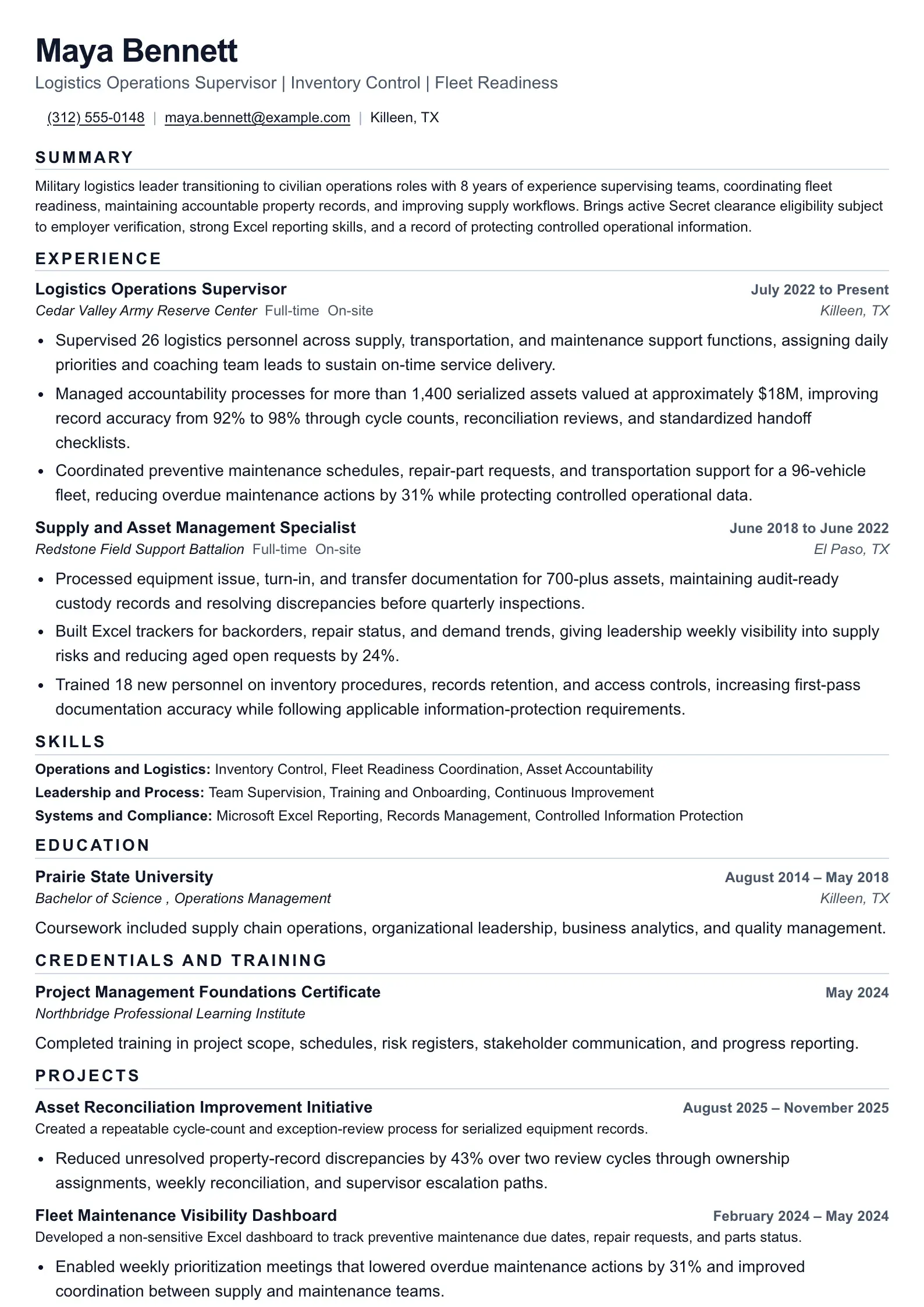
Military-to-civilian resume example
Use a focused structure that makes leadership scope, operational outcomes, credentials, and clearance context easy to find.
Transferable Skills to Express in Civilian Terms
Separate tools from transferable capabilities. Software, equipment platforms, and methods can be listed directly when they are not sensitive. Leadership, training, compliance, process improvement, and emergency decision-making need proof in experience bullets. Review the target posting and use the employer's terminology where it accurately matches your work. This improves alignment without overstating civilian experience.
For help making the skills section readable by screening systems, use the guidance in ATS-friendly resumes. Avoid unexplained acronyms. Spell out a term once if it is useful, then use the civilian equivalent consistently. For example, write "preventive maintenance scheduling" instead of relying only on a military maintenance code.
Convert Military Duties Into Business Evidence
Strong military-to-civilian bullets begin with a business action and finish with a result that a private-sector reader can recognize. Include scale where it can be safely disclosed: personnel led, asset value range, transaction volume, budget responsibility, number of sites supported, cycle time, accuracy rate, or training completion. Any numbers below are illustrative examples, not performance benchmarks.
Before
Served as unit supply sergeant responsible for equipment and property book.
After
Managed inventory accountability and issue processes for 1,200 serialized assets, resolving documentation gaps that improved quarterly audit accuracy from 91% to 98%.
Why it works
The revised bullet replaces rank-dependent language with civilian inventory ownership, safe scope, and a measurable compliance result.
Do not convert every accomplishment into a percentage. A useful result may be reduced backorders, faster handoffs, successful inspection preparation, fewer overdue maintenance actions, or improved onboarding consistency. Explain how you delivered the outcome: redesigned a tracker, standardized a checklist, trained supervisors, reconciled records, or coordinated with maintenance and transportation partners.
Use the bullet-writing approach in strong resume bullet points, then remove details that could expose controlled procedures, deployment patterns, security vulnerabilities, or personal data. It is better to write "supported distributed field operations" than to name a sensitive location or mission identifier.
ATS Keywords Without Military Jargon
Applicant tracking systems do not understand that every military term maps to a commercial role. Mirror accurate terms from the target posting across your headline, summary, skills, and experience. A facilities operations opening may call for work order management, preventive maintenance, contractor coordination, asset tracking, safety compliance, and CMMS. A veteran who performed equivalent work should use those terms when truthful.
Create a translation list before editing. In one column, write your military duty. In another, write the target-role capability. "Motor pool operations" may become fleet operations, maintenance coordination, vehicle readiness reporting, and asset lifecycle support. "Training management" may become workforce onboarding, learning administration, performance coaching, and compliance training.
Use resume keyword guidance to identify repeated nouns, systems, and deliverables in job descriptions. Do not insert keywords as a disconnected list. A recruiter will look for evidence that you performed the work, especially when you are changing industries or moving from military command structures into a civilian employer.
Translate a logistics job posting
| Job requirement | Matching evidence | Keyword |
|---|---|---|
| Inventory accuracy and audit readiness | Reconciled serialized asset records and prepared documentation for recurring inspections. | inventory control |
| Team leadership across shifts | Coached 24 personnel, assigned daily priorities, and balanced workload during high-volume issue periods. | supervisory experience |
| Security-conscious operations | Handled controlled operational data under established access and records procedures without disclosing protected details. | data protection |
How to Position Military Seniority and Civilian Scope
Your resume should signal the level of civilian role you are pursuing. For an individual contributor transition, emphasize hands-on systems work, technical training, reliable execution, and the volume or complexity of work completed. For a supervisor role, quantify direct reports, shift coverage, coaching, performance management, scheduling, and process ownership. For manager-level roles, show budget influence, multi-site coordination, vendor relationships, policy implementation, risk management, and leadership through subordinate supervisors.
Avoid assuming that rank alone establishes seniority outside the military. A hiring team needs context. A senior noncommissioned officer may be highly competitive for operations leadership when the resume documents workforce planning, asset accountability, training governance, and stakeholder coordination. A junior service member with strong technical work may be better positioned for a specialist role by emphasizing systems, certifications, troubleshooting, and documented results.
State scope with careful wording. "Led a 12-person team" is clear. "Oversaw an enterprise" is not credible unless you define the organization, function, and decision authority. If you managed equipment, explain whether you owned lifecycle planning, conducted inspections, coordinated repairs, tracked custody, or supported procurement decisions.
Military-to-Civilian Resume Mistakes to Correct
The most common military-to-civilian resume mistake is writing for someone who already understands the military. Unit names, duty titles, awards, and acronyms can be meaningful context, but they cannot carry the story. Another mistake is treating all military experience as interchangeable leadership. A targeted resume must explain the actual function: logistics, cyber, healthcare administration, intelligence analysis, aviation maintenance, human resources, engineering, or operations.
Clearance wording without oversharing
- Why it hurts
- Candidates either omit relevant clearance information or list sensitive program names, locations, and access details.
- Better approach
- When relevant to the job, state the level and current status, such as Active Secret Clearance, and allow employer verification. Never include classified work products, access methods, operational schedules, or protected mission information.
Also avoid inflating credentials. Military training can be valuable, but a course completion is not automatically a civilian license. Name completed training, issuer, date if useful, and the relevant capability. If a state license, professional certification, or employer credential is required, confirm the applicable jurisdiction and requirements before claiming eligibility.
Frequently asked questions
The following answers address common resume decisions for service members, veterans, reservists, and military spouses supporting a transition into civilian work.
- How should I describe my military rank on a civilian resume?
- List rank only when it clarifies scope, then immediately translate it into a civilian functional title, such as Operations Supervisor or Logistics Manager.
- Should I put my security clearance on a civilian resume?
- Include the clearance level and status when relevant to the target job, such as Active Secret Clearance. Do not disclose access programs, operational details, or sensitive identifiers.
- How can I explain military equipment experience to a private-sector employer?
- Name the civilian capability first, such as fleet maintenance coordination, asset accountability, or inventory control, then add non-sensitive scale and outcomes.
- Do I need certifications before leaving military service?
- Not always. Prioritize credentials requested in your target field, and list completed training accurately without implying a license or certification you do not hold.

Ready to build your Military-to-Civilian resume?
Choose sample data or build your own resume, then personalize it before you download.