
A Medical Biller & Coder resume needs to show more than familiarity with billing software. It should trace a defensible revenue cycle workflow: review clinical documentation, assign ICD-10-CM, CPT, and HCPCS codes within approved scope, submit accurate claims, resolve denials, and protect patient information. Use this guide to make each claim credible for physician practice, hospital, specialty clinic, or outsourced billing roles.
What Revenue Cycle Employers Review First
Hiring managers scan first for coding relevance, payer-facing judgment, and evidence that your work protects reimbursement accuracy. Put your coding credential, coding systems, specialty exposure, and claim-volume context near the top. A Medical Biller & Coder differs from a front-desk scheduler or a general accounts receivable specialist because the role connects clinical documentation to coded claims and payer adjudication.
Lead with a headline that names your target scope, such as “CPC-Certified Medical Biller & Coder | Outpatient ICD-10-CM, CPT, HCPCS, Denials.” In the summary, identify the setting, systems, and compliance habits you bring. Then make bullets show what you reviewed, coded, submitted, corrected, or escalated. Do not imply clinical authority you do not hold. Coding, query, and escalation practices must follow employer policy, payer rules, and applicable scope requirements.
What earns an interview
- Hiring signal
- Clear linkage between documentation review, code assignment, claim quality, and denial resolution.
- Evidence to show
- Name the code sets, payer workflow, EHR or practice management system, and an illustrative result such as reduced corrected claims or recovered delayed reimbursement.
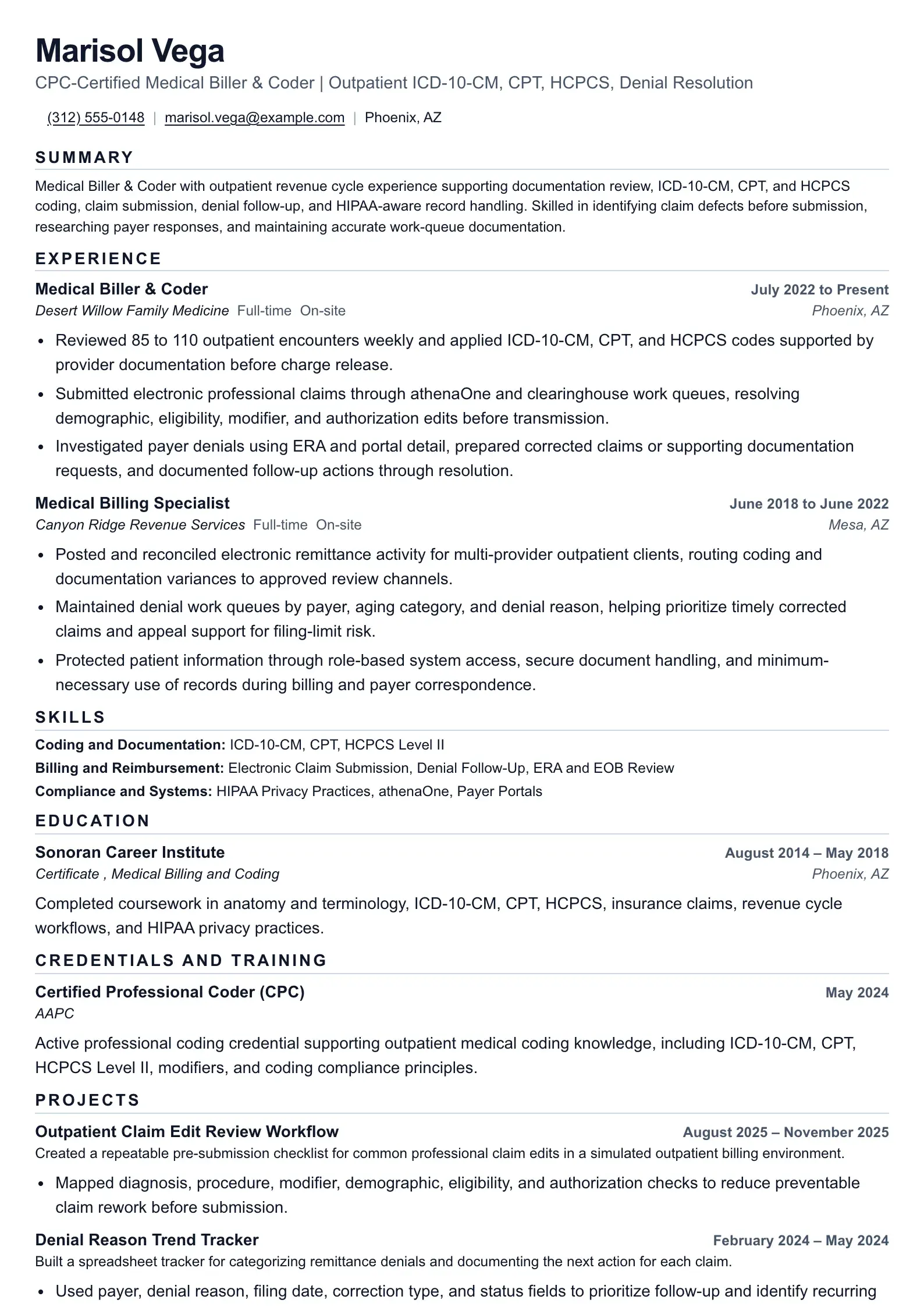
Medical Biller & Coder resume example
Use Polaris to organize coding credentials, reimbursement evidence, and compliant revenue cycle experience.
Coding and Billing Skills to Substantiate
Organize skills around the actual sequence of medical billing and coding work. Include ICD-10-CM diagnosis coding, CPT procedure coding, HCPCS Level II supplies or services, modifier awareness, charge review, claim edits, eligibility checks, payment posting awareness, remittance analysis, and denial follow-up. If you have specialty experience, name it precisely: primary care, orthopedics, cardiology, behavioral health, radiology, or another documented setting.
Technical skill lists should also name the systems you used, such as Epic, athenaOne, NextGen, eClinicalWorks, Waystar, Availity, or a payer portal, but only when true. Pair each platform with a task. “Waystar claim scrubbing and corrected claim submission” is stronger than a loose software list. Privacy belongs here too: describe HIPAA-aware access, minimum-necessary handling, secure document routing, and escalation of incomplete documentation.
Turn core requirements into proof
| Job requirement | Matching evidence | Keyword |
|---|---|---|
| ICD-10-CM, CPT, and HCPCS coding | Reviewed outpatient encounters and assigned supported diagnosis and procedure codes before charge release. | ICD-10-CM |
| Denial follow-up | Researched remit codes, corrected claim defects, and documented payer outreach through resolution. | denial management |
| Privacy and compliance | Used role-based system access and routed documentation questions through approved channels. | HIPAA |
Write Bullets That Trace Clean Claims
Strong bullets begin with a coding or billing action, identify the documentation or payer method, and finish with a verifiable result. Use dates, claim counts, denial categories, turnaround times, audit findings, or reimbursement outcomes when your records support them. Numbers below are illustrative examples, not industry benchmarks. Replace them with your own supported results and preserve confidentiality.
Weak bullets often describe responsibility without showing whether the work was accurate, compliant, or financially useful. Specify the encounter type, code set, claim status, payer issue, or review process. If a result depended on a team, state your individual contribution rather than claiming full ownership of a department outcome.
Before
Responsible for medical billing and coding.
After
Reviewed 85 to 110 outpatient encounters weekly, applied ICD-10-CM, CPT, and HCPCS codes supported by documentation, and resolved claim edits before daily submission.
Why it works
The revised bullet identifies coding systems, documentation review, workload context, and the claim-submission outcome.
For additional structure, review examples in the strong resume bullet points guide. Medical Biller & Coder bullets should show clean claim prevention as well as denial recovery. For example, explain how you identified missing modifiers, demographic mismatches, authorization gaps, or documentation conflicts before a payer rejection occurred.
ATS Keywords for Billing and Coding Roles
An applicant tracking system may search for code sets, credentials, claim functions, payer terms, and software. Mirror language from the job description when it accurately reflects your experience. If a posting requests inpatient coding and your work is outpatient only, state outpatient experience rather than stretching the match. Learn how employers parse skills in the ATS-friendly resume guide.
Medical Biller & Coder ATS terms
- ICD-10-CM
- CPT
- HCPCS Level II
- medical necessity
- charge capture
- claim submission
- claim scrubbing
- CMS-1500
- EOB
- ERA
- remittance advice
- denial management
- corrected claims
- appeals
- payer portals
- HIPAA
- CPC
- reimbursement accuracy
Use keywords inside accomplishment bullets, skills, credential details, and job titles rather than repeating them in a dense block. The resume keywords guide can help you map a posting to truthful evidence. For Medical Biller & Coder roles, payer terminology is especially valuable when connected to a specific action and outcome.
How Revenue Cycle Responsibility Expands With Seniority
Entry-level candidates should foreground completed coding education, supervised practicum work, credential status, documentation review exercises, and careful familiarity with code books or encoder workflows. Avoid presenting training cases as production billing. A junior biller and coder can still show precision by describing quality checks, escalation habits, and secure handling of protected health information.
Experienced candidates should show ownership of more complex work: modifier review, claim-edit prevention, denial trend analysis, payer-specific corrections, appeal support, work-queue prioritization, and feedback to clinicians or charge-entry teams through approved processes. Senior candidates can demonstrate process improvement, peer coaching, audit readiness, and measured reimbursement protection while remaining clear about who holds final compliance authority.
The common thread is evidence. Whether you processed a supervised training queue or managed a specialty payer portfolio, explain the documentation basis, code set, claim action, and result. Employers value accuracy and sound escalation more than inflated volume claims.
Medical Billing Resume Mistakes to Avoid
Medical Biller & Coder resumes lose credibility when they blur billing, coding, and clinical duties. Do not write that you “diagnosed patients” when you assigned diagnosis codes from provider documentation. Do not list every code family you have seen without clarifying specialty, setting, or supervised status. Avoid unsupported claims that you guaranteed payment, because payer adjudication and reimbursement depend on factors beyond the coding team.
Avoid a vague compliance claim
- Why it hurts
- Saying “HIPAA compliant” without describing a work practice gives no evidence of privacy awareness.
- Better approach
- State the behavior: used role-based EHR access, applied minimum-necessary handling, maintained secure claim documentation, and escalated release-of-information or documentation concerns through employer procedures.
Another frequent error is treating denied claims as a generic collections task. Show the denial reason, research path, correction or appeal step, payer communication method, and documented status. Also distinguish active credentials from coursework. Certification eligibility, employer requirements, and payer rules can vary, so use precise status labels such as “CPC certified,” “coding certificate completed,” or “preparing for CPC examination” only when accurate.
Frequently asked questions
- What credentials should a Medical Biller & Coder list on a resume?
- List active coding credentials such as AAPC CPC or AHIMA CCS when held, plus relevant payer, EHR, or revenue cycle training. Employer requirements vary by specialty, setting, and coding scope.
- How should a Medical Biller & Coder show coding accuracy?
- Connect ICD-10-CM, CPT, and HCPCS selection to documentation review, audit feedback, clean-claim performance, corrected claims, or fewer preventable denials. Identify the coding system and work setting.
- What denial follow-up evidence belongs on a Medical Biller & Coder resume?
- Describe how you researched remit codes, verified payer policy or authorization details, prepared appeals or corrected claims, and documented follow-up actions through resolution.
- Can a Medical Biller & Coder resume include HIPAA responsibilities?
- Yes. State practical privacy actions such as minimum-necessary access, secure work queues, compliant record handling, and escalation of documentation issues according to employer policy.

Ready to build your Medical Biller & Coder resume?
Choose sample data or build your own resume, then personalize it before you download.