
A medical assistant resume must connect safe patient support with an organized visit. Show whether your work is clinical, administrative, or blended, then name the setting, specialty, patient population, and workflow you know. Put current credentials near the top when the employer requests them.
Medical assistants work under different state laws, employer policies, and supervision arrangements. Describe tasks you actually performed, such as taking vital signs, preparing rooms, documenting histories, scheduling, or verifying insurance. Do not claim diagnosis, independent triage, prescribing, or another responsibility outside your role.
What medical assistant hiring managers scan first
Reviewers first look for a match to the practice. A family clinic, urgent care center, dermatology office, and cardiology practice can use different procedures and schedules. State your environment and show how you helped patients move safely from check-in through rooming, clinician support, follow-up, and checkout.
Safe, accurate patient preparation
- Hiring signal
- The candidate gathers and records information consistently, follows infection-control procedures, and alerts the licensed clinician when findings require attention.
- Evidence to show
- Name the intake steps, equipment, documentation method, escalation action, and de-identified result.
Dependable visit flow
- Hiring signal
- The candidate coordinates clinical and front-office work without sacrificing accuracy or privacy.
- Evidence to show
- Show daily visit scope, room readiness, scheduling or referral work, chart completion, and a verified improvement or quality check.
If the posting separates front-office and back-office duties, follow that language. A resume for a primarily administrative role should not bury scheduling, registration, insurance verification, referrals, and phone work under a long clinical list.
Skills that prove effective medical assisting
Organize skills by workflow instead of presenting one undifferentiated list. Clinical support may include patient intake, vital signs, room preparation, medication-list review, specimen handling, electrocardiogram setup, injections, or phlebotomy only when trained and permitted. Administrative support may include scheduling, registration, referrals, prior authorization support, and records management.
Patient support
- Patient intake
- Vital signs
- Room preparation
Records and coordination
- Electronic health records
- Medication-list updates
- Referral follow-up
Practice operations
- Scheduling
- Insurance verification
- Supply checks
Name the electronic health record or practice-management system only if you used it. Add languages when they support direct communication, while making clear when a qualified interpreter was used. List CPR, Basic Life Support, or a medical assistant credential only with accurate status and issuer information.
Medical assistant achievement bullets with credible evidence
Useful bullets show how your work affected readiness, accuracy, access, or patient experience. Measures can include average visit volume, time saved, chart corrections, referral completion, reduced supply variance, or onboarding completed. Use only figures you can explain.
Before
Roomed patients, took vital signs, and updated charts.
After
Prepared and roomed an average of 24 patients per shift for a two-provider family practice, recorded vital signs and medication-list changes in the EHR, and escalated reported symptoms to the licensed clinical team.
Why it works
The rewrite gives the setting, scope, system, and escalation boundary without claiming a clinical decision the assistant did not make.
Action
Improved morning room readiness
Method
Introduced a closing checklist for disinfected surfaces, stocked supplies, calibrated equipment, and forms
Result
Reduced first-visit setup delays documented during the clinic's six-week workflow review
When you cannot disclose a number, describe a specific correction or process. The strong resume bullet points guide can help turn a routine duty into evidence without exaggeration.
ATS keywords matched to medical assistant proof
Use terms from the specific vacancy that reflect your experience. Common examples include patient intake, vital signs, electronic health records, infection control, room preparation, medication reconciliation, specimen handling, phlebotomy, appointment scheduling, referrals, insurance verification, prior authorizations, and patient education support.
Match clinic requirements to defensible evidence
| Job requirement | Matching evidence | Keyword |
|---|---|---|
| Accurate intake and documentation | Recorded histories, vital signs, allergies, and medication-list changes in the EHR before clinician review | patient intake |
| Efficient practice flow | Prepared rooms, coordinated schedules, and tracked referral follow-up for a multispecialty clinic | clinical workflow |
Do not add procedures because they appear in a posting. The resume keywords guide explains natural matching, and the ATS-friendly resume guide covers headings and formatting.
How medical assistant evidence changes by seniority
An extern should lead with supervised hours, setting, safety practice, and skills performed. An experienced medical assistant can show steady patient flow, specialty procedures, accurate records, and coordination. A lead can add onboarding, supply controls, schedule design, or quality work while remaining clear about clinical authority.
- 1
Extern or new graduate
- Focus
- Safe fundamentals and supervised practice
- Proof to show
- Verified externship hours, clinic setting, intake, rooming, documentation, and instructor feedback
- 2
Experienced medical assistant
- Focus
- Reliable clinical and administrative workflow
- Proof to show
- Visit scope, specialty skills, EHR use, referrals, patient communication, and documented improvements
- 3
Lead medical assistant
- Focus
- Team consistency and practice operations
- Proof to show
- Onboarding, competency reinforcement, supply control, workflow updates, and quality participation
Medical assistant resume mistakes that weaken trust
Do not merge every healthcare task into a single skills paragraph. Reviewers need to see where you performed each skill, under what supervision, and with what result. Separate education, externship, employment, credentials, and optional procedures.
Overstating clinical authority
- Why it hurts
- Phrases such as diagnosed symptoms, triaged independently, or managed medications can misrepresent the medical assistant's role.
- Better approach
- State what you collected, documented, prepared, communicated, or completed under direction, then credit the licensed clinician for decisions.
Protect patient privacy in every example. Check credential dates, use the exact title on the vacancy, and remove unsupported adjectives. A precise resume builds more trust than a long list of tasks.
Use this resume template for medical assistant applications
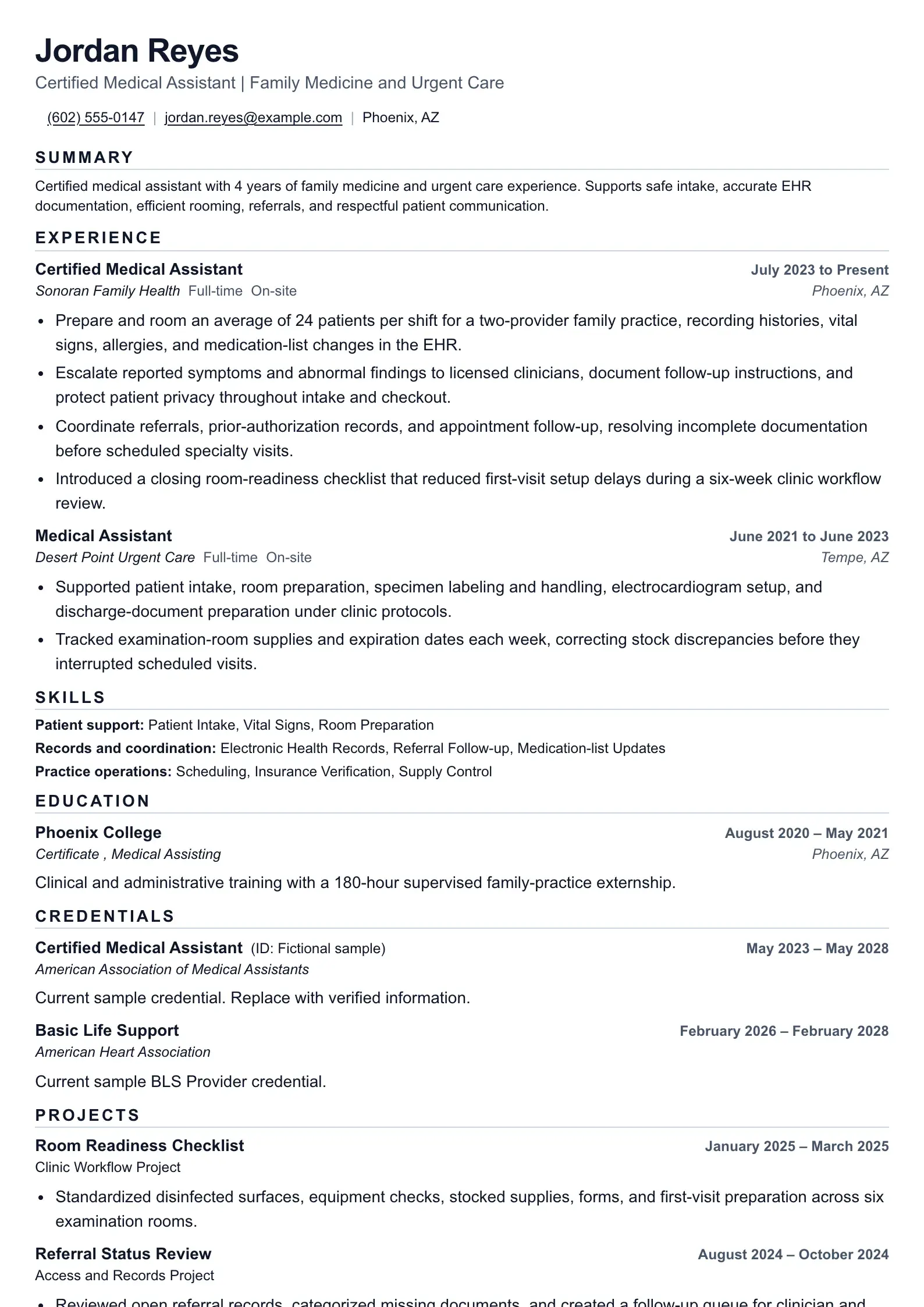
Keep credentials, practice setting, clinical support, records work, and visit-flow evidence easy to review.
Frequently asked questions
- What should a medical assistant put on a resume?
- Show the settings and specialties where you worked, the patient volume you supported, clinical and administrative duties you performed, the electronic health record you used, and current credentials. Keep every task within your training, delegated authority, employer policy, and state law.
- Should I list a medical assistant certification?
- List a current credential with its full name, issuing organization, and expiration or renewal date when applicable. Certification and education requirements vary by employer and state, so do not describe an expired credential as active or imply that one credential grants a broader legal scope.
- How can a new medical assistant write experience bullets?
- Use supervised externship evidence. Name the clinic type, verified hours, patient-flow tasks, documentation system, safety procedures, and feedback or outcomes you can support. Label the experience as an externship rather than paid employment and never invent patient counts.
- Can a medical assistant resume include patient metrics?
- Use aggregate, de-identified measures such as average daily visit volume, chart-completion timeliness, scheduling accuracy, or supply discrepancies resolved. Do not include names, dates of birth, record numbers, rare diagnoses, or details that could identify a patient.

Ready to build your Medical Assistant resume?
Choose sample data or build your own resume, then personalize it before you download.