
An internship resume is not a shortened professional resume. It is a targeted case for potential: you can learn quickly, apply relevant skills, contribute reliably, and begin work with a clear understanding of the role. Hiring teams do not expect every applicant to have held a full-time job. They do expect honest, organized evidence that connects classes, projects, campus work, and volunteering to the internship they need to fill.
For each application, choose one target role such as marketing intern, software engineering intern, research intern, or operations intern. Then organize your strongest evidence around that role. A biology lab report may support a research internship, while a student organization newsletter may better support a communications internship. Do not make recruiters infer the connection.
What Internship Reviewers Look For First
What signals internship readiness
- Hiring signal
- Specific evidence of learning and follow-through
- Evidence to show
- A course project, campus role, or volunteer assignment that names the tool used, the deliverable completed, and the result or audience served.
Place your most relevant project or role before less relevant paid work. A campus help desk position can prove customer communication, ticket tracking, troubleshooting, and documentation for a technical internship. A food-service job can prove reliability, prioritization, and team coordination for an operations internship when written around actual tasks.
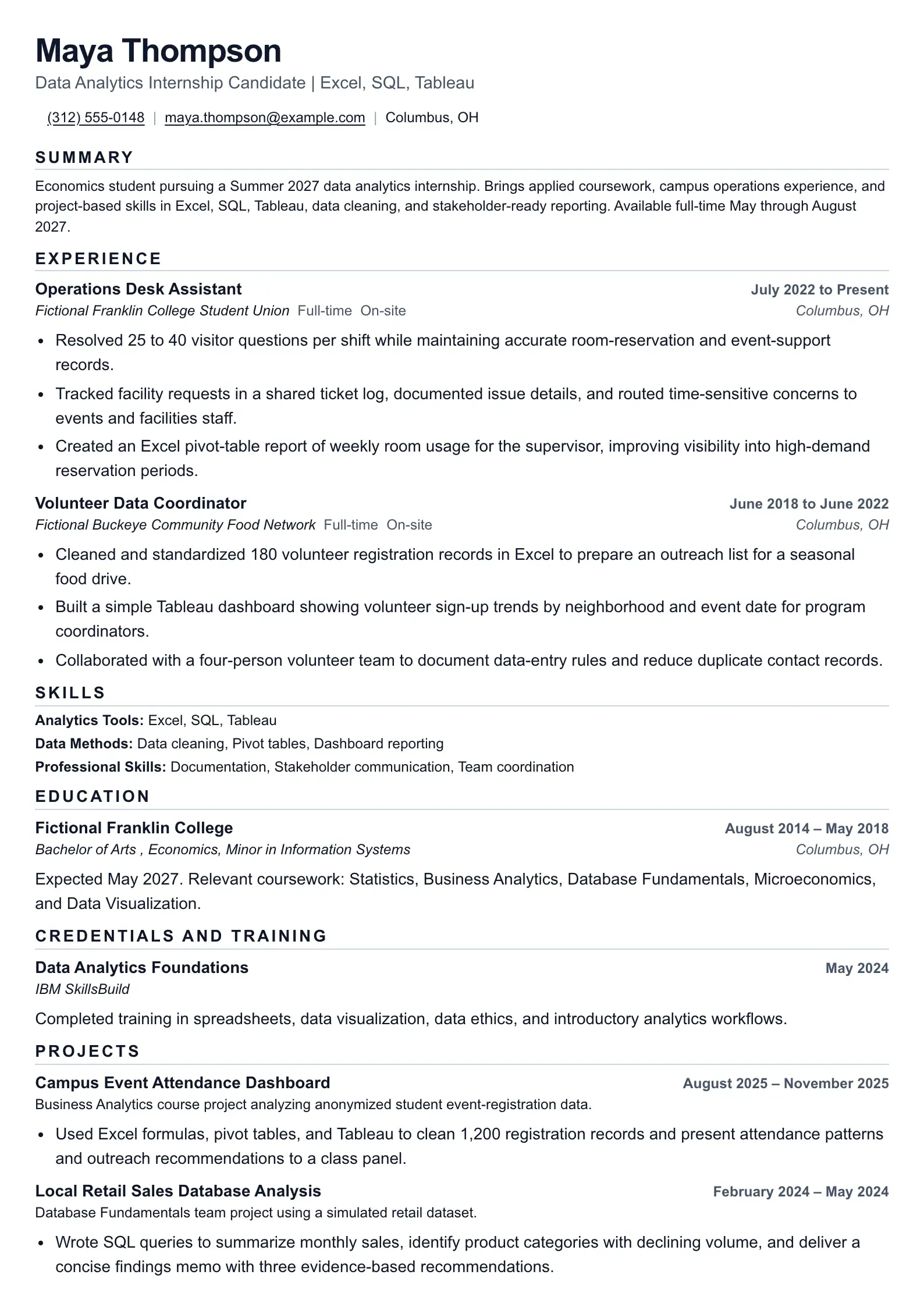
Atlas internship resume
Use a focused one-page structure to connect education, campus experience, projects, and job-specific skills for an internship application.
Early-Career Skills That Need Concrete Proof
Use a skills section to make target-role capabilities easy to find, not to create a long inventory. Pull skills from the internship description and include only tools or methods you can discuss in an interview. For a data-focused internship, this might mean Excel, SQL, Tableau, survey analysis, and presentation development. For a design internship, it might mean Figma, user research, wireframing, accessibility basics, and content collaboration.
Target-role tools
- Excel
- SQL
- Tableau
Analytical methods
- Data cleaning
- Survey analysis
- Dashboard reporting
Working strengths
- Documentation
- Stakeholder communication
- Team coordination
Learning speed matters for internships, but do not merely claim that you are a fast learner. Show it. Mention the unfamiliar platform you learned, the training you completed, the deadline you met, or the deliverable you produced after learning a new process.
Turn Coursework and Projects Into Strong Bullets
Write bullets around evidence, not titles. An internship recruiter needs to know what happened within a class, project, club, or job. Start with an action verb, identify the method or tool, and finish with a concrete output, audience, scale, or result. Metrics are illustrative examples, not industry benchmarks: only use numbers you can explain and verify.
A weak campus job bullet says, “Worked at the student center.” A stronger version identifies the transferable work: “Resolved 25 to 40 visitor questions per shift, updated room-reservation records, and escalated facility issues to the events coordinator.” This demonstrates service, systems use, accuracy, and judgment without overstating authority.
Action
Built a weekly attendance dashboard
Method
cleaning event-registration data in Excel and creating pivot tables
Result
giving the student organization a repeatable report for planning outreach
Use projects as proof of target-role skills. State the problem, your contribution, tools, and output. For group work, distinguish your own work from the team result. “Co-led” is accurate only if you actually shared leadership. If the project did not produce a measurable outcome, use a verifiable deliverable such as a prototype, research brief, process map, presentation, or tested recommendation.
For more help with structure and specificity, review strong resume bullet points. Keep each bullet readable in one or two lines and prioritize the evidence that matches the internship description.
ATS Keywords for Internship Applications
Applicant tracking systems and recruiters both benefit from clear terminology. Read the internship posting closely and collect repeated nouns, tools, methods, and deliverables. Match those terms to real evidence in your resume. If a posting asks for market research, customer insights, Excel, and presentation skills, those exact phrases can appear in your project or campus-work bullets when truthful.
Do not paste a keyword list into a summary or hide terms in white text. That can create a poor reader experience and may be screened out. Instead, place keywords naturally in education, skills, project descriptions, and experience bullets. Use the employer spelling where possible, such as “customer relationship management” and “CRM,” if you have relevant exposure.
Mapping an operations internship posting
| Job requirement | Matching evidence | Keyword |
|---|---|---|
| Excel reporting | Built pivot-table reports for weekly club event attendance | Excel |
| Cross-functional communication | Coordinated room requests with student groups and facilities staff | stakeholder communication |
| Process improvement | Documented a check-in workflow and reduced duplicate entries in a class simulation | process improvement |
Use the guidance in ATS-friendly resumes to preserve simple headings and readable text. Then deepen your terminology choices with this guide to resume keywords. Keywords earn attention only when the surrounding bullet proves them.
How Internship Evidence Supports Seniority Growth
Internship candidates should frame seniority through readiness, not years of experience. A first-year student may lead with foundational coursework, class projects, and campus involvement. A junior or senior may lead with advanced projects, a practicum, research assistance, or a previous internship. A career changer entering an internship can emphasize prior work skills that transfer directly, while being transparent about their learner status in the new field.
The target matters more than your academic year. A computer science student applying for a product internship should not submit only programming evidence. Include user research, product requirements, teamwork, or communication evidence if those appear in the posting. Similarly, a marketing applicant should show writing or campaign analysis, not only broad social media familiarity.
Explain limited experience through selection, not apology. Do not write “no experience” in a summary. Use relevant evidence to show what you have done and what you can contribute on day one with appropriate supervision.
Internship Resume Mistakes That Hide Potential
The most common internship resume mistake is treating every activity as equally relevant. A long list of clubs, courses, and part-time jobs makes it difficult to see your fit for one target internship. Select the evidence that supports the job, then give each chosen item a meaningful bullet. Another frequent error is inflating classroom exposure into professional mastery. Employers can tell the difference between introductory knowledge and independent production work.
Replacing vague student claims
- Why it hurts
- Listing 'hardworking, fast learner, team player' without evidence.
- Better approach
- Replace traits with a project or campus-work bullet that shows a tool learned, a deadline met, a collaborator supported, or a deliverable completed.
Avoid unavailable or uncertain claims. Do not promise a start date, relocation, work authorization status, certification, background clearance, or academic credit arrangement unless you can confirm it. Some internships have employer-specific eligibility rules, and some technical, clinical, financial, or legal settings require training, supervision, or credentials that vary by employer and jurisdiction. State completed training accurately and never imply a license you do not hold.
Frequently asked questions
- What should an internship resume include with little work experience?
- Include education, relevant coursework, projects, campus jobs, volunteer work, technical skills, and concise evidence of results or responsibility.
- Should I include my GPA on an internship resume?
- Include GPA when it is strong, requested by the employer, or relevant to a competitive academic program. Leave it off when it does not strengthen your candidacy.
- How long should an internship resume be?
- Most internship candidates should use one page. Prioritize evidence that directly supports the target internship over older or unrelated activities.
- Can coursework count as experience for an internship?
- Yes. Coursework can demonstrate tools, research, analysis, collaboration, and deliverables when you describe a specific assignment, your contribution, and the outcome.

Ready to build your Internship resume?
Choose sample data or build your own resume, then personalize it before you download.