
An HVAC technician resume should make your diagnostic process visible. A hiring manager needs to know which heating, cooling, ventilation, and refrigeration systems you can service, how you isolate faults, and whether you finish work safely. Put your EPA Section 608 credential, any required state or local license, equipment experience, and service setting near the top.
Do not reduce the job to a list of parts replaced. Strong evidence connects a complaint or maintenance finding to measurements, a confirmed cause, the repair, and a verification step. Use accurate figures from work orders when available, but never invent callback, efficiency, or revenue results.
What HVAC technician hiring managers scan first
The first scan usually checks authorization, relevant equipment, and independent service ability. State the exact Section 608 type you hold. Add state or local licensing only when it applies to you, because requirements differ by jurisdiction. Mention commercial, residential, industrial, or refrigeration work so the reader can judge fit quickly.
Then prove disciplined troubleshooting. Useful details include static pressure, temperature split, superheat or subcooling, electrical readings, combustion analysis, leak detection, control sequences, and manufacturer procedures. Select only methods you actually use, and show that you confirmed operation after the repair.
A measured diagnosis followed by verified operation
- Hiring signal
- The technician can move from a reported symptom to a supported root cause without unsafe guessing or unnecessary parts replacement.
- Evidence to show
- Name the system, readings or test method, fault found, corrective work, and final operational check.
Skills that prove HVAC service capability
Organize skills around real work rather than a single equipment list. Diagnostics can cover electrical circuits, airflow, refrigeration cycle readings, combustion, and controls. Service can cover preventive maintenance, repair, startup, and work-order closeout. Safety includes electrical isolation, personal protective equipment, refrigerant recovery, and jobsite procedures.
Diagnostics
- Electrical testing
- Airflow and static pressure
- Refrigeration cycle readings
Equipment and controls
- Heat pumps and split systems
- Furnaces and rooftop units
- Thermostats and control sequences
Safe service
- Refrigerant recovery
- Electrical isolation
- Work-order documentation
Separate credentials from skills. Section 608 certification is required by federal regulation for technicians who maintain, service, repair, or dispose of equipment in ways that could release regulated refrigerants. Other credentials, apprenticeship requirements, and contractor licenses depend on the work and location.
HVAC technician achievement bullets with credible evidence
A useful bullet begins with the service outcome, then explains the method. You might describe reducing repeat visits, completing a maintenance route, resolving an intermittent fault, improving documentation, or returning critical equipment to service. Clarify whether a number covers your own work, a team, or a defined period.
Before
Repaired air conditioners and performed maintenance for customers.
After
Resolved 38 residential no-cooling calls during the summer service period by testing airflow and electrical components, documenting confirmed faults, and verifying temperature split before closeout.
Why it works
The rewrite defines the workload and diagnostic process without claiming that every call required the same repair or an unsupported business result.
For installation work, show what you personally handled: equipment setting, line sets, condensate, electrical connections, evacuation, startup readings, controls, or customer handoff. For maintenance, describe the inspection standard and issues caught before failure. Use the strong resume bullet points guide to keep action, method, and result together.
ATS keywords for HVAC technician applications
Match the job posting’s equipment and service setting. Common terms can include HVAC service, preventive maintenance, EPA Section 608, refrigeration, heat pumps, furnaces, rooftop units, package units, electrical diagnostics, airflow, static pressure, leak detection, refrigerant recovery, brazing, building automation, and customer service.
HVAC terms to use only when your evidence supports them
- EPA Section 608
- preventive maintenance
- electrical diagnostics
- airflow testing
- refrigerant recovery
- heat pumps
- rooftop units
- service documentation
Write out a credential or technical term once before using an abbreviation. Place high-value terms in the summary, skills, and experience where they read naturally. The guides to resume keywords and an ATS-friendly resume explain how to match language without stuffing.
How HVAC technician evidence changes by seniority
An apprentice or helper should emphasize safety, training hours, supervised tasks, reliable tool use, and accurate readings. A service technician can show independent diagnosis, a wider equipment range, customer explanations, documentation, and dependable closeout. A lead technician or supervisor should add complex troubleshooting, quality review, scheduling, mentoring, and responsibility for service standards.
Do not promote yourself by title alone. If your jurisdiction uses formal apprentice, journeyman, or contractor classifications, state them accurately. Where those classifications do not apply, describe scope through the work you were trusted to complete and the decisions you owned.
HVAC technician resume mistakes that weaken trust
The most damaging mistake is claiming a diagnosis when the bullet only shows a replacement. A reviewer cannot tell whether you identified the fault, followed a dispatch instruction, or swapped parts until the system ran. Add the tests and verification that were truly yours.
Treating Section 608 as a complete HVAC license
- Why it hurts
- Federal refrigerant certification does not automatically satisfy every state, local, contractor, or employer requirement.
- Better approach
- Name the exact Section 608 type, list separate licenses or registrations accurately, and match the posting’s jurisdiction.
Using efficiency claims without measurements
- Why it hurts
- A claim that a repair improved efficiency is hard to defend when no baseline, reading, or utility result is available.
- Better approach
- Report the verified operational reading or documented customer outcome you actually observed, and avoid broader savings claims.
Keep customer and facility information private. Describe equipment, symptoms, tests, and scope without exposing addresses, access details, or proprietary building data.
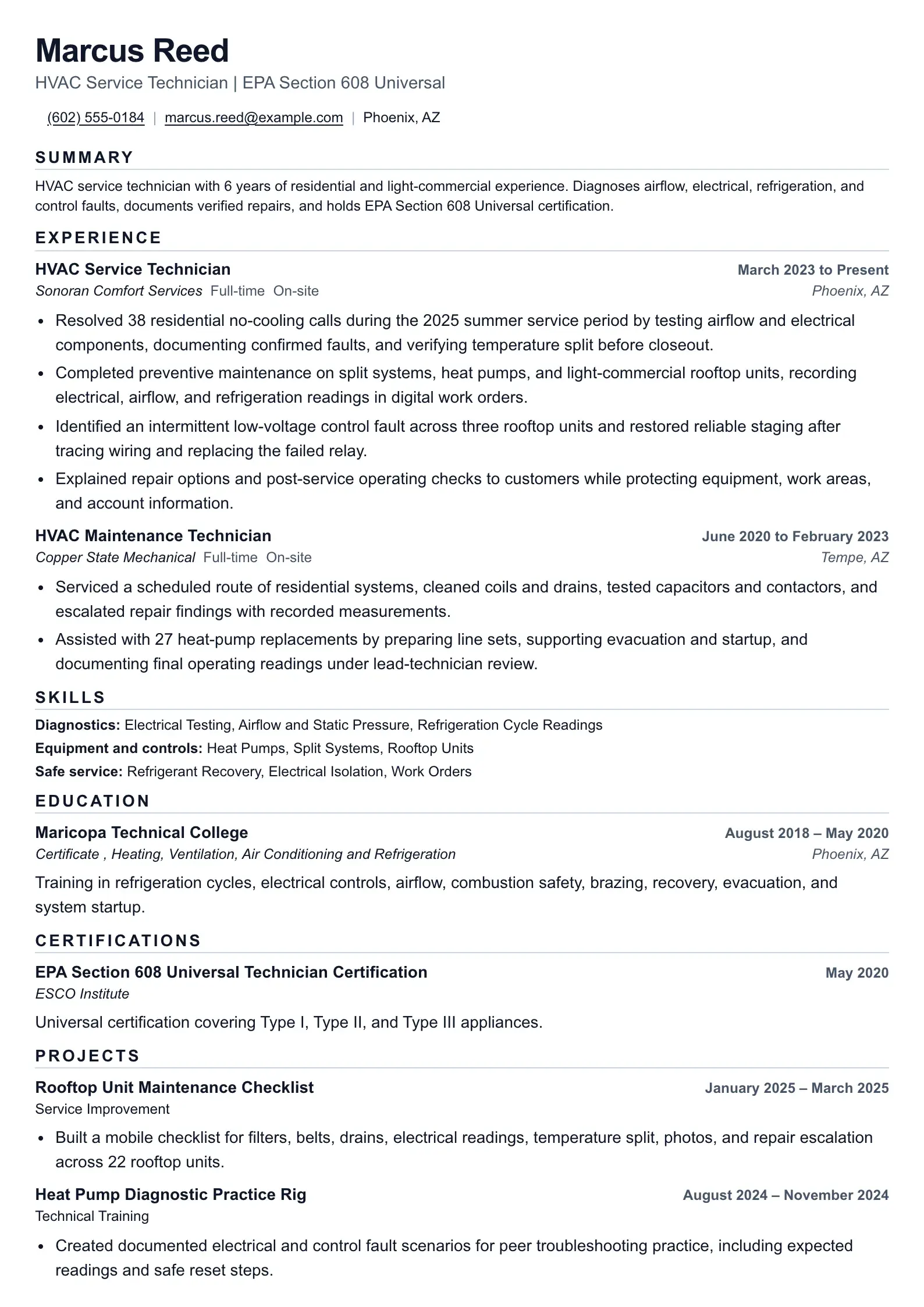
Use this resume template for HVAC technician applications
Keep credentials, equipment experience, diagnostic evidence, and service results easy to scan in a practical single-column layout.
Frequently asked questions
- What should an HVAC technician put on a resume?
- Lead with the systems you service, the settings you know, and evidence of safe diagnosis and repair. Include relevant credentials, refrigerants, controls, test instruments, preventive maintenance, work-order documentation, and customer communication. Support important skills with examples of faults found, work completed, and results verified.
- Where should EPA Section 608 certification appear?
- Place a current EPA Section 608 credential near the top and repeat the correct type in a certification section. Universal, Type I, Type II, and Type III are not interchangeable labels. State only the credential you hold and avoid implying that it replaces a state or local trade license.
- How can an entry-level HVAC technician show experience?
- Use supervised field training, apprenticeship work, labs, maintenance assignments, and ride-alongs. Describe the equipment, readings, safety steps, diagnosis, and verification you performed. Make your level of responsibility clear, especially when a licensed technician approved the repair or handled regulated work.
- Should an HVAC resume list every tool and brand?
- List tools, controls, and manufacturers that match the posting and that you can use competently. Group routine hand tools instead of creating a long inventory. Give more space to diagnostic instruments, building controls, refrigerant practices, and equipment families that distinguish your experience.

Ready to build your HVAC Technician resume?
Choose sample data or build your own resume, then personalize it before you download.