
A strong Home Health Aide and Caregiver resume shows what happened during a visit, how you followed the authorized plan of care, and how you preserved the client’s routines and choices. It is not a nursing resume and should not imply clinical tasks outside your training, delegation, employer policy, or state-specific scope. Frame your work around dependable in-home support, careful observation, and respectful independence.
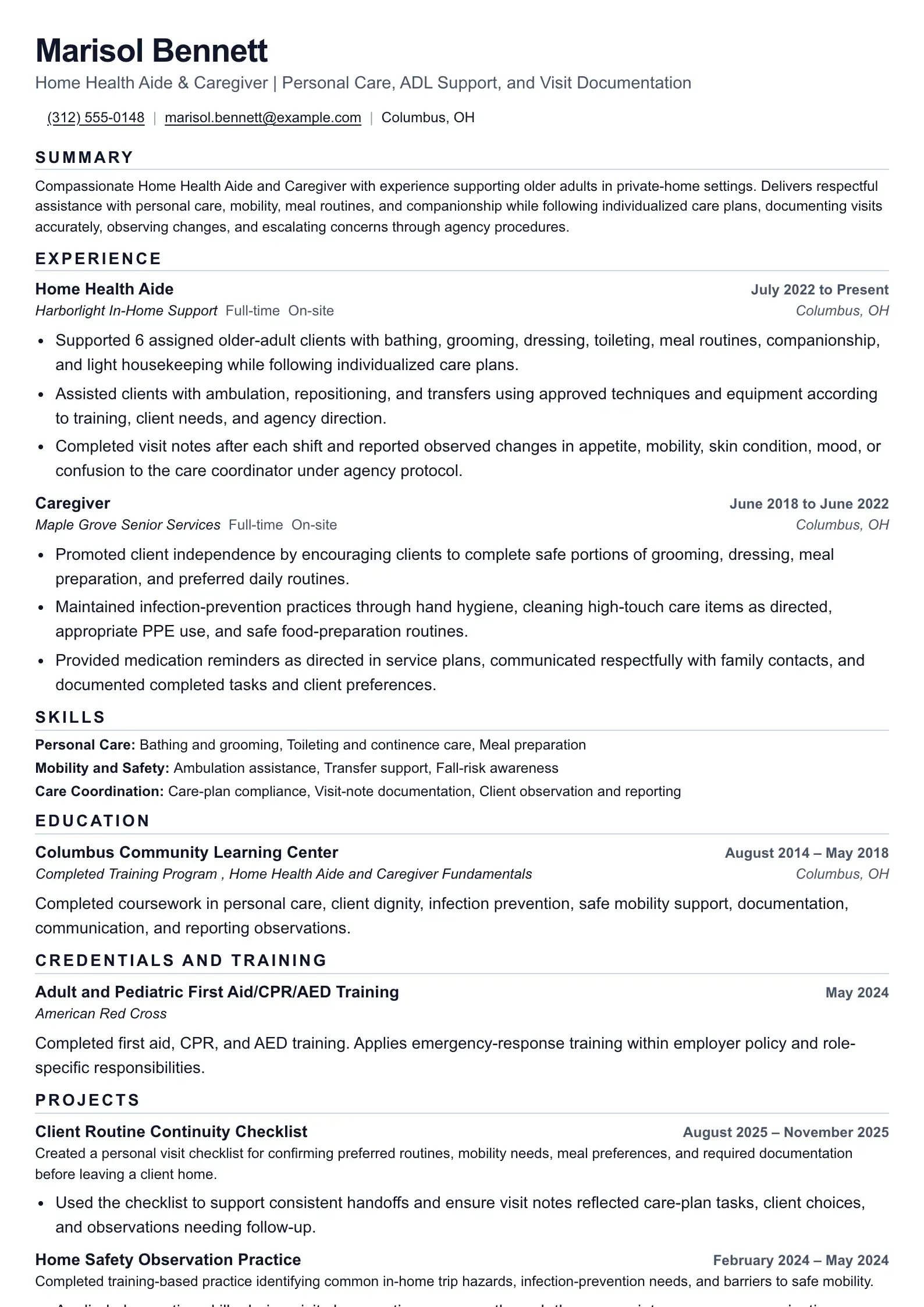
Home Health Aide & Caregiver resume example
See a care-focused resume structure that foregrounds client routines, documentation, and safe in-home support.
What Care Employers Need to See First
A home care supervisor often scans first for proof that you can arrive prepared, complete personal care safely, document the visit, and report changes through the correct channel. Replace broad claims such as “compassionate caregiver” with a brief picture of the client needs you supported: bathing and grooming, toileting, meal preparation, transfers, ambulation, light housekeeping, companionship, and reminders that stayed within the care plan.
What makes a caregiver resume credible
- Hiring signal
- Specific client-support routines tied to observation and timely communication
- Evidence to show
- Assisted assigned older adults with ADLs, noted changes in appetite, mobility, or mood during visits, documented care completed, and escalated concerns to the supervising nurse or coordinator under agency protocol.
Your summary should name the setting and population you know, such as private homes, older adults, or clients with mobility limitations. Then show reliability with evidence: consistent completion of visit notes, clean hand hygiene practices, or clear handoffs to family and care teams. Be precise about medication support. “Provided medication reminders as directed” is safer and more accurate than claiming medication administration unless your verified role and local requirements authorize it.
Caregiving Skills That Need Evidence
Organize skills around the work performed in a client’s home rather than copying a hospital skills list. A hiring manager needs to see that you understand ADLs, fall-risk awareness, infection prevention, documentation, and professional boundaries. Include equipment only when you have been trained to use it and your employer permits it. Mention transfers carefully, such as using a gait belt or transfer device according to the care plan and training.
Personal care and mobility
- Bathing and grooming
- Toileting and continence care
- Ambulation and transfer support
Care coordination
- Care-plan compliance
- Client observation
- Visit-note documentation
Safe home support
- Hand hygiene and PPE
- Meal preparation
- Fall-risk awareness
Match the skill language to the posting without adding tasks you did not perform. For example, a companionship-focused role may value conversation, errands, meal routines, and escorting, while a personal-care assignment may prioritize bathing, repositioning, and mobility support. The common thread is preserving the client’s preferences, privacy, and capacity to do what they can safely do themselves.
Turn Daily Care Into Strong Achievement Bullets
Write bullets that show a repeatable care action, the method you used, and the result for the client or team. Numbers can help when they are real, such as a manageable caseload, completed visits, or documented routines. Do not use made-up percentages or imply that an illustrative number is an industry benchmark. For more structure, review these strong resume bullet points.
Before
Helped elderly clients with daily tasks and kept them company.
After
Supported 6 assigned older-adult clients with bathing, grooming, meal routines, mobility assistance, and companionship while following individualized visit plans and documenting care completed after each shift.
Why it works
The revised bullet identifies client population, ADL support, care-plan compliance, and documentation instead of relying on a vague duty statement.
Action
Supported
Method
individualized ADL routines, safe mobility techniques, and completed visit notes
Result
clients received consistent care while coordinators had timely information for follow-up
Use observation as evidence, not diagnosis. A strong bullet might say you noticed reduced food intake, new unsteadiness, skin concerns, confusion, or a change in mood and reported it according to agency procedure. Avoid saying you diagnosed a condition, changed a treatment, or independently altered the care plan. That distinction helps employers trust both your judgment and your boundaries.
ATS Terms for Home Care Roles
Applicant tracking systems reward clear alignment with the actual home care posting. Use the employer’s terms where they truthfully describe your experience, then place them in your summary, skills, and accomplishment bullets. Read this guide to resume keywords before submitting. It explains why a natural, evidence-based match is stronger than repeating terms in a separate block.
Home Health Aide and Caregiver keywords
- Activities of daily living
- Personal care
- Care plan
- Client observation
- Visit documentation
- Infection prevention
- Mobility assistance
- Medication reminders
- Companionship
- Family communication
Prioritize exact terms in the job description, especially care plan, ADLs, personal care, documentation, and infection control. If the posting requests dementia support, hospice companionship, meal preparation, or transportation, include those only if you have actually performed them. For ATS-safe formatting and readable section structure, use the guidance in this ATS-friendly resume guide.
How Caregiving Evidence Changes With Seniority
An entry-level caregiver can lead with completed training, supervised practice, dependable attendance, personal care routines, and careful reporting. A more experienced Home Health Aide can show a wider variety of client needs, confident adaptation to established routines, family communication, and accurate documentation across multiple visits. Neither level should overstate authority over clinical decisions.
As you advance, your evidence should shift from “assisted with” to “coordinated within the care plan.” For example, an experienced aide may explain how they prepared a home for a safe morning routine, tracked supplies for the next scheduled visit, or gave a coordinator concise observations that supported follow-up. Formal certifications, registries, background checks, and permitted duties vary by state and employer, so list only credentials and scope you can verify.
Caregiver Resume Mistakes That Reduce Trust
A common mistake is presenting caregiving as only warmth and companionship. Empathy matters, but a home care employer also needs evidence of safe hygiene, personal care, respectful boundaries, observation, documentation, and escalation. Another mistake is treating client independence as an obstacle. Show how you encouraged clients to complete the portions of grooming, dressing, mobility, or meals that they could safely manage.
Avoid overstating clinical authority
- Why it hurts
- A resume says the caregiver monitored conditions, administered medications, and revised care plans without defining authorized duties.
- Better approach
- State the observed change, the approved action, and the reporting path: provided reminders as directed, documented observations, and notified the supervising nurse or coordinator under agency protocol.
Also avoid vague safety claims such as “maintained a safe environment.” Name the practice: hand hygiene before and after care, PPE use when required, clearing trip hazards, checking mobility equipment according to training, or following food-safety routines. These details differentiate an in-home caregiver from a general housekeeper, sitter, or hospital support worker.
Frequently asked questions
- What should a Home Health Aide resume emphasize?
- Emphasize direct personal care, safe assistance with activities of daily living, care-plan compliance, observations, accurate documentation, infection prevention, and respect for client choice.
- How can a caregiver show results without exaggerating metrics?
- Use concrete examples such as the number of assigned clients, visit documentation completion, timely escalation of observed changes, or routines supported. Label all metrics accurately and never present illustrative figures as benchmarks.
- Should Home Health Aides list certifications?
- List completed training and credentials that you genuinely hold, such as CPR or first aid. Home health aide certification, registration, and scope requirements vary by state, payer, employer, and care setting.
- What keywords matter for a caregiver ATS scan?
- Use terms from the posting when accurate, including personal care, ADLs, care plan, client observation, visit notes, infection control, medication reminders, mobility assistance, companionship, and caregiver communication.

Ready to build your Home Health Aide & Caregiver resume?
Choose sample data or build your own resume, then personalize it before you download.