
A Firefighter resume must show more than courage or availability. It should establish that you can operate safely within a crew, apply department procedures, maintain apparatus readiness, support patient care within your authorized scope, and document the work that keeps a station prepared for the next call. Hiring teams look for evidence that your judgment holds up during routine checks, live-fire drills, medical responses, prevention activities, and multi-unit incidents.
What Fire Service Panels Assess First
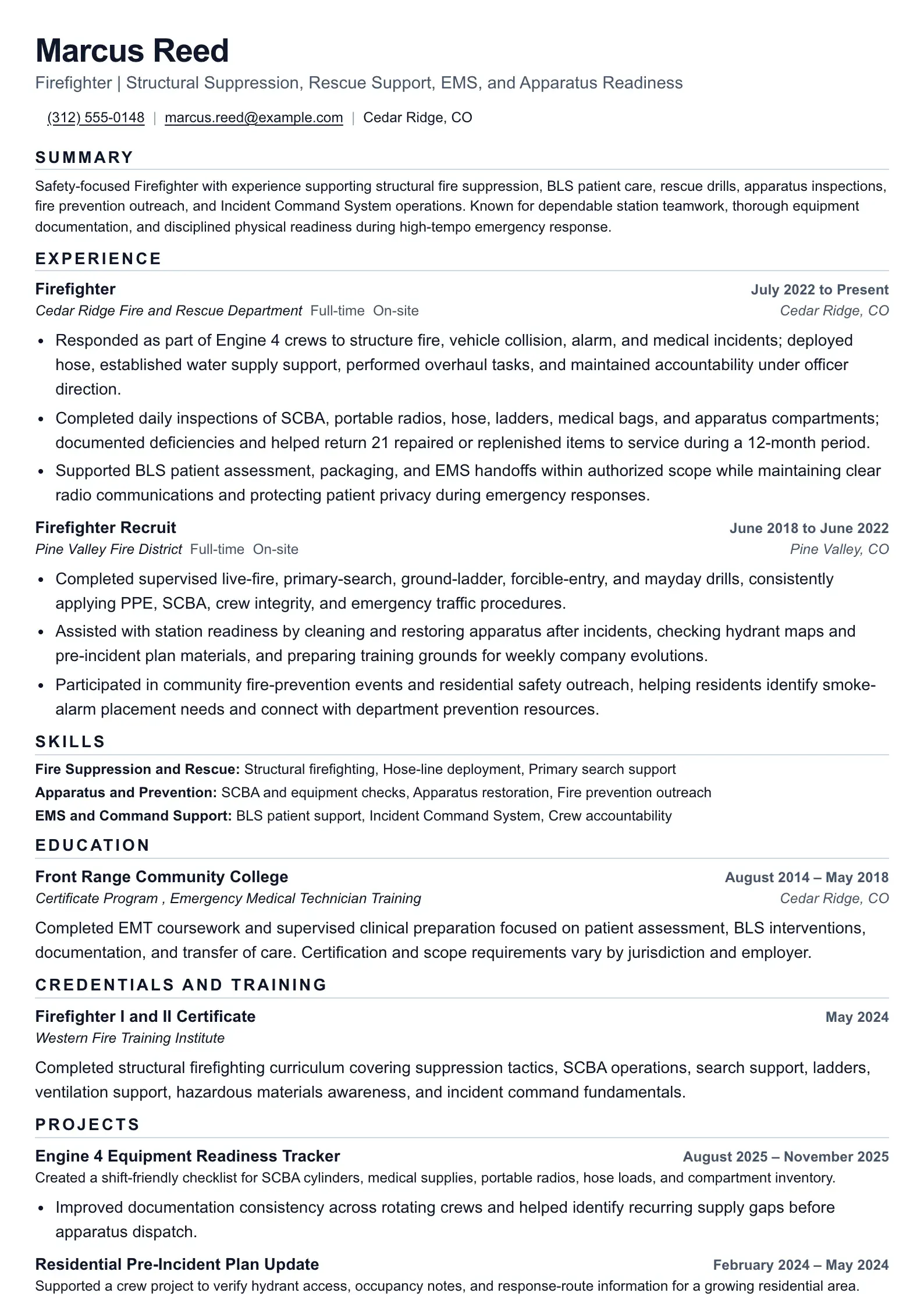
Firefighter resume example for operational evidence
Use this Firefighter example to organize suppression, rescue, apparatus checks, EMS support, and station-readiness accomplishments.
What makes a Firefighter candidate credible
- Hiring signal
- Specific operational evidence is stronger than broad claims such as dedicated first responder.
- Evidence to show
- Name the apparatus or equipment checked, the drill objective, the incident assignment, the command framework used, and the readiness outcome achieved with your crew.
For career Firefighter roles, distinguish supervised assignments from lead responsibilities. A firefighter may report to an officer under an incident action plan, while an acting officer may coordinate a company task, complete accountability checks, and communicate updates within department policy. That distinction protects your credibility and helps a panel assess your actual command readiness.
Firefighter Skills to Ground in Readiness
Group skills by fireground function rather than placing a long unfiltered list under a single heading. A department needs to see whether you can contribute to hose-line deployment, search, ladder work, forcible entry support, apparatus checks, EMS handoffs, and station operations. Include software or reporting systems only if you used them in a fire service setting, such as inspection reporting, pre-plan mapping, or inventory tracking.
Suppression and rescue
- Structural firefighting
- Primary search support
- Hose-line deployment
- Ground ladder operations
Readiness and prevention
- Apparatus inspections
- SCBA checks
- Hydrant familiarization
- Fire prevention inspections
EMS and command support
- BLS patient support
- Incident Command System
- Radio communications
- Crew accountability
Physical readiness belongs on a Firefighter resume when supported by relevant proof. Mention successful academy physical training, department fitness testing where disclosure is appropriate, stair-climb conditioning, hose advancement practice, or participation in job-task drills. Do not report medical information or present a fitness activity as a formal qualification unless the employer recognizes it that way.
Write Bullets Around Response and Preparedness
Write each Firefighter bullet as a short operational record. Start with an action, identify the method or environment, and close with a tangible result. The result can be readiness, safer workflow, faster correction of an equipment deficiency, stronger drill consistency, or better prevention follow-through. Metrics should be accurate illustrations from your own records, not industry benchmarks or estimates.
A weak bullet says: Assisted with fire calls and equipment maintenance. It does not show assignment, technical work, or outcome. A stronger bullet gives the panel enough context to understand your contribution without exposing sensitive incident information.
Before
Assisted with emergency calls and maintained fire equipment.
After
Completed daily SCBA, portable radio, hose, and medical-bag checks for Engine 4; documented deficiencies and helped return 18 corrected items to service during a six-month period.
Why it works
The revised bullet identifies the apparatus assignment, inspection scope, documentation practice, and a clearly illustrative readiness result.
Use the same approach for suppression and rescue evidence. For example, describe deploying a backup line under officer direction, assisting with victim search during training or incidents, establishing a water supply, conducting post-incident apparatus restoration, or supporting BLS assessment and transfer of care. Review the guidance on strong resume bullet points when converting routine station tasks into concise evidence.
Avoid claiming that you commanded an incident when you served in a firefighter role. Instead, state that you operated within ICS, maintained accountability, relayed conditions to your officer, or led an assigned drill station when authorized. This phrasing shows command discipline and preserves a clear chain of responsibility.
ATS Keywords for Firefighter Roles
Applicant tracking systems and human reviewers both search for the vocabulary used in job announcements. Pull exact terms from the target department posting, especially apparatus types, emergency medical level, rescue disciplines, inspection duties, and incident management expectations. Use the terms only where your experience, training, or certification supports them. Read more about matching language responsibly in this guide to resume keywords.
Firefighter ATS keywords to validate against your experience
- Fire suppression
- Structural firefighting
- Emergency medical services
- Incident Command System
- SCBA inspection
- Apparatus maintenance
- Fire prevention
- Public education
- Technical rescue
- Hazardous materials awareness
- Crew accountability
- Pre-incident planning
Place important keywords in your headline, summary, skills, and experience bullets rather than repeating them unnaturally. If a posting requires an EMT credential, list the credential with issuer and status where permitted. If a requirement is pending, describe it accurately as completed coursework, scheduled examination, or eligibility only when that statement is true.
How Fire Service Evidence Changes With Seniority
A recruit, Firefighter, senior Firefighter, and company officer can all use the same resume structure, but the evidence should mature with responsibility. Recruit-level candidates should emphasize academy performance, supervised evolutions, safety habits, and coachability. Career Firefighters should show reliable incident assignments, equipment readiness, prevention participation, and station teamwork. Senior personnel should demonstrate mentoring, operational planning support, specialized rescue capability, and acting leadership authorized by the department.
For an officer-track application, connect command evidence to decisions you actually made: assigning drill rotations, checking accountability status, coordinating apparatus restoration, briefing crews on a pre-plan, or communicating tactical updates to an incident commander. State whether the work occurred as acting officer, training lead, apparatus operator, or assigned firefighter. This is more persuasive than using leadership labels without fireground context.
Tailor the amount of detail to the role. A municipal department may value prevention inspection and EMS integration, while an industrial brigade may prioritize process hazards, foam systems, confined-space rescue, and mutual-aid coordination. Use an ATS-friendly resume structure so these job-specific terms remain readable and searchable.
Firefighter Resume Mistakes That Weaken Readiness
Do not turn a Firefighter resume into a list of dramatic incidents. Panels need proof of disciplined routine work because station checks, training, documentation, prevention, and rehabilitation procedures directly support safe emergency operations. Also avoid naming patients, addresses, protected medical details, or incident facts that should remain confidential under department policy.
Replace vague hero language with safe operational proof
- Why it hurts
- The resume says fearless firefighter who thrives under pressure, but gives no evidence of safe assignments, crew coordination, or equipment readiness.
- Better approach
- Describe a specific duty such as completing SCBA checks, supporting a primary search drill, preparing a medical bag, updating a pre-plan, or restoring an apparatus after a response. Identify your authorized role and the readiness result.
Another frequent error is overstating qualifications. Do not label yourself paramedic, driver operator, technical rescue technician, fire inspector, or incident commander unless you hold the applicable credential, assignment, and authority required by the jurisdiction or employer. If you completed awareness-level training, list it at that level. Accurate scope language signals professionalism.
Frequently asked questions
- What should a Firefighter put first on a resume?
- Lead with a Firefighter headline and summary that identify your suppression, rescue, EMS support, apparatus readiness, and incident command experience. Put current certifications and jurisdiction-required credentials near the top when they are relevant to the target department.
- How can an entry-level Firefighter show experience without career firehouse tenure?
- Use academy evolutions, supervised department drills, EMT clinical support, wildland assignments, prevention inspections, apparatus familiarization, volunteer service, and documented physical-readiness training. State your role precisely and do not imply independent authority you did not hold.
- Should Firefighter resumes include incident metrics?
- Yes, when records permit and the numbers are accurate. Good examples include inspected equipment counts, drill participation, pre-incident plan updates, hydrant checks, patient-care support volume, or inspection findings corrected. Protect patient privacy and avoid publishing sensitive incident details.
- Do Firefighter certifications vary by department or state?
- Yes. Firefighter, EMT, driver operator, wildland, technical rescue, hazardous materials, and incident command requirements can vary by state, local authority, collective bargaining agreement, and employer policy. List only active or completed credentials and identify their issuing organization.

Ready to build your Firefighter resume?
Choose sample data or build your own resume, then personalize it before you download.