
A current federal resume for USAJOBS must fit within two pages. USAJOBS says federal agencies began accepting resumes of no more than two pages on September 27, 2025, so older advice recommending a routine four-page or five-page federal resume is no longer safe. Always follow the live vacancy announcement and application instructions.
Two pages do not turn a federal resume into a vague private-sector summary. It still must establish qualifications clearly. The job announcement determines the specialized experience, grade, competencies, eligibility, education, licenses, and documents that matter.
What federal hiring reviewers scan first
Reviewers need to determine whether the application meets the announced requirements. Start with the qualifications and specialized-experience sections, then connect your work directly to those requirements. Use exact month and year dates, employer and role details, and hours per week when the announcement or USAJOBS instructions require them.
Specialized experience at the required level
- Hiring signal
- The resume shows work comparable in complexity and responsibility to the announcement's qualifying experience, not just exposure to related topics.
- Evidence to show
- Use a recent example with the problem, your authority, the work performed, stakeholders, scale, and verified result.
A complete, internally consistent application
- Hiring signal
- Resume dates, hours, duties, grade-related scope, eligibility answers, questionnaire responses, and supporting documents agree.
- Evidence to show
- Check every claim against employment records, transcripts, licenses, performance records, and the announcement before submission.
Do not assume a keyword alone proves qualification. A sentence stating that you know acquisition, grants, cybersecurity, or program management is weaker than a concise example showing what you did and at what level.
Skills that prove federal qualifications
Build the skills section from the announcement, but reserve space for evidence. Depending on the role, useful groups might cover program operations, technical methods, statutes or policy, stakeholder service, written analysis, data systems, supervision, or financial stewardship. Use only competencies you can defend in an assessment or interview.
Map the announcement before drafting
| Job requirement | Matching evidence | Keyword |
|---|---|---|
| Specialized experience | Led a defined workstream, applied the named policy or technical method, resolved exceptions, and documented the result | program analysis |
| Communication competency | Prepared decision material for named stakeholders and converted their feedback into an approved action | written communication |
| Grade-level responsibility | Showed independent judgment, scope, consequence, and review level rather than relying on the former job title | independent analysis |
Check eligibility and documents separately
| Job requirement | Matching evidence | Keyword |
|---|---|---|
| Who may apply | Selected the correct hiring path and supplied the requested proof, such as an SF-50 or veteran document, when applicable | eligibility |
| Education or credential substitution | Listed the qualifying degree, coursework, license, or transcript exactly as the announcement requires | education requirement |
Never use the skills section to conceal a missing requirement. If qualifying education, certification, citizenship, clearance, or experience is mandatory, the application must support it in the requested location and format.
Federal resume achievement bullets with credible evidence
Compact federal bullets should still show context. State the action, governing requirement or method, scale, authority, and outcome. Spell out unfamiliar internal abbreviations. Quantify dollars, cases, people, cycle time, backlog, error rate, compliance findings, or service levels only when the figure is documented.
Before
Responsible for reviewing program applications and communicating with stakeholders.
After
Reviewed 86 grant applications against published eligibility and documentation criteria, resolved 31 incomplete submissions with state partners, and prepared decision summaries for the selecting official before the fiscal-year deadline.
Why it works
The revision shows the rule-based work, volume, partner interaction, deliverable, and deadline without claiming the selecting official's authority.
The strong resume bullet points guide helps compress evidence. Remove repeated context across bullets and keep the strongest examples that collectively cover the announcement.
ATS keywords matched to the USAJOBS announcement
Federal applications are reviewed against the actual vacancy, not a universal list. Pull language from duties, qualifications, specialized experience, competencies, and assessment questions. Use exact terms naturally where your evidence supports them. Do not copy entire sentences or rate yourself above what your resume proves.
The resume keywords guide explains evidence-led matching. The ATS-friendly resume guide can help with readable headings, but the federal announcement takes priority over general formatting advice.
How federal resume evidence changes by seniority
Early-career applicants can use qualifying education, internships, volunteer service, military experience, or entry-level work when the announcement permits it. Mid-career applicants should foreground independent work and job-relevant results. Senior applicants need to show program scope, leadership, policy judgment, resources, and organizational outcomes without crowding the resume with an entire career history.

Cut for qualification, not chronology
Keep the recent examples that prove the announced specialized experience and grade. Compress older relevant roles, remove unrelated early work, and use the application fields or required documents for information that does not need narrative space.
Federal resume mistakes that can cost consideration
Submitting an old five-page document is now a direct risk. Rebuild it around the two-page limit instead of reducing the font, margins, or line spacing until the file becomes hard to read.
Following outdated long-form federal resume advice
- Why it hurts
- Legacy guidance often encouraged exhaustive duty narratives across four or five pages, but current USAJOBS instructions limit accepted resumes to two pages.
- Better approach
- Start from the live announcement, retain only qualification evidence, use concise bullets, and verify the final uploaded file has two pages.
Treating the questionnaire as separate from the resume
- Why it hurts
- A high self-rating that is not supported by duties and accomplishments can create an inconsistency during qualification review.
- Better approach
- Answer accurately, then confirm that the resume contains clear evidence for every material level you selected.
Remove sensitive data that is not requested, including Social Security numbers and photographs. Confirm the closing time, accepted file type, page count, required documents, and application status before the deadline. Save the announcement because it may no longer be available after closing.
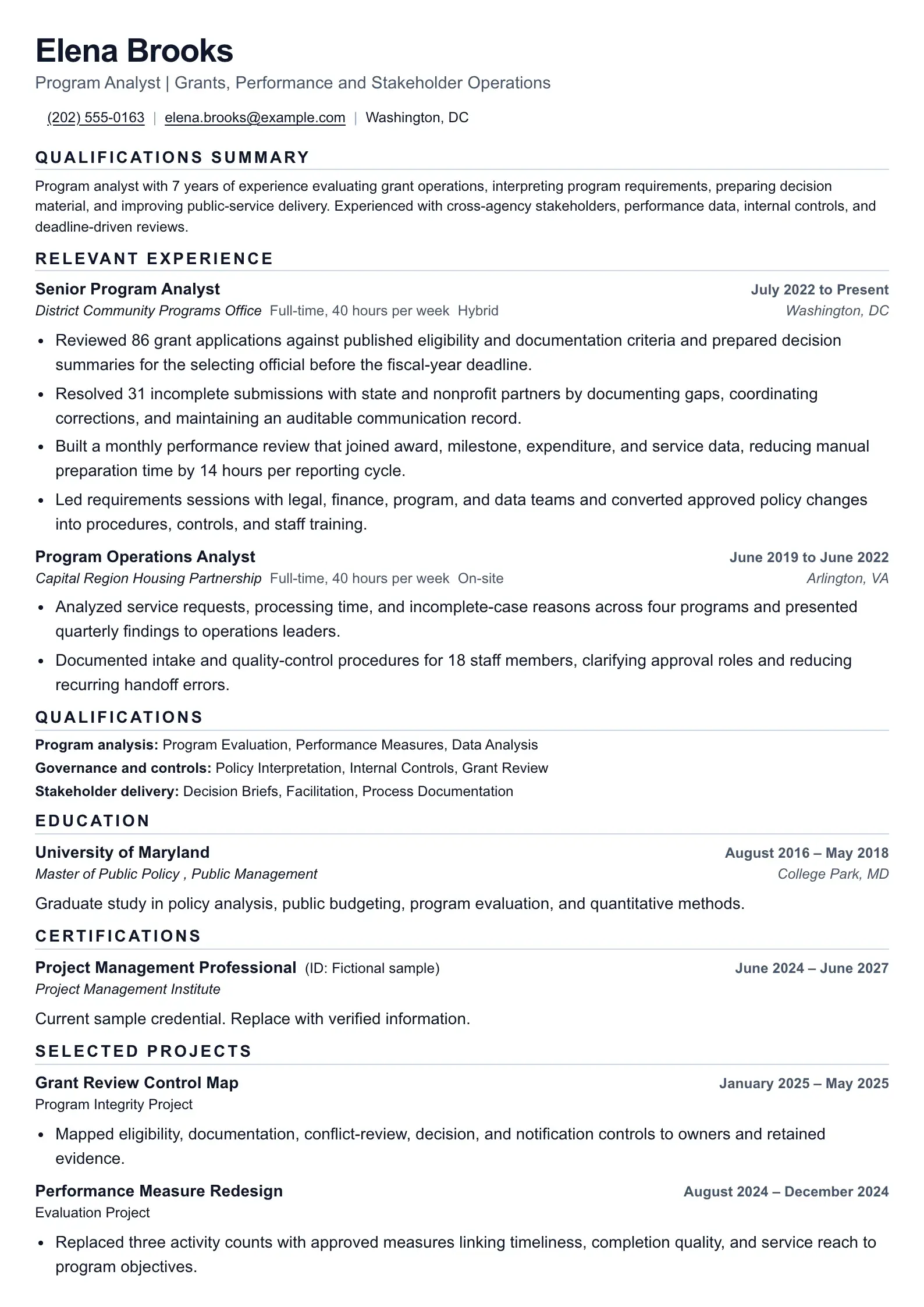
Use this resume template for a two-page federal application
Organize specialized experience, complete work details, qualifications, education, and credentials within the current USAJOBS limit.
Frequently asked questions
- Are federal resumes now limited to two pages?
- USAJOBS states that federal agencies only accept resumes up to two pages. The change took effect on September 27, 2025. Read the current announcement and agency instructions before applying because required documents, assessments, and submission methods can differ.
- What information belongs in a USAJOBS resume?
- Include contact details, relevant work history with month and year dates, hours worked per week when requested, clear duties and accomplishments, education, and job-related credentials. The announcement controls. Supply every required detail and supporting document without adding sensitive information that was not requested.
- How do I prove specialized experience in two pages?
- Start with the qualifications section of the announcement. For each required area, choose one or two recent examples that show the task, level of responsibility, method, and result. Remove unrelated history, repeated duties, broad objectives, references, and unsupported claims before shrinking the type.
- Can I use the same federal resume for every vacancy?
- Use a reliable base document, but tailor each submission to the announcement. Specialized experience, grade level, competencies, conditions of employment, eligibility questions, and required documents change by vacancy. Your resume and questionnaire answers must agree and remain fully supportable.
Ready to build your Federal Resume resume?
Choose sample data or build your own resume, then personalize it before you download.