
An Emergency Medical Technician resume earns attention when it makes your clinical judgment visible without exceeding your authorized scope. Democruit employers need evidence that you can assess a changing patient, use protocols and medical direction, deliver safe basic life support, select an appropriate transport response with your partner and dispatch resources, and document the encounter clearly. This guide focuses on the field work that separates EMT candidates from adjacent medical support roles.
What EMS Employers Verify First
An EMS supervisor often scans an EMT resume for immediate operational readiness. Put your current credential status, CPR status, and service area authorization near the top, but qualify each item accurately because state licensure, county credentialing, employer onboarding, and protocol privileges vary. A National Registry credential does not by itself confirm authority to practice in every jurisdiction.
Your summary should connect assessment to action. State the environments where you worked, such as 911 response, interfacility transport, event medicine, or mixed deployment. Then name the work: primary and secondary assessment, vital-sign trending, airway support within scope, bleeding control, splinting, patient movement, radio reports, and electronic patient care reports. A hiring manager should not have to infer that your customer-service position included patient care.
What EMS supervisors look for first
- Hiring signal
- A candidate can explain how assessment findings changed care, transport, notification, or documentation.
- Evidence to show
- Use bullets that pair a patient presentation with protocol-guided EMT interventions, medical direction when used, destination or transport reasoning, and a concise transfer-of-care report.
Use a targeted headline rather than a vague objective. For example, write “EMT | 911 and interfacility transport | BLS assessment, trauma care, ePCR documentation” only if those claims match your experience. For a first EMT job, use supervised clinical and ride-along evidence honestly. Label field training as supervised, name the setting, and identify what you performed under preceptor or instructor direction.
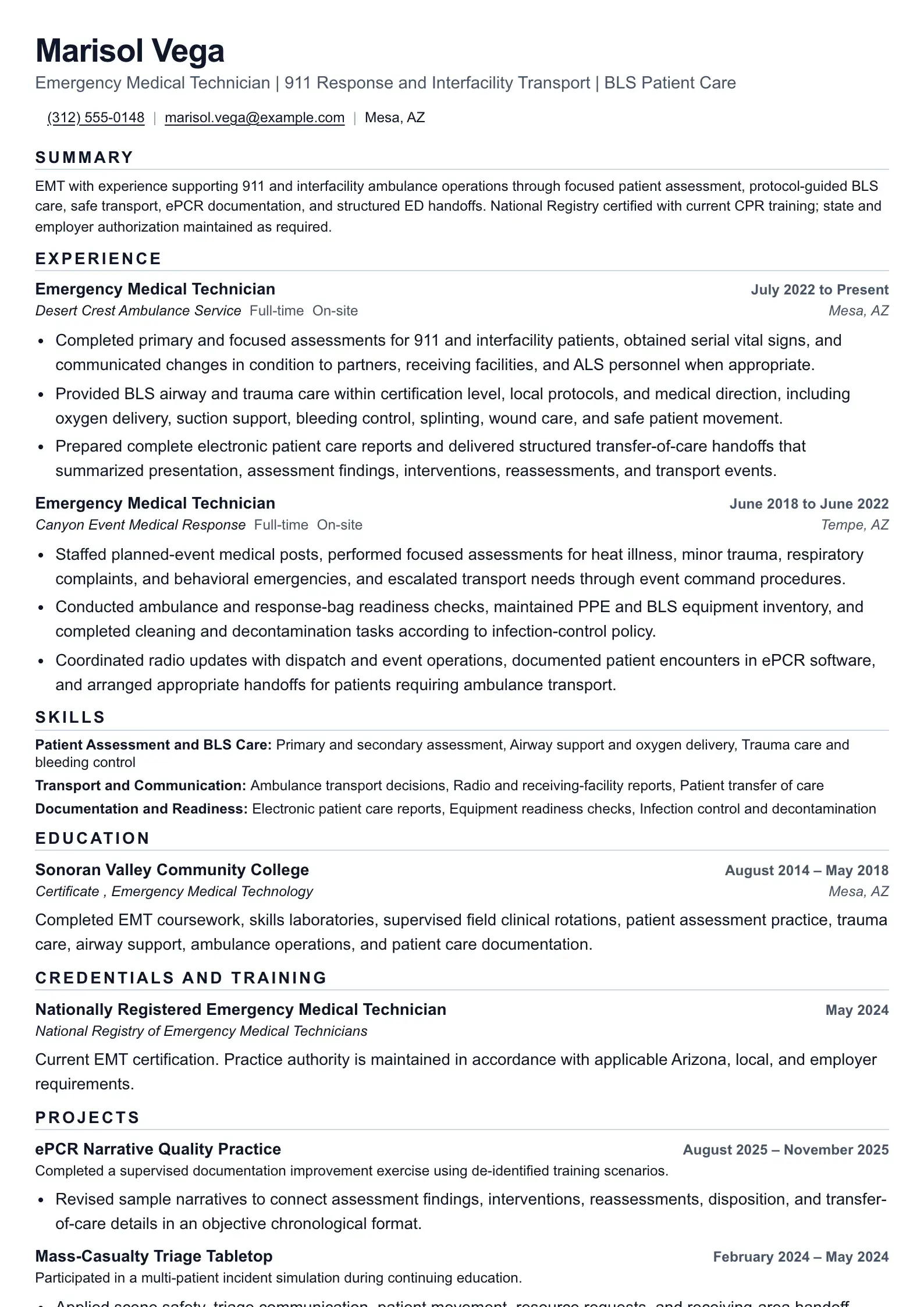
Emergency Medical Technician resume example
A focused EMT resume for demonstrating protocol-guided patient care, transport communication, documentation, and continuing education.
EMT Skills to Show Within Scope
Operational skills matter because patient care happens inside a coordinated system. Include dispatch interpretation, radio communication, ambulance readiness checks, equipment decontamination, destination coordination, lift-assist ergonomics, and ePCR completion. If you supported ALS, state that you assisted with tasks delegated within your role and documented your observations. Do not convert that support into a claim that you independently performed paramedic-level interventions.
For each skill group, decide whether you have a proof point. “Airway management” is stronger when your experience explains that you assessed respiratory effort, applied oxygen or assisted ventilation within protocol, reassessed response, and communicated changes to the receiving team. Read the target posting alongside this guide to an ATS-friendly resume so the vocabulary remains readable to both software and EMS leaders.
Write Bullets Around Assessment and Handoff
EMT bullets should show a call-related decision chain. Start with a clear action, add the assessment or protocol context, then close with a patient-care, communication, safety, or documentation outcome. Do not use patient names, dates of birth, addresses, incident numbers, or details that could identify a patient.
Before
Responded to emergency calls and helped patients.
After
Completed primary and focused assessments on 911 and interfacility patients, provided BLS airway and trauma interventions within protocol, and delivered structured handoffs to ED staff.
Why it works
The revised bullet names the assessment work, limits interventions to scope and protocol, and shows the handoff destination instead of making an unsupported claim about outcomes.
Action
Performed a focused assessment and BLS intervention
Method
Using local protocols, partner coordination, equipment checks, reassessment, and medical direction when indicated
Result
Supported safe transport decisions, complete ePCR narratives, and a concise transfer of care at the receiving destination
For more structures that keep clinical claims precise, use the EMT examples in strong resume bullet points. Every bullet should be defensible in an interview through a de-identified scenario.
ATS Keywords for EMT Positions
Use the exact language in the employer posting when it accurately reflects your training and experience. EMS employers may search for credential names, response environments, electronic documentation systems, transport terminology, clinical procedures, and compliance duties. Repeat core terms naturally in your headline, summary, skills, and experience rather than placing them in an unreadable keyword block.
EMT keywords to match when accurate
- Emergency Medical Technician
- EMT
- BLS
- patient assessment
- primary survey
- secondary assessment
- airway management
- oxygen therapy
- trauma care
- bleeding control
- splinting
- ambulance transport
- interfacility transport
- medical direction
- ePCR
- patient care report
- transfer of care
- radio communication
- infection control
- NREMT
A posting may require “state EMT license,” “county accreditation,” “ambulance driver clearance,” or a specific ePCR platform. Include these only when current and applicable, and use wording that matches the jurisdiction. Review how systems interpret terms in this explanation of resume keywords. Avoid inserting ALS medications, intubation, diagnosis, or independent treatment decisions unless your certification, protocols, and documented role clearly support those claims.
How EMT Evidence Grows With Seniority
At the entry level, employers expect proof of safe fundamentals. Lead with EMT education, supervised clinical rotations, ride time, current certifications, patient assessment practice, infection control, stretcher operations, and ePCR exposure. A student should describe supervised tasks in a way that makes the preceptor relationship clear.
An experienced EMT should show dependable independent performance within EMT scope: managing scene tasks with a partner, prioritizing assessment, reassessing during transport, communicating with dispatch and receiving facilities, maintaining unit readiness, and writing complete narratives. Add examples of supporting new employees, participating in quality assurance feedback, or contributing to station training only when you actually held those responsibilities.
For a lead EMT, field training officer, or operations-oriented opening, elevate evidence of coaching, protocol updates, supply control, vehicle checks, documentation quality, and cross-agency coordination. Leadership does not mean claiming authority that belongs to medical directors, paramedics, supervisors, or incident command. Explain your contribution to the team and the escalation path you followed.
List completed, relevant courses such as trauma refreshers, pediatric assessment, behavioral emergency de-escalation, emergency vehicle operations, mass-casualty preparedness, or ePCR documentation training. Include completion dates when helpful and avoid presenting an expired course as current authorization.
EMT Resume Mistakes That Raise Clinical Concerns
Do not overstate EMT authority
- Why it hurts
- A resume says the EMT diagnosed conditions, administered unrestricted medications, chose all destinations independently, or performed advanced airway procedures without showing the required credential and protocol authority.
- Better approach
- Describe observable findings, EMT-level interventions, consultation with medical direction or higher-level clinicians when applicable, partner coordination, and the documented transport or handoff process. State credentials and authorization precisely.
Another frequent problem is treating documentation as an afterthought. Patient care reports are legal and clinical records, and employers want candidates who can produce timely, objective narratives. Mention relevant ePCR systems only if you used them, and show that your report included assessment findings, interventions, reassessments, disposition, signatures, and transfer-of-care details according to service policy.
Avoid using hospital-centered language to describe ambulance work. EMTs operate in uncontrolled scenes, manage safe movement and transport, communicate over radio and phone channels, and transfer care across agencies and facilities. Also avoid a long “medical skills” list with no context. One accurate trauma or respiratory-care bullet tied to assessment, protocol, reassessment, transport, and handoff is more persuasive than twenty unsupported procedures.
Frequently asked questions
- What should an EMT put on a resume?
- An EMT resume should show patient assessment, protocol-guided airway and trauma care, transport decisions, medical direction communication, patient care reports, handoffs, and current certifications.
- How should an EMT describe clinical skills without overstating scope?
- Name the intervention, the applicable protocol or medical direction, the patient condition, and the documented handoff. Avoid claiming independent diagnosis, medication authority, or procedures outside your certification and local scope.
- Should EMT students include ride-along experience?
- Yes. Identify it as supervised field clinical experience and describe assessments, reports, observations, and skills completed under preceptor or instructor direction.
- Which certifications belong near the top of an EMT resume?
- List the credential required by the target employer, such as NREMT certification where applicable, state or local EMT authorization where applicable, CPR credentials, and relevant completed continuing education.

Ready to build your Emergency Medical Technician resume?
Choose sample data or build your own resume, then personalize it before you download.