
A data scientist resume should demonstrate judgment across the full analytical lifecycle, not simply name algorithms. The strongest evidence explains why a problem needed prediction, estimation, experimentation, or segmentation, then shows how you built a credible answer and helped a team use it.
Give each project a defensible frame. State the baseline, relevant data, validation design, chosen metric, constraint, and result. If a model entered production, explain monitoring and collaboration with engineering or product partners. If it remained a study, describe the decision or next experiment it informed without implying deployment.
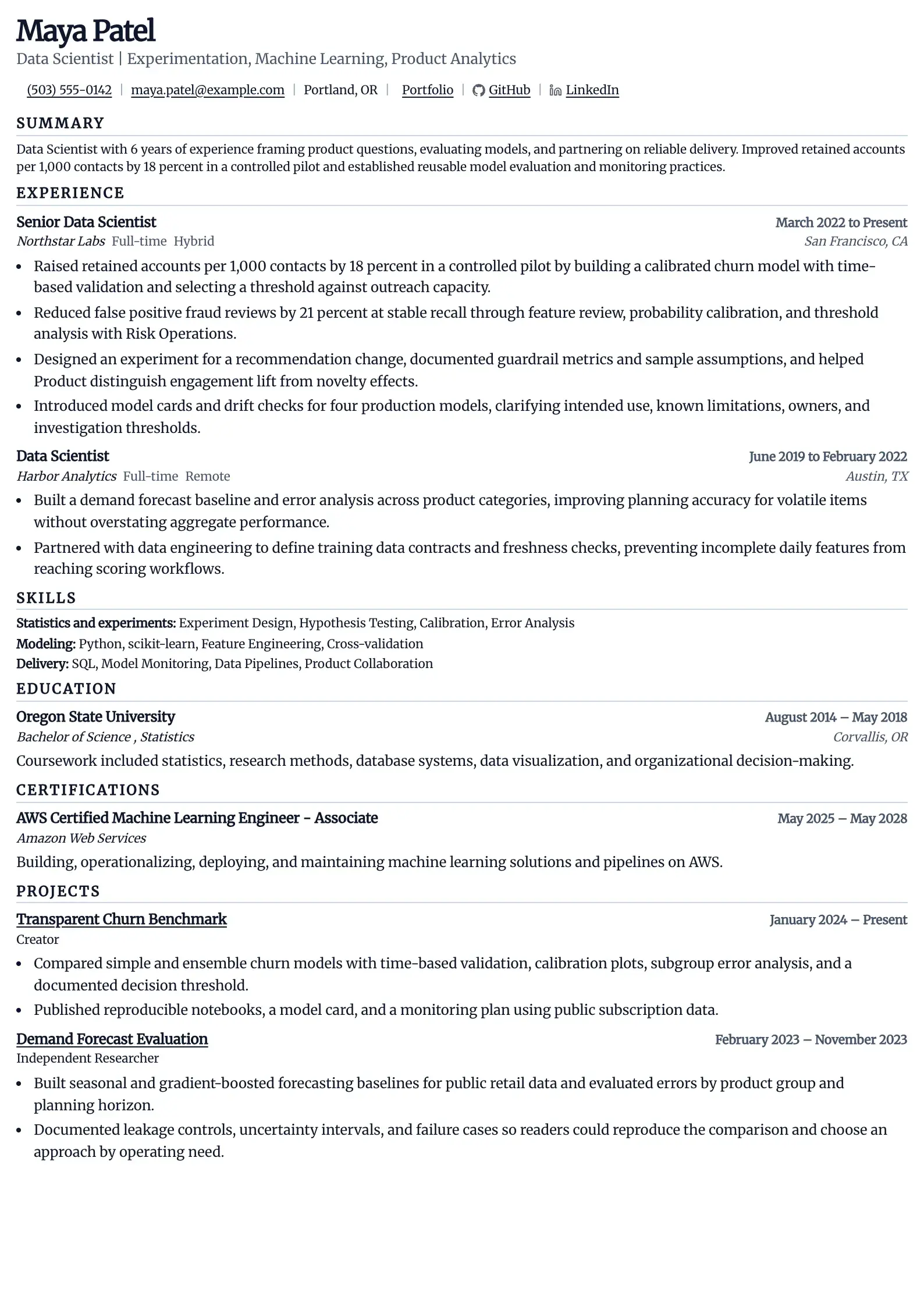
Use this resume template for data scientist applications
Keep experiments, modeling decisions, and product outcomes easy to trace from question to result.
What data scientist hiring managers scan first
Reviewers look for evidence that you can select and evaluate an approach under real constraints. A sophisticated model is not automatically better than a reliable baseline. Show why the method matched the cost of errors, available labels, latency limits, interpretability needs, or experiment design.
They also look for the boundary of your contribution. Distinguish between research you led, features you engineered, pipelines you collaborated on, and services another team deployed. Precise ownership makes strong work believable and gives interviewers a useful starting point.
A model decision grounded in the cost of error
- Hiring signal
- The candidate can choose an evaluation strategy that reflects the actual product or operational consequence.
- Evidence to show
- Name the baseline, validation design, metric, decision threshold, relevant constraint, and observed outcome.
Skills that prove data science depth
Organize capabilities around statistical reasoning, modeling, and delivery. Statistical evidence can include experiment design, uncertainty, sampling, or causal limitations. Modeling evidence includes baselines, feature design, validation, error analysis, and interpretation. Delivery can include data contracts, reproducible pipelines, model services, monitoring, and communication with domain partners.
Use the vocabulary of the target role. A research-heavy team may value publications and experimental rigor. A product team may prioritize iteration, online tests, and collaboration. A risk team may emphasize calibration, explainability, governance, and documentation.
Statistics and experiments
- Hypothesis testing
- Experiment design
- Uncertainty and error analysis
Modeling
- Baseline selection
- Feature engineering
- Cross-validation and model evaluation
Delivery
- Reproducible Python workflows
- Model monitoring
- Product and engineering collaboration
Data scientist achievement bullets with credible evidence
Avoid the formula “built a model with high accuracy.” It leaves the reader unable to judge the baseline, class balance, validation design, or practical value. Build the bullet around the decision and include only metrics that clarify model quality or impact.
Action
Improved prioritization for retention outreach
Method
Built a calibrated churn model with time-based validation and selected a threshold against team capacity
Result
Raised retained accounts per 1,000 contacts by 18 percent in a controlled pilot
Separate offline and online evidence. An increase in recall on a held-out set is a model result. A lift in completed purchases during a controlled release is a product result. State which one you measured, and avoid attributing a team outcome entirely to the model when pricing, messaging, or operations also changed. See strong resume bullet points for help expressing shared contributions accurately.
ATS keywords matched to data scientist proof
Applicant tracking system (ATS) keywords should reflect the actual role. Include Python, SQL, a relevant library, and cloud or workflow tools only when they appear in your work. Methods such as forecasting, natural language processing, causal inference, or deep learning belong only when the posting and your evidence support them.
Data science terms worth proving
- statistical modeling
- machine learning
- experiment design
- feature engineering
- cross-validation
- model evaluation
- Python
- SQL
- scikit-learn
- A/B testing
- model monitoring
- data pipelines
Use resume keywords to match terminology without keyword stuffing. Follow ATS-friendly resume structure so technical evidence remains readable.
How data scientist evidence changes by seniority
Early-career candidates can prove fundamentals with rigorous projects, research, internships, or scoped production analysis. Mid-level work should show independent framing and collaboration through delivery. Senior evidence often includes portfolio choices, standards, mentorship, and systems that improve how multiple teams evaluate or operate models. Titles vary, so describe scope rather than relying on the label.
- 1
Entry level
- Focus
- Rigorous work on a defined question
- Proof to show
- Reproducible analysis, sensible baselines, clean validation, and honest limitations
- 2
Mid-level
- Focus
- Independent model and experiment ownership
- Proof to show
- Problem framing, cross-functional delivery, monitoring, and an outcome tied to a decision
- 3
Senior
- Focus
- Technical direction across a model portfolio
- Proof to show
- Evaluation standards, prioritization, governance, mentoring, and measurable organizational leverage
Data scientist resume mistakes that obscure judgment
Do not present a leaderboard metric without context. Accuracy can be misleading for imbalanced outcomes, and a small offline improvement may not justify added latency or maintenance. State the metric that matched the decision, the comparison used, and important constraints.
Claiming deployment without defining ownership
- Why it hurts
- Saying you deployed a model can overstate your role and hides the engineering, monitoring, and release work that made delivery possible.
- Better approach
- Describe the artifact you owned, the partners you worked with, the release criteria, and the production behavior you personally measured.
Avoid listing every technique used in coursework. Curate evidence that matches the employer's problem space. Protect private data and explain synthetic or public substitutes clearly in portfolio work. Never invent business impact or imply that a model caused a result when the evaluation cannot support that conclusion.

Make model evidence interview-ready
Demi can help you connect the baseline, validation choice, error tradeoff, collaboration boundary, and measured outcome behind each data science project.
Frequently asked questions
- What should a data scientist highlight on a resume?
- Show the problem, baseline, data, modeling choice, evaluation method, and outcome. Explain why the metric fit the decision and how you checked leakage, bias, stability, or production behavior when relevant. Connect technical work to a product, risk, research, or operational decision.
- Should a data scientist list every model and library?
- List methods and libraries that matter to the target role and that you can discuss in depth. Prove the central ones inside bullets or projects. A shorter set tied to model choices, experiments, and deployment work is more credible than a long inventory of tutorial exposure.
- How should a data scientist describe model performance?
- Name the baseline, evaluation set, metric, and practical consequence. Use precision, recall, calibration, error, lift, or latency only when each fits the problem. Avoid presenting an isolated accuracy figure without class balance, comparison, validation design, or business context.
- Do data scientists need a projects section?
- Projects help when they add evidence missing from employment, especially for early-career or transitioning candidates. Choose work with a clear question, reproducible method, honest limitations, and interpretable result. Link a clean repository or write-up, not a collection of copied notebooks.
Ready to build your Data Scientist resume?
Choose sample data or build your own resume, then personalize it before you download.