
A Cybersecurity Analyst resume earns attention when it shows disciplined security operations rather than a list of tools. Hiring teams want evidence that you can triage noisy alerts, validate activity across endpoint and identity telemetry, document decisions, and escalate incidents according to the organization’s playbooks. Your bullets should also make authorized scope clear: investigate, test, scan, or contain only systems and actions approved by the employer.
What Security Hiring Teams Validate First
A hiring manager often scans for three signals in the first minute: operational judgment, technical traceability, and communication that helps the business act. Lead with a headline that identifies your environment, such as SIEM and EDR monitoring, vulnerability management, or cloud identity investigation. Then use the summary to establish the scale or cadence of your work without overstating ownership of enterprise-wide security architecture.
For alert triage, show the path from signal to decision. State the alert source, the data reviewed, the enrichment performed, and whether you closed, escalated, contained, or opened a remediation ticket. An effective bullet can reference Microsoft Sentinel, Splunk, CrowdStrike, Microsoft Defender, or another platform only when you explain what you did in it. “Monitored dashboards” is weak because it does not prove analytical judgment.
What makes a Cybersecurity Analyst credible
- Hiring signal
- The candidate connects detection evidence to a documented response decision.
- Evidence to show
- Show alert source, investigative pivot, authorized action, case documentation, and outcome in one concise bullet.
Your resume should separate investigation from offensive testing. If you performed scans, phishing simulations, endpoint isolation, or access reviews, identify the approved program, runbook, ticket, or assigned scope. This protects credibility and distinguishes a security operations analyst from a penetration tester or security engineer.
Cybersecurity Skills to Anchor in Incidents
Organize skills around the work a Cybersecurity Analyst performs, not around every product encountered. Group detection and investigation tools separately from vulnerability workflows, governance work, and scripting. Include platforms you used directly and can discuss in an interview, including the log sources, queries, or actions you handled.
Detection and investigation
- SIEM query development
- EDR telemetry review
- Identity and authentication analysis
Response and exposure management
- Incident triage
- Vulnerability remediation tracking
- Phishing investigation
Assurance and communication
- Control testing
- Risk reporting
- Case documentation
Use the language from the target posting where it is accurate. A role centered on cloud security may value Azure AD or AWS CloudTrail evidence, while a regulated environment may prioritize access-control testing, audit artifacts, and risk exceptions. Read the employer’s terminology alongside this guide to ATS-friendly resumes, then mirror only the systems and methods you can substantiate.
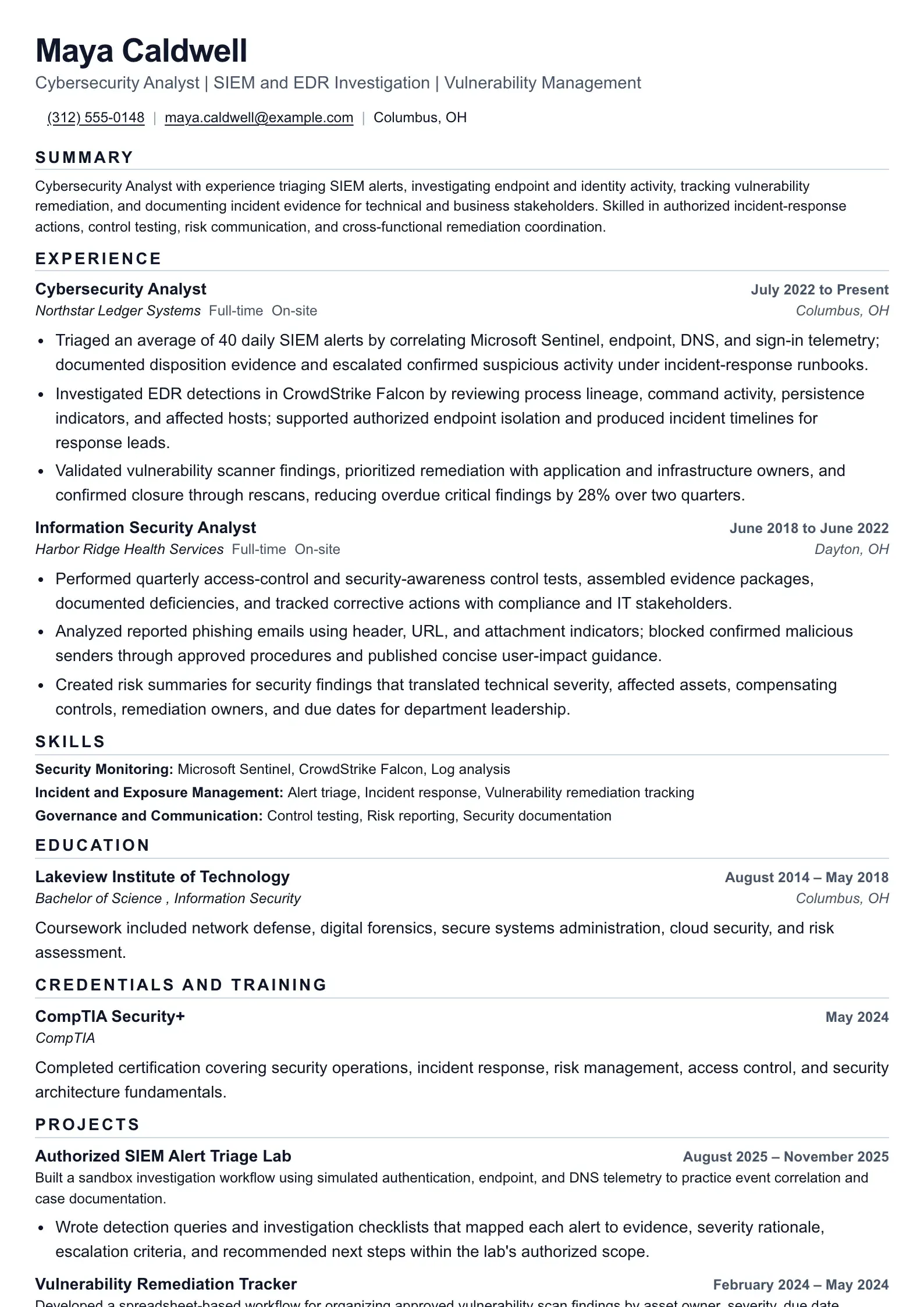
Cybersecurity Analyst evidence structure
Use a focused resume structure that places investigation outcomes, remediation coordination, and control-testing proof where security hiring teams can scan them quickly.
Write Bullets Around Detection and Response
Cybersecurity Analyst bullets work best when they describe a repeatable investigation or assurance process. Begin with a precise action, identify the evidence or method, then finish with a business-relevant result. The result may be a faster escalation, a validated remediation, fewer duplicate alerts, a complete evidence package, or a risk decision that leaders could understand.
A strong alert-triage bullet might read: “Triaged 35 to 50 daily SIEM alerts by correlating firewall, endpoint, and sign-in logs; escalated 12 confirmed suspicious events with timeline evidence and reduced incomplete case notes by 30%.” The volume and percentage are illustrative examples, not industry benchmarks. Use your own verified numbers, or describe cadence and scope when measured results are unavailable.
For vulnerability management, avoid claiming that you “fixed vulnerabilities” if infrastructure teams applied the patches. Instead, show your role in validating scanner findings, prioritizing exposure with asset owners, tracking exception approvals, and confirming remediation through a rescanned result. For control testing, name the control objective, sample evidence, deficiency, and follow-up owner.
Build these statements with the same discipline used in strong resume bullet points. A documented incident-response bullet can mention an approved containment step, such as isolating an endpoint through EDR after manager or incident-lead authorization. It should never imply unilateral shutdowns, unrestricted access, or activity beyond your assigned authority.
ATS Keywords for Cybersecurity Analyst Roles
Cybersecurity Analyst screening commonly combines tools, operational practices, and governance terms. Put relevant keywords in your summary, experience bullets, skills, and project descriptions rather than collecting them in a disconnected list. The best keyword is paired with proof of the work performed.
Cybersecurity Analyst ATS keywords
- SIEM
- EDR
- alert triage
- log analysis
- incident response
- vulnerability management
- control testing
- threat intelligence
- risk assessment
- security monitoring
- phishing analysis
- remediation tracking
A job posting may use “security event analysis” instead of “SOC monitoring,” or “exposure management” instead of “vulnerability management.” Use both terms only if they accurately describe your experience. For a detailed approach to selecting and placing terms, review resume keywords. Avoid adding tools simply because they are popular; security interviewers can quickly test whether your claimed experience includes real telemetry, workflows, and case decisions.
Translate Cybersecurity Analyst requirements into proof
| Job requirement | Matching evidence | Keyword |
|---|---|---|
| Triage SIEM alerts | Correlated authentication, DNS, and endpoint events to close false positives or escalate confirmed activity. | alert triage |
| Manage vulnerability findings | Validated scanner results, assigned remediation owners, and confirmed closure through rescans. | vulnerability management |
| Support audits and controls | Tested access-review evidence, documented exceptions, and tracked corrective actions. | control testing |
How Security Ownership Expands With Seniority
At junior level, prove that you follow playbooks, record clear evidence, and recognize when escalation is required. Authorized labs, internships, service desk security tasks, and coursework can support this story when they show reproducible steps and ethical boundaries.
At mid-level, demonstrate independent case management: tuning recurring detections, coordinating vulnerability owners, leading defined incident tasks, and translating technical findings into risk summaries. Senior Cybersecurity Analysts are typically expected to improve detection processes, guide analysts through complex investigations, contribute to control design or maturity reviews, and communicate risk tradeoffs to technical and business stakeholders.
- 1
Junior Cybersecurity Analyst
- Focus
- Runbook-based triage, evidence capture, and timely escalation.
- Proof to show
- Documented alert cases, authorized lab investigations, and remediation ticket follow-up.
- 2
Cybersecurity Analyst
- Focus
- Independent investigations, exposure prioritization, and control validation.
- Proof to show
- Detection improvements, incident timelines, rescanned findings, and risk reports.
- 3
Senior Cybersecurity Analyst
- Focus
- Operational improvement, complex incident coordination, and stakeholder guidance.
- Proof to show
- Playbook enhancements, control-gap analysis, analyst mentoring, and leadership-ready risk communication.
Cybersecurity Resume Mistakes That Reduce Confidence
A common Cybersecurity Analyst mistake is listing tools without explaining investigation behavior. “Splunk, CrowdStrike, Wireshark” does not tell a reviewer whether you searched authentication events, traced process ancestry, validated network traffic, or documented an escalation. Another mistake is treating every alert as an incident. Strong analysts demonstrate closure rationale, false-positive patterns, severity decisions, and evidence preservation.
Avoid unsupported security claims
- Why it hurts
- The resume claims penetration testing, containment authority, or enterprise remediation ownership without naming an approved assignment, runbook, or collaboration model.
- Better approach
- Describe the authorized scope, state your specific action, identify the approving team or incident lead when relevant, and distinguish validation or coordination from system ownership.
Frequently asked questions
- What should a Cybersecurity Analyst resume emphasize?
- Emphasize alert triage, SIEM and EDR investigations, vulnerability remediation follow-up, incident response actions, control testing, and concise risk communication within authorized scope.
- How should a Cybersecurity Analyst describe SIEM work?
- Name the alert type, explain the queries or telemetry reviewed, state the containment or escalation decision, and report an accurate outcome such as reduced duplicate alerts or faster case closure.
- Should entry-level Cybersecurity Analysts include labs?
- Yes. Include authorized home labs, coursework, capture-the-flag exercises, or sandbox projects when they demonstrate documented investigation steps, detection logic, remediation validation, and ethical boundaries.
- Which keywords matter for Cybersecurity Analyst ATS screening?
- Common keywords include SIEM, EDR, incident response, vulnerability management, log analysis, threat hunting, control testing, ticketing, risk assessment, phishing analysis, and remediation tracking.

Ready to build your Cybersecurity Analyst resume?
Choose sample data or build your own resume, then personalize it before you download.