
A Construction Laborer resume should show that you can make a jobsite ready for the next trade, move materials safely, follow direction, and keep production moving. Hiring teams are not looking for vague claims about being hardworking. They want proof that you handled physical work safely, used tools within training and employer procedures, and showed up ready for changing site conditions. Use only figures supported by your records. Any figures in this guide are illustrative examples of scope, not industry benchmarks.
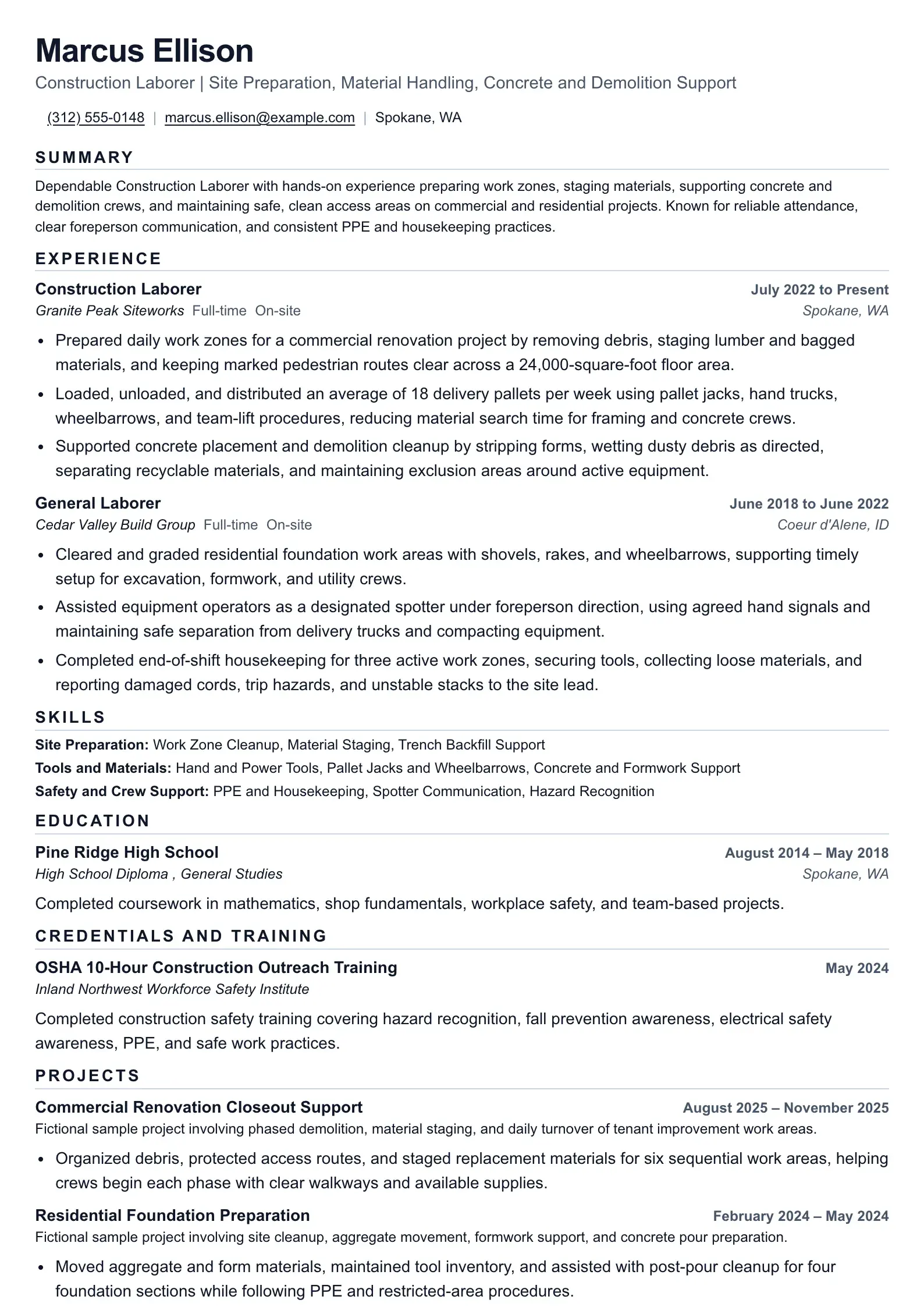
Construction Laborer resume example
A focused Construction Laborer resume that connects site preparation, safe material handling, concrete support, and dependable crew work.
What Construction Supervisors Notice First
A superintendent, foreperson, or contractor often scans a laborer resume for immediate evidence of jobsite usefulness. Put your strongest construction work near the top: clearing and staging work areas, loading and unloading deliveries, maintaining access routes, supporting concrete pours, separating demolition debris, and completing end-of-shift cleanup. State the environment when it adds context, such as commercial renovation, roadwork, residential foundations, utility work, or warehouse build-outs.
What hiring teams notice first
- Hiring signal
- Reliable laborers reduce setup delays and leave safe, organized work areas for the next crew.
- Evidence to show
- Name the work area, materials handled, tools used, hazard control followed, and the measurable scope or schedule result.
Jobsite Skills That Show Readiness
Organize skills around actual field tasks instead of a long list of personality traits. Site preparation skills can include layout support, debris removal, grading assistance, trench backfill, erosion-control placement, barricade setup, and staging lumber, pipe, rebar, or bagged materials. Material handling can include hand trucks, wheelbarrows, pallet jacks, chain and sling awareness, team lifts, and load staging, but list only tools you have used safely.
Tool skills matter when connected to the job. A Construction Laborer may use shovels, rakes, brooms, sledgehammers, demo bars, tape measures, levels, drills, compactors, or concrete vibrators according to training and site rules. Include inspection, cleanup, and secure storage where relevant. Employers also value practical communication: responding to foreperson direction, signaling around active equipment, reporting damaged cords or unstable materials, and coordinating with a crew during pours or teardown.
Use the ATS-friendly resume guide to keep these skills readable in standard sections. Do not bury construction terms inside a dense profile paragraph. A recruiter should be able to identify site preparation, material handling, concrete support, demolition support, PPE, housekeeping, and hand tools in seconds.
Build Bullets From Safe, Productive Work
Strong Construction Laborer bullets answer five questions: What task did you complete? Where or for which phase? What materials, tools, or equipment support did you use? Which safety control did you follow? What scope, quality, or schedule result did it support? This structure turns routine labor into credible evidence.
A weak bullet says, "Helped with construction projects and cleanup." It gives no indication of trade support, work volume, safety awareness, or reliability. A better bullet says, "Cleared and staged materials across a 24,000-square-foot commercial renovation floor, maintaining marked access paths and completing daily debris removal before trade handoffs."
Action
Start with a construction task such as staged, cleared, loaded, stripped, backfilled, or supported.
Method
Add materials, hand tools, crew coordination, and the hazard control or procedure used.
Result
Finish with documented scope, a completed phase, reduced obstruction, on-time handoff, or clean work area.
Build bullets from your daily logs, delivery tickets, supervisor assignments, and project notes. If exact counts are unavailable, use honest scale language such as multi-unit residential site, weekly deliveries, multiple work zones, or daily closeout. For more structure, review strong resume bullet points and adapt each example to your actual duties.
ATS Keywords for Construction Labor Roles
Construction employers may search for job terms pulled from project needs and safety requirements. Match the language in the posting when it accurately describes your background. If an employer asks for concrete labor, include concrete placement support, form stripping, curing support, and site cleanup only when you performed those tasks. If the role is demolition-heavy, use demolition cleanup, material segregation, dust control, debris chutes, and exclusion zones where accurate.
Useful keywords include site preparation, material handling, hand tools, power tools, PPE, housekeeping, trench backfill, concrete support, demolition support, loading and unloading, traffic control support, spotter communication, hazard recognition, and crew coordination. Use the resume keywords guide to compare a posting with your resume without copying qualifications you do not have.
Place keywords in your summary, skills, and experience bullets. Do not create a separate keyword block filled with equipment you never used. An ATS match can earn a review, but the interview will test whether you can explain the task, the safety procedure, and the result.
How Jobsite Responsibility Grows With Seniority
At entry level, your evidence should emphasize dependable attendance, PPE compliance, cleanup, material staging, safe lifting, and following foreperson direction. As you gain experience, show broader responsibility: preparing zones before deliveries, coordinating a small work area, helping newer laborers locate supplies, checking that walkways remain clear, and anticipating the next phase of work.
A more experienced Construction Laborer can demonstrate trade-specific support without overstating authority. For example, you may have supported formwork crews, assisted with concrete placement, served as a spotter under site procedure, managed debris-sorting stations, or prepared tools and materials for a demolition sequence. If you have equipment training, state the equipment and employer-authorized scope accurately. Requirements for operating equipment, directing traffic, or entering regulated spaces vary by employer, project, and jurisdiction.
- 1
Entry Construction Laborer
- Focus
- Safe cleanup, material movement, PPE, and daily direction.
- Proof to show
- Completed assigned work zones, maintained orderly access paths, and reported hazards promptly.
- 2
Experienced Construction Laborer
- Focus
- Independent staging, trade support, and multi-area jobsite readiness.
- Proof to show
- Prepared work areas for deliveries, pours, teardown, or next-trade handoffs.
- 3
Lead Laborer Support
- Focus
- Crew coordination, task sequencing, and consistent site standards.
- Proof to show
- Helped organize labor tasks, monitored housekeeping needs, and communicated site changes to the foreperson.
Construction Laborer Resume Mistakes to Fix
Do not write a resume that could belong to a warehouse associate, landscaper, or general cleaner. Construction Laborer experience is distinct because it occurs around changing work zones, active trades, delivery schedules, temporary hazards, and project sequencing. Name the construction context and the crew support you provided.
Another common mistake is listing "equipment operation" with no detail. If you only assisted with equipment movement as a spotter or loaded materials for an operator, say that. If you used a compactor, saw, mixer, or other tool, identify it only when you were trained and permitted to use it. Never imply a license, certification, or legal scope that you do not hold.
Replace vague physical-work claims
- Why it hurts
- Saying 'performed heavy labor' does not show what you handled, how you worked safely, or why the crew relied on you.
- Better approach
- Name the task, material, work zone, tool or support activity, hazard control, and documented result, such as a cleared access route or completed pour setup.
Finally, avoid unsupported superlatives such as best worker or expert in all tools. Strong evidence is more convincing: consistent attendance, completed closeout tasks, accurate material staging, clean handoffs, and safe response to changing jobsite conditions.
Frequently asked questions
- What should a Construction Laborer put on a resume?
- A Construction Laborer should show site preparation, material handling, tool use, cleanup, hazard controls, concrete or demolition support, and reliable crew attendance with specific work scope.
- How do I describe construction laborer experience with no formal title?
- Use the work performed, such as site cleanup, trench backfill, form stripping, debris removal, material staging, and spotter support, then name the contractor or project context accurately.
- Which certifications belong on a Construction Laborer resume?
- List completed training that applies to the job, such as OSHA 10-Hour Construction Outreach training, first aid, CPR, or employer-provided equipment training when you actually completed it.
- Should Construction Laborer resume bullets include numbers?
- Yes, when records support them. Use quantities such as yards cleared, pallets moved, truckloads sorted, crew size supported, or project areas prepared, without presenting examples as industry benchmarks.

Ready to build your Construction Laborer resume?
Choose sample data or build your own resume, then personalize it before you download.