
A collections manager resume should demonstrate accountable stewardship of objects and their records. Employers need evidence that you can maintain location and ownership information, identify risks, coordinate movement and access, and translate policy into consistent daily practice. A software list or collection size alone does not prove control.
Frame achievements around a known risk or documentation gap. Explain the collection scope, the procedure or standard you applied, the people you coordinated, and the verified result. Strong evidence may concern inventory accuracy, storage conditions, object retrieval, loan readiness, emergency response, or safer handling.
What collections manager hiring teams scan first
Reviewers often look first for direct responsibility for collections and records. State the material types and approximate scale you managed, then show inventory, cataloging, location control, condition reporting, environmental monitoring, integrated pest management, loans, storage, or emergency planning as relevant.
Institutions distribute registration and collections-management duties differently. Some roles handle acquisitions, insurance, customs, and legal documentation, while others focus on physical care and access. Reflect the vacancy and describe your authority accurately instead of assuming one universal job boundary.
Reliable physical and intellectual control
- Hiring signal
- The candidate can reconcile objects, locations, records, condition, and access requirements through documented procedures.
- Evidence to show
- Show the collection scale, control gap, system or workflow, verification method, and measurable improvement in accountability or care.
Skills that prove collections control
Group capabilities around control, care, and access. Documentation includes accession records, catalog data, numbering, location history, rights or ownership files, and audits. Preventive conservation includes environmental and pest monitoring, condition assessment, storage materials, housekeeping, and risk mitigation. Operations may include handling, packing, shipping, loans, installations, researcher access, and emergency response.
Documentation and inventory
- Accession and catalog records
- Location control and reconciliation
- Collections database administration
Preventive care
- Condition assessment
- Environmental and pest monitoring
- Storage, housing, and risk mitigation
Movement and access
- Object handling and packing
- Loans and installations
- Research access and emergency procedures
Name systems only when you can explain the work performed in them. Database configuration, data cleanup, controlled vocabularies, reports, user training, and migration testing are more informative than an unsupported product name.
Collections manager achievement bullets with credible evidence
Begin with the control or care result, then explain the procedure. Inventory figures become useful when the reviewer sees how records were checked and exceptions resolved. Environmental claims should identify the monitoring or response process without suggesting that one target range suits every material type.
Before
Managed the inventory and helped move objects into new storage.
After
Reconciled database and shelf locations for 2,400 objects, documented pre-move condition, coordinated custom supports and handling teams, and closed the project with zero unresolved location exceptions.
Why it works
The rewrite defines scale, verification, preventive care, coordination, and a concrete control result.
Action
Improved retrieval and accountability across an off-site store
Method
Standardized location codes, audited barcode records against shelves, and assigned documented exception reviews
Result
Verified 98 percent of 6,800 records in the first pass and resolved the remaining discrepancies before annual reporting
All figures here are illustrative. Use results you can verify from project records. If a result is qualitative, name the risk reduced or process established. Review strong resume bullet points to keep scope, method, and outcome in one claim.
Use this resume template for collections manager applications
Keep collection scope, control procedures, risk reduction, and operational outcomes easy to verify at a glance.
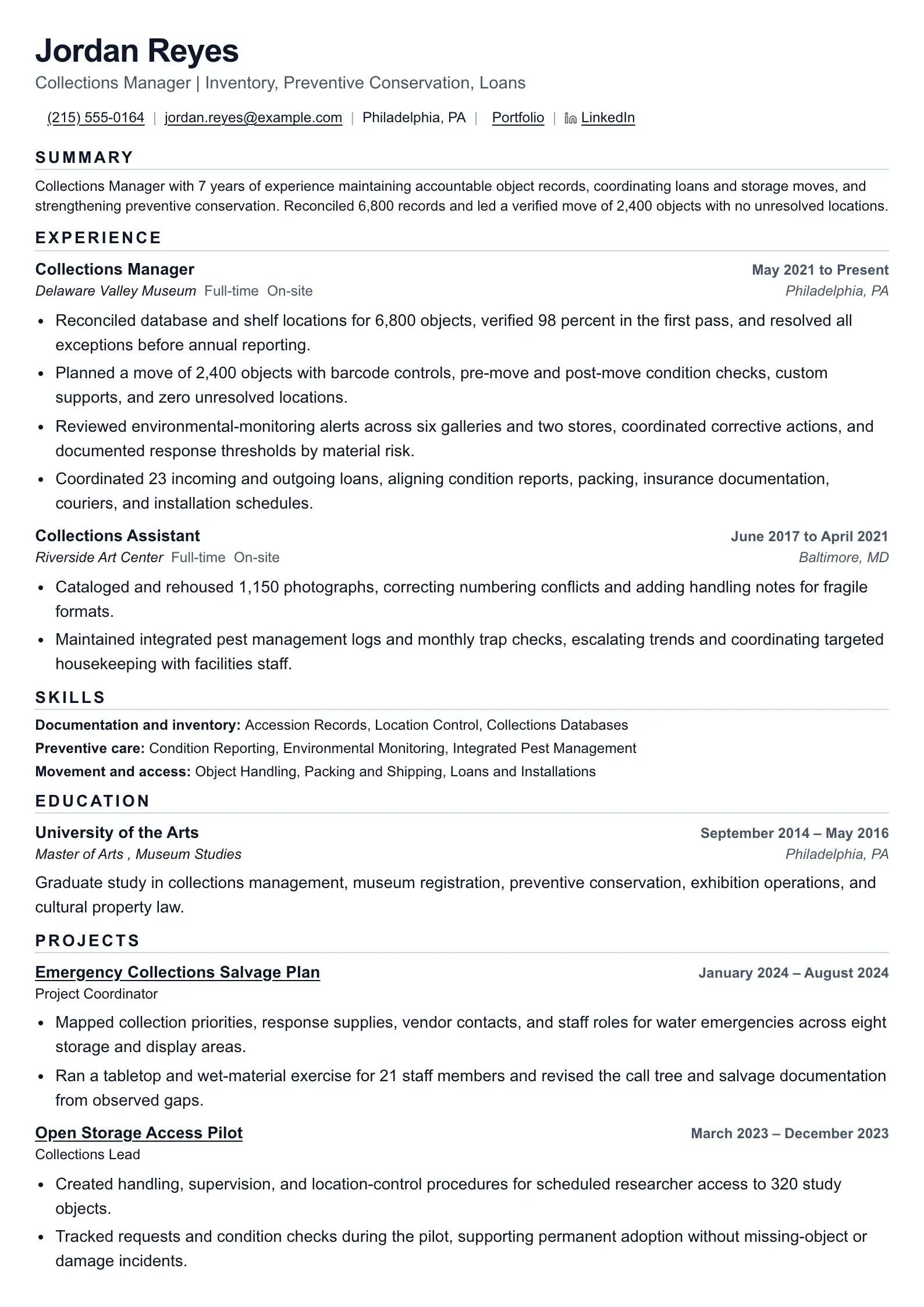
ATS keywords matched to collections management proof
Applicant tracking system (ATS) terms may include collections management, inventory control, accessioning, cataloging, condition reporting, preventive conservation, environmental monitoring, integrated pest management, loans, object handling, packing and shipping, emergency planning, risk assessment, and a named collections database.
Match stewardship requirements to defensible proof
| Job requirement | Matching evidence | Keyword |
|---|---|---|
| Maintain accurate object and location records | Reconciled database locations against shelf checks and resolved documented exceptions | inventory control |
| Support preventive conservation | Reviewed environmental alerts, coordinated condition checks, and improved storage supports for vulnerable materials | preventive conservation |
Use resume keywords only where your evidence supports them. An ATS-friendly resume structure should keep dates, employers, section headings, and collection outcomes in plain text.
How collections manager evidence changes by seniority
Early-career candidates can demonstrate careful documentation, handling, monitoring, and project follow-through. Mid-level evidence should show independent ownership of inventory, loans, storage improvements, procedures, contractors, or access. Senior roles may add policy, budgets, capital projects, emergency planning, database governance, cross-department priorities, and staff supervision.
- 1
Early career
- Focus
- Accurate execution and safe handling
- Proof to show
- Complete records, careful condition checks, consistent monitoring, and documented project work
- 2
Mid-level
- Focus
- Independent collections operations
- Proof to show
- Inventory control, loans, storage projects, procedures, vendor coordination, and risk resolution
- 3
Senior
- Focus
- Program-wide stewardship
- Proof to show
- Policy, budgets, emergency readiness, systems governance, capital planning, and team leadership

Turn invisible stewardship into visible evidence
Bring Demi a routine collections task and the project records behind it. Demi can help identify the scale, risk, control step, collaborators, and verified result without overstating your authority.
Collections manager resume mistakes that create risk
Avoid presenting collection size as achievement by itself. Hiring teams need to know what you controlled, improved, or protected. Do not blur preventive care with conservation treatment beyond your training, or imply legal responsibility for decisions owned by a registrar, curator, conservator, or director.
Listing procedures without showing control
- Why it hurts
- Terms such as inventory, monitoring, and loans do not reveal whether records were verified, exceptions resolved, or risks reduced.
- Better approach
- Add collection scale, the control procedure, your verification method, the collaborators involved, and the documented result.
Never reveal security-sensitive storage details, insurance values, transport routes, alarm procedures, or confidential ownership information. Describe scale, controls, and outcomes at a level appropriate for a public application.
Frequently asked questions
- What should a collections manager put on a resume?
- Show collection scale and type, documentation systems, inventory or reconciliation work, preventive conservation, environmental monitoring, loans, storage projects, emergency planning, and safe access. Connect procedures to verified improvements in accountability, condition, retrieval, or risk control.
- How is a collections manager resume different from a curator resume?
- A collections manager resume centers on physical and intellectual control, documentation, care, movement, storage, risk, and access procedures. A curator resume usually centers on subject research, acquisitions, interpretation, exhibitions, and scholarship. Some institutions combine duties, so follow the posting.
- Which metrics work for collections management?
- Useful measures include objects inventoried, records reconciled, locations verified, condition reports completed, loans coordinated, storage capacity improved, environmental excursions resolved, or retrieval time reduced. Explain the method and use only figures supported by your records.
- Should collections managers list conservation treatments?
- Describe preventive care, condition assessment, handling, housing, and collaboration with qualified conservators. Claim hands-on treatment only when it falls within your training and authority. Clear boundaries demonstrate sound collections stewardship rather than a lack of experience.
Ready to build your Collections Manager resume?
Choose sample data or build your own resume, then personalize it before you download.