
A certified nursing assistant (CNA) resume should prove that you deliver respectful daily care, notice meaningful changes, report them promptly, and document within your role. Put your active state credential or nurse aide registry status near the top, including the state and expiration or renewal information when applicable.
Hiring teams also need the care setting and population. Distinguish long-term care, skilled nursing, hospital, rehabilitation, home care, hospice, or assisted living experience. Never claim nursing assessment, diagnosis, medication administration, or another responsibility outside your training, delegation, and local scope.
What CNA hiring managers scan first
The first scan checks current eligibility, hands-on care experience, reliability, and safe teamwork. Show activities of daily living (ADLs), transfers, mobility support, vital signs, intake and output when assigned, infection-prevention practices, observation, and timely communication with the nurse. Match terminology to the target setting.
Reliable care plus timely escalation
- Hiring signal
- The CNA completes delegated care, protects dignity and safety, notices changes, and gives the licensed nurse clear information.
- Evidence to show
- Describe the assigned population, care task, observation, reporting action, documentation, and de-identified outcome.
Credential and setting match
- Hiring signal
- The candidate’s current state status and recent experience fit the employer’s care environment.
- Evidence to show
- Name the state credential or registry, care setting, shift pattern, population, and current CPR or Basic Life Support credential only when relevant.
Reliability can be supported with attendance recognition, consistent shift coverage, completed rounding, or documented handoffs when you have records. Avoid generic claims such as compassionate or hardworking unless an example demonstrates the behavior.
Skills that prove dependable nursing assistant care
Group skills around personal care, observation, and safety. Personal care includes bathing, grooming, dressing, toileting, feeding assistance, repositioning, and comfort measures. Observation includes vital signs, intake and output, skin or behavior changes, and clear reporting. Safety includes transfers, mobility devices, fall precautions, infection prevention, and call-light response.
Daily care
- Bathing and grooming
- Feeding assistance
- Repositioning and comfort
Observation and records
- Vital signs
- Change reporting
- Electronic documentation
Mobility and safety
- Transfer equipment
- Fall precautions
- Infection prevention
Use facility-specific systems or devices only when you can operate them competently. If training or policy limits a task, do not list it as an independent skill. State language ability when it helps you communicate directly with patients, residents, or families.
CNA achievement bullets with credible evidence
Strong CNA bullets focus on care quality, observation, coordination, and dependable execution. Measures may include assignment size, shift type, rounding completion, documentation timeliness, training participation, or response improvement. Do not turn patient acuity into a performance boast.
Before
Helped residents with daily activities and took vital signs.
After
Provided morning ADL, transfer, and mobility support for an assigned group of 10 residents, recorded vital signs before handoff, and promptly reported changes in appetite, skin condition, or behavior to the charge nurse.
Why it works
The rewrite shows care scope, timing, documentation, and escalation while staying within the CNA role and protecting resident privacy.
Action
Improved consistency of shift handoffs
Method
Completed assigned rounding, documented care and observations before report, and used the facility handoff checklist
Result
Reduced missing care details found during the unit’s monthly documentation review
Use only an outcome you can support through records or feedback. When numbers are unavailable, a precise example of noticing a change, following transfer precautions, preparing a room, or supporting a calm handoff still shows value. The strong resume bullet points guide helps separate your action from the team’s clinical decision.
ATS keywords matched to CNA proof
Applicant tracking system (ATS) terms should reflect the posting, setting, and your actual duties. Useful language may include certified nursing assistant, CNA, nurse aide registry, patient care, resident care, activities of daily living, vital signs, safe transfers, gait belt, mechanical lift, repositioning, fall prevention, infection prevention, intake and output, electronic health record, and care team communication.
Do not copy skills that sit outside your authorized role. Place your exact credential, state, and status in a certification section. Put care terms inside bullets where they show competent practice. The resume keywords guide explains matching, while the ATS-friendly resume guide covers readable structure.
How CNA evidence changes by seniority
A new CNA can lead with state-approved training, supervised clinical experience, safe procedures, and readiness for the target setting. An experienced CNA should show dependable assignments, varied patient needs, accurate documentation, and confident communication. A senior CNA, preceptor, or unit support lead can add onboarding, skill demonstrations, supply workflows, and quality participation without claiming licensed-nurse authority.
- 1
Newly certified
- Focus
- Safe fundamentals, supervised clinical practice, dignity, and accurate reporting
- Proof to show
- Current state status, clinical setting, verified training scope, transfer skills, vital signs, and examples of escalation
- 2
Experienced CNA
- Focus
- Consistent care across shifts and changing needs
- Proof to show
- Assignment scope, documentation, mobility support, observation, teamwork, and dependable handoffs
- 3
Preceptor or senior CNA
- Focus
- Peer support and unit reliability within the CNA role
- Proof to show
- New-hire orientation, competency reinforcement, workflow improvements, and quality participation
CNA resume mistakes that weaken patient-care credibility
Do not write as if assisting with care means independently assessing or directing treatment. Describe what you observed, what you reported, and which delegated actions you completed. Give the nurse or care team credit for clinical decisions outside your role.
Using vague compassion claims
- Why it hurts
- Words such as caring and empathetic do not show how the candidate protected dignity, reduced distress, or communicated a concern.
- Better approach
- Describe a specific behavior, such as explaining a transfer, honoring a preference, using an interpreter process, or reporting a change promptly.
Keep all examples de-identified. Do not include a patient name, exact admission date, room number, photograph, rare diagnosis, or a story detailed enough to reveal identity. Check dates on registry status and CPR credentials before every application.
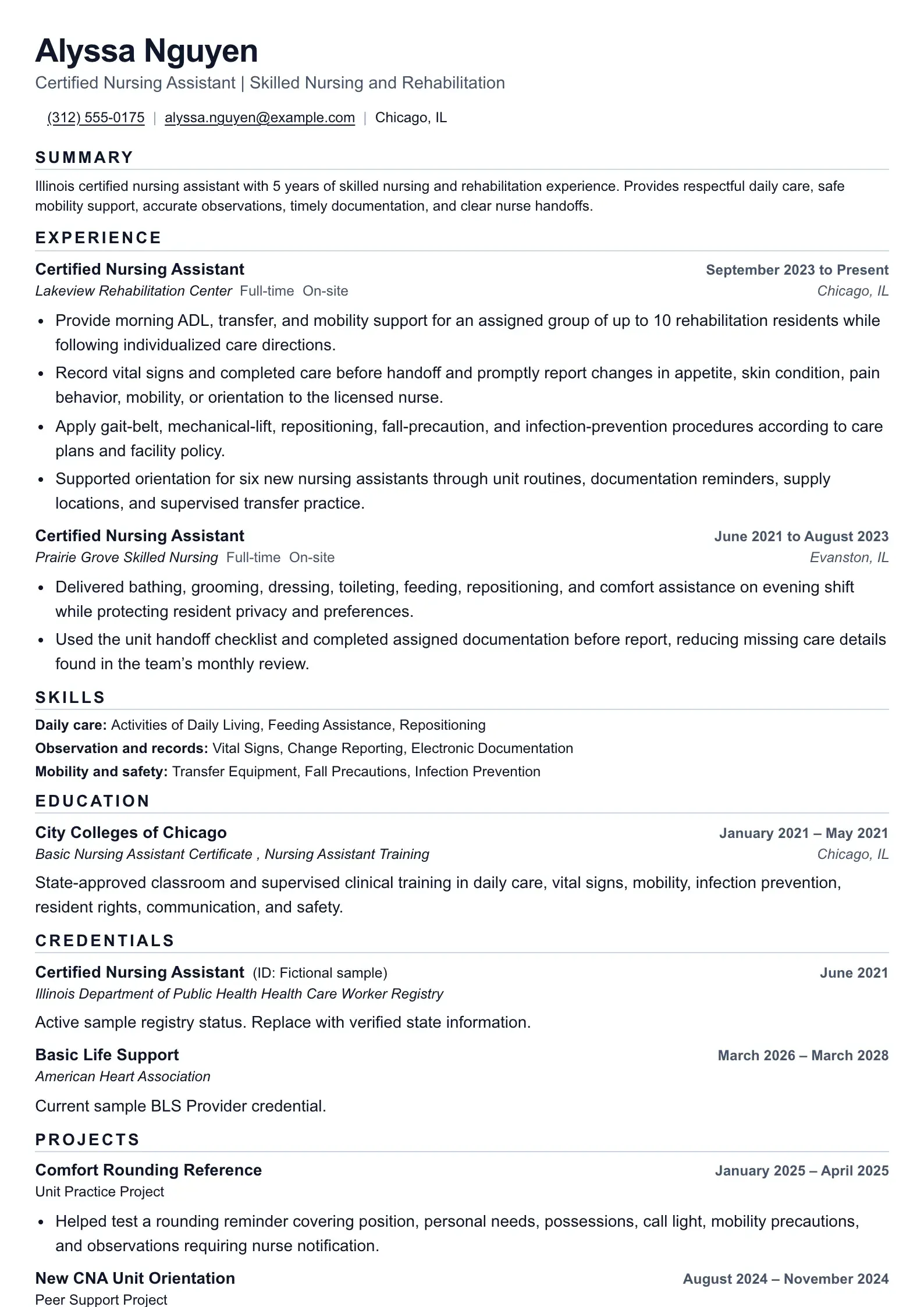
Use this resume template for certified nursing assistant applications
Keep state credential, care setting, daily-care skills, observation, and dependable teamwork clear for a fast clinical review.
Frequently asked questions
- What should a CNA put on a resume?
- Show your active state credential or registry status, care setting, shift experience, patient or resident population, activities of daily living, vital signs, transfers, observation, documentation, and teamwork. Add CPR or Basic Life Support only when current and relevant to the employer.
- How can a new CNA show experience?
- Use supervised clinical training and state the setting, hours when verified, care tasks, safety procedures, and observations you reported. Separate clinical education from paid employment. Service, caregiving, or volunteer work can support reliability and communication but should not be presented as licensed clinical practice.
- Should a CNA include patient ratios or counts?
- Include a typical assignment size only when accurate and useful, and make clear that acuity and staffing vary. Never imply that a high count proves quality by itself. Pair scope with safe care, timely reporting, documentation, fall prevention, comfort, or team coordination.
- How should a CNA describe confidential patient work?
- Use aggregate scope and de-identified examples. Describe the unit, population, task, observation, escalation, and care result without names, exact dates, room numbers, rare diagnoses, or other identifying details. Follow employer policy and applicable privacy requirements in every portfolio or application document.

Ready to build your Certified Nursing Assistant resume?
Choose sample data or build your own resume, then personalize it before you download.