
A Career Change resume works when it makes one hiring decision easy: this candidate is pursuing a specific Project Coordinator role and has already performed closely related work. Do not ask a recruiter to infer that retail operations, client service, education, logistics, or administrative experience can transfer. State the target in the headline, then prove it through schedules, stakeholder updates, documentation, dependencies, process improvement, and measurable delivery results.
For this situation, the resume is not a biography of every past responsibility. It is a targeted case for moving into project coordination. Use a conventional reverse-chronological work history, retain accurate job titles, and add bridge training and project work that connect your prior field to the role you want.
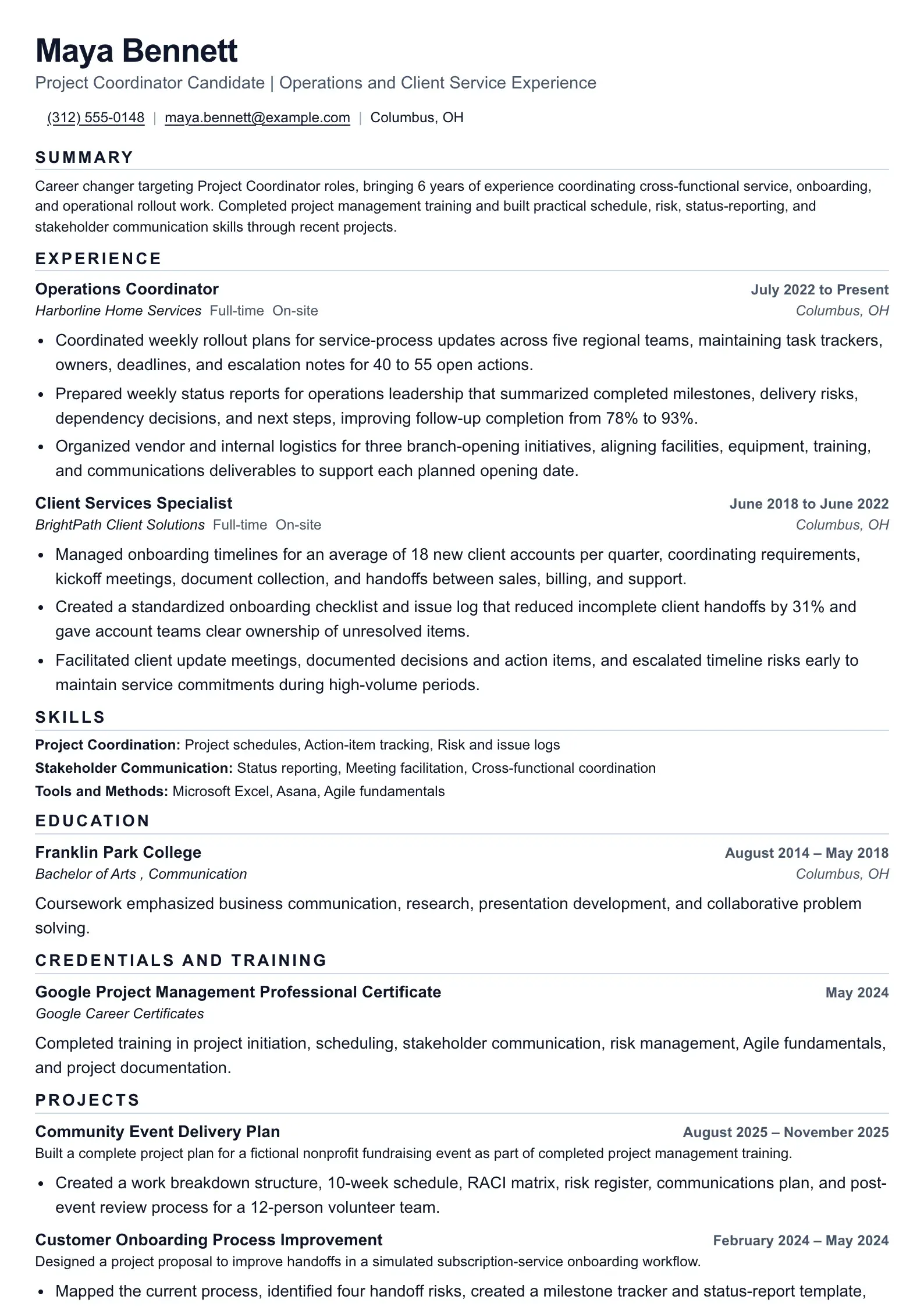
Career Change Project Coordinator Resume
A targeted example that connects operations and client-service accomplishments to Project Coordinator work.
What Employers Need to Understand About Your Pivot
Your prior title does not need to match the target title. A client services specialist who ran onboarding timelines, or an operations coordinator who managed location openings, can offer strong adjacent evidence. Keep the original title and translate the accomplishment in language a project team recognizes. This is more credible than renaming past jobs or using a functional format that hides dates and employers.
Immediate target-role signal
- Hiring signal
- Project Coordinator candidate with operations coordination experience
- Evidence to show
- Headline, completed project-management training, two scoped coordination projects, and chronological bullets showing schedules, stakeholder updates, risk tracking, and delivery outcomes.
If your career move involves regulated work, such as healthcare, construction, finance, or public contracts, distinguish coordination capability from regulated authority. A resume can show support for compliant workflows, but it should not claim authority to approve, sign off on, or practice within a licensed scope unless that authority is real and applicable.
Transferable Skills to Reframe for the Target Role
Build the skills section around the Project Coordinator job, not a full inventory from your former career. Include tools only if you can discuss how you used them. For example, Excel is weak by itself; Excel: trackers, milestone reporting, and issue logs better supports coordination work. Put bridge training near the top when it is complete, clearly naming the provider and credential or course rather than overstating its status.
Transferable skills are strongest when they describe a repeated business behavior. Customer service becomes stakeholder communication when you gathered requirements and managed expectations. Store operations becomes schedule and vendor coordination when you organized opening tasks across teams. Administrative support becomes project documentation when you maintained decisions, action items, meeting notes, and file control.
Project coordination
- Timeline tracking
- Meeting facilitation
- Action-item follow-up
Stakeholder operations
- Status reporting
- Vendor coordination
- Requirements documentation
Tools and methods
- Microsoft Excel
- Asana
- Agile fundamentals
Avoid listing a methodology as a credential unless your training supports that claim. Employers vary in whether they require PMP, CAPM, Scrum, or industry-specific credentials. If a posting requires one, state your actual status precisely, such as CAPM exam scheduled only if it is true, or emphasize completed coursework and practical coordination evidence.
Write Bullets That Bridge Past and Future Work
Career-change bullets should lead with project-relevant action, name the coordination method, and end with a concrete result. Replace duty statements such as Responsible for helping with events with evidence of the scope you organized. Metrics are illustrative examples, not benchmarks: a candidate might report the number of stakeholders, tasks, locations, deliverables, days saved, or percentage reduction in missed handoffs when records support the number.
Select accomplishments from prior positions that show work moving from request to completion. Useful source material includes onboarding, launches, events, process rollouts, service recovery, inventory changes, communications campaigns, software adoption, and cross-team reporting. Describe the coordination itself, even if the project was not formally called a project.
For example, an operations professional could write: Coordinated a 14-task site-opening checklist across facilities, vendors, and store leadership, resolving five dependencies before launch and opening on the planned date. That bullet demonstrates scope, stakeholders, tracking, problem solving, and outcome. It says more than a claim of being organized.
Review each bullet against the guidance in strong resume bullet points. Keep only bullets that support the Project Coordinator decision. A selective work history is not concealment when it accurately presents relevant achievements from each role.
ATS Keywords for a Career-Change Resume
Applicant tracking systems look for the language in the target posting, while people look for proof that the language is earned. Mirror exact terms from Project Coordinator postings where they truthfully match your experience, training, or projects. Read the role description for nouns such as deliverables, project plans, stakeholders, budgets, risks, and status reports. Then place those terms naturally in your headline, summary, skills, project descriptions, and bullets.
Project Coordinator keywords for a career-change resume
- Project coordination
- Project schedules
- Stakeholder communication
- Status reports
- Risk tracking
- Meeting minutes
- Vendor management
- Action items
- Cross-functional teams
- Project documentation
Do not paste a keyword block with tools you have never used. Instead, connect each important term to a result. For a deeper explanation of matching language without keyword stuffing, use resume keywords and test the final document against the principles in this ATS-friendly resume guide.
How to Balance Prior Seniority With New Evidence
A former manager can present leadership as transferable evidence while respecting the target level. Show that you led operating rhythms, coached peers, coordinated decisions, or improved delivery. Do not claim formal authority over project budgets, contracts, or technical approvals if your past role did not include it.
Translate adjacent experience into Project Coordinator evidence
| Job requirement | Matching evidence | Keyword |
|---|---|---|
| Maintain schedules and milestones | Built weekly launch trackers and followed up with task owners across five locations. | Project schedules |
| Communicate project status | Prepared concise weekly updates covering completed work, blockers, owners, and next steps. | Status reports |
| Coordinate stakeholders | Aligned operations, vendors, and client contacts on onboarding deliverables and deadlines. | Stakeholder communication |
Career-Change Resume Mistakes That Create Confusion
The most damaging Career Change mistake is presenting a broad desire to leave one field without a clear destination. Experienced professional seeking a challenging new career gives Project Coordinator employers no reason to keep reading. A second mistake is overcorrecting with a functional resume that groups vague strengths under headings such as leadership or communication while omitting a readable timeline. Recruiters need employers, titles, and chronology to evaluate your context.
From career-change intent to project evidence
- Why it hurts
- The resume lists transferable skills but does not show a target role, completed bridge training, or examples of coordinating work across people and deadlines.
- Better approach
- Use a Project Coordinator headline, retain chronological experience, add completed project-management training, include two practical projects, and rewrite selected bullets around schedules, owners, documentation, risks, and delivered outcomes.
Also avoid treating motivation as a standalone objective statement. Motivation becomes believable when the resume shows a sequence: you identified project coordination as the target, completed relevant training, practiced the work in projects, and reframed past achievements with accurate project language. That sequence is more persuasive than saying you are passionate about making a change.
Frequently asked questions
- Should a career changer use a functional resume for a Project Coordinator role?
- No. Use a reverse-chronological resume with a target-role headline, a focused summary, transferable accomplishment bullets, training, and relevant projects. This gives employers the context they need without obscuring your work history.
- How much prior experience is needed to move into project coordination?
- Many entry and associate Project Coordinator roles accept adjacent experience when candidates can show scheduling, stakeholder communication, documentation, follow-through, issue tracking, and completed project-related training or projects.
- Should I include a project management certification when changing careers?
- Include completed, relevant training such as a project management certificate or course. Requirements vary by employer and industry, so do not imply that a course grants a professional credential or certification that you have not earned.
- How do I explain why I am changing careers on a resume?
- Show the motivation through choices and evidence: project-focused training, practical projects, and bullets that demonstrate repeated coordination work. Save a fuller personal narrative for the cover letter and interview.

Ready to build your Career Change resume?
Choose sample data or build your own resume, then personalize it before you download.