
A business analyst resume should show how you turned an unclear need into a change that people could build, adopt, and evaluate. The role varies across product, operations, finance, technology, and consulting teams, but the central evidence is consistent: you clarified the problem, aligned the right people, defined testable needs, and helped move a process or system toward a useful outcome.
Avoid reducing the job to meetings and documents. Name what was uncertain, how you investigated it, which artifact made the decision clearer, and what changed after delivery. This gives hiring managers evidence of facilitation, analytical judgment, and follow-through.
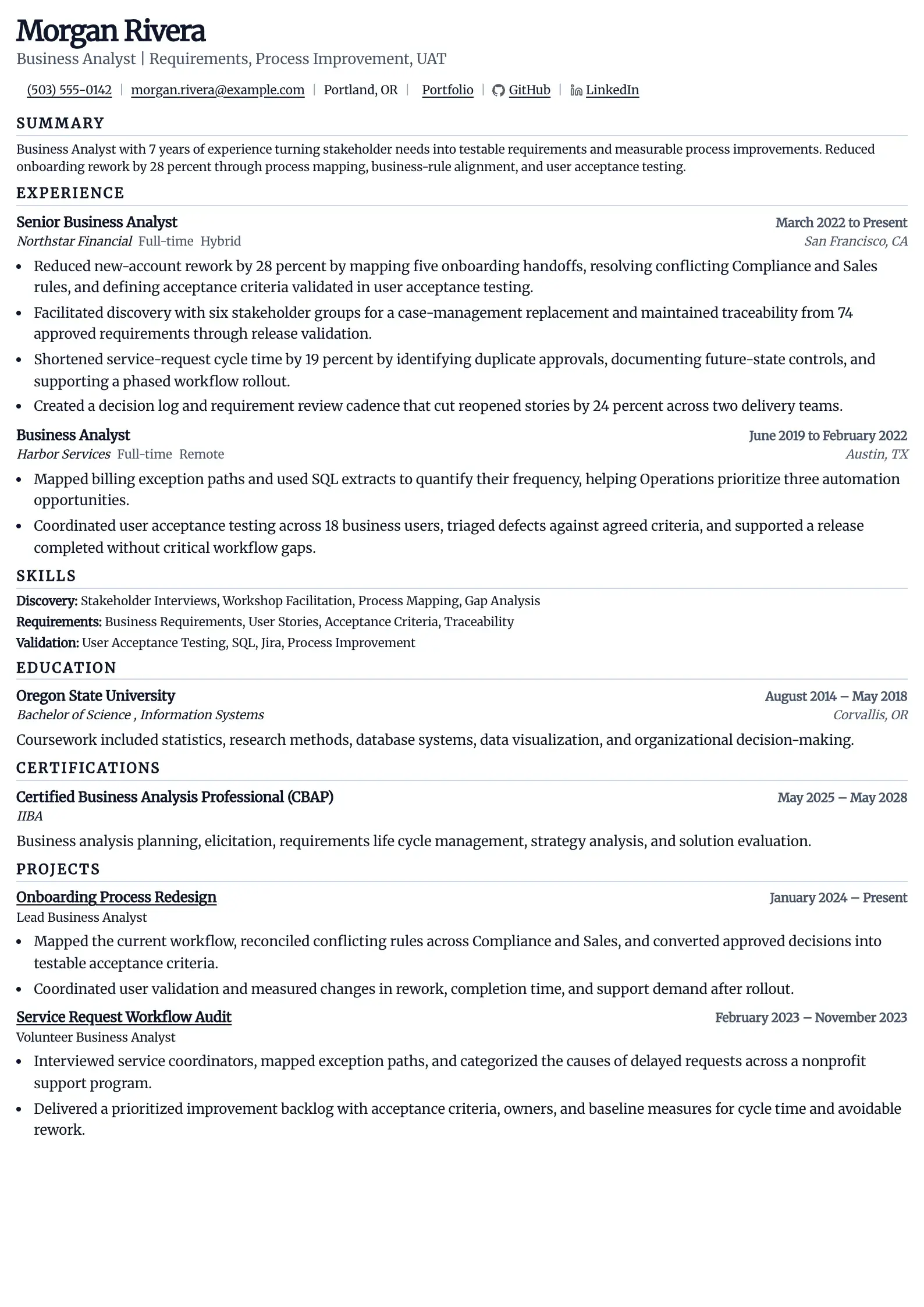
Use this resume template for business analyst applications
Present requirements, stakeholder scope, and business outcomes in a direct chronological narrative.
What business analyst hiring managers scan first
The first scan looks for a clear link between stakeholder needs and delivered results. Useful proof may include a current-state process map, requirement set, decision log, gap analysis, user story, acceptance criteria, or user acceptance testing plan. The artifact matters because of the ambiguity it resolved, not because it existed.
Be specific about your environment. A technology business analyst may work closely with product managers and engineers. An operations analyst may focus on controls, handoffs, and service levels. A consulting role may emphasize discovery across several clients. Use the title in the posting, but let your bullets explain the real scope.
A requirement that prevented rework
- Hiring signal
- The candidate can uncover conflicting needs, define an observable outcome, and give delivery partners enough clarity to build and test the change.
- Evidence to show
- Show the affected workflow, stakeholder groups, discovery method, agreed requirement, validation approach, and delivered result.
Skills that prove business analysis depth
Organize skills around discovery, definition, and validation. Discovery includes interviews, workshops, observation, data review, and document analysis. Definition includes process models, business rules, requirements, user stories, and acceptance criteria. Validation includes walkthroughs, traceability, user acceptance testing, adoption review, and outcome measurement.
Tools should support that work. Jira, Confluence, Visio, Miro, Excel, SQL, and business intelligence platforms may be useful, but tool expectations differ. Match the posting and connect key platforms to an artifact or decision.
Discover
- Stakeholder interviews
- Workshop facilitation
- Process and data investigation
Define
- Business requirements
- User stories and acceptance criteria
- Process and gap analysis
Validate
- Requirements traceability
- User acceptance testing
- Adoption and outcome review
Business analyst achievement bullets with credible evidence
Strong bullets describe the business problem, your analysis, the people or systems involved, and the result. Measures can include processing time, error rate, handoffs, rework, adoption, support requests, control findings, or money saved. When you cannot disclose a figure, show scale through the number of teams, workflows, markets, or requirements.
Before
Gathered requirements and worked with stakeholders on a new onboarding system.
After
Reduced new-account rework by 28 percent by mapping five onboarding handoffs, resolving conflicting Compliance and Sales rules, and defining acceptance criteria validated in user acceptance testing.
Why it works
The rewrite identifies the process, stakeholder conflict, analysis artifact, validation step, and measured operating result.
Action
Reduced new-account rework by 28 percent
Method
Mapped five handoffs, reconciled business rules, and defined testable acceptance criteria
Result
Validated the revised onboarding flow through user acceptance testing
Distinguish your contribution from the team's delivery. You may have led discovery and requirements while a product manager prioritized the release and engineers implemented it. Accurate boundaries strengthen credibility. Use strong resume bullet points to express collaboration without losing your own contribution.
ATS keywords matched to business analyst proof
Applicant tracking system (ATS) terms vary by domain. General language may include requirements gathering, process mapping, gap analysis, stakeholder management, user stories, acceptance criteria, and user acceptance testing. Regulated or technical roles may add controls, data mapping, integration requirements, or specific platforms.
Translate business analyst requirements into evidence
| Job requirement | Matching evidence | Keyword |
|---|---|---|
| Facilitate cross-functional requirements workshops | Aligned Compliance, Sales, and Operations on five onboarding handoffs and documented approved business rules | stakeholder facilitation |
| Support user acceptance testing | Converted approved rules into acceptance criteria and coordinated validation before release | user acceptance testing |
| Analyze and improve business processes | Mapped the current workflow, identified rework causes, and measured a 28 percent reduction after launch | process improvement |
Read resume keywords to choose exact terms you can support. Keep headings and text straightforward with the ATS-friendly resume guide.
How business analyst evidence changes by seniority
Junior candidates can demonstrate careful analysis on a defined workflow and reliable documentation. Mid-level analysts should show independent discovery, conflict resolution, and validation across a delivery. Senior analysts often shape analysis approaches across programs, manage complex stakeholder environments, mentor others, and improve how decisions are governed. Employer expectations vary, so use scope and outcomes to make the level clear.
- 1
Junior
- Focus
- Reliable analysis within a defined process
- Proof to show
- Accurate process maps, clear requirements, traceable changes, and supported testing
- 2
Mid-level
- Focus
- Independent ownership from discovery through validation
- Proof to show
- Cross-functional alignment, resolved ambiguity, testable requirements, and measured outcomes
- 3
Senior
- Focus
- Analysis leadership across complex initiatives
- Proof to show
- Program-level decisions, governance, mentoring, reusable standards, and organizational impact
Business analyst resume mistakes that hide impact
Meeting counts and document counts rarely show value. “Led 20 workshops” says little unless those sessions resolved a decision or prevented a delivery risk. Avoid calling every artifact a requirement. Separate the business need, solution constraint, user behavior, acceptance condition, and implementation detail when that distinction mattered.
Describing documentation as the final outcome
- Why it hurts
- A requirement document is an intermediate artifact, so listing it alone hides whether the team reached agreement or delivered a useful change.
- Better approach
- Connect the artifact to the ambiguity it resolved, the people who approved it, the validation performed, and the process or system result.
Do not present a framework or certification as proof of delivery. Show how you adapted a method to the situation. Avoid inflated ownership for results produced by a broader team, and never invent savings or adoption rates. A precise account of your contribution is more persuasive than a broad claim you cannot defend.
Frequently asked questions
- What should a business analyst put on a resume?
- Show how you clarified a business problem, aligned stakeholders, documented requirements, and helped deliver a measurable change. Name the process, users, artifact, decision, and outcome. Include tools and methods only when a project or experience bullet demonstrates how you applied them.
- How do I quantify business analyst work?
- Use measures tied to the process you changed, such as cycle time, error rate, rework, adoption, support volume, cost, or completion rate. You can also describe scope through stakeholder groups, workflows, requirements, or locations. Use approved figures and state shared ownership accurately.
- Should a business analyst resume include technical skills?
- Include technical skills that support the target role, such as SQL, process modeling, reporting tools, Jira, or API concepts. Connect them to business analysis evidence. A query that validated a requirement or a process model that resolved disagreement is more useful than an isolated software list.
- Are certifications required for a business analyst resume?
- Requirements vary by employer and seniority. A relevant certification can support your profile, but it does not replace evidence of discovery, requirements quality, facilitation, and delivered outcomes. Prioritize certifications named in the posting and keep them secondary to demonstrated work.

Ready to build your Business Analyst resume?
Choose sample data or build your own resume, then personalize it before you download.