
An archivist resume should prove that you can make records understandable, discoverable, and usable without losing their context. Hiring teams look for judgment across appraisal, arrangement, description, preservation, and access. A list of collections and software does not explain how you balanced evidence, user needs, restrictions, and available resources.
Build each example around a collection problem and a defensible response. State the format and scale, the processing or preservation decision, the professional standard or system applied, and the access result. Metrics such as linear feet processed, digital files stabilized, finding-aid use, request turnaround, or backlog reduction are helpful only when they are accurate and appropriately qualified.
What archivist hiring managers scan first
The first scan often asks whether you understand archival context and can complete work that improves access. Show how you assessed a collection, preserved meaningful relationships among records, documented decisions, and produced a usable finding aid or access workflow. Mention sensitive-material review when it was part of the assignment.
Different repositories divide duties differently. A university archive may emphasize instruction and reference service, while a government or corporate archive may emphasize retention, transfer, and records controls. Match the institution, collection formats, and communities in the posting rather than presenting one archival setting as universal.
Context preserved while access improved
- Hiring signal
- The candidate can make proportionate appraisal, arrangement, description, and access decisions for a real collection.
- Evidence to show
- Name the collection scale and formats, explain the processing judgment, identify the standard or system, and show how researchers or staff gained reliable access.
Skills that demonstrate archival judgment
Group skills by the responsibility they support. Collections work may include appraisal, accessioning, arrangement, description, reappraisal, and deaccessioning. Access work can include reference interviews, instruction, reproduction, rights research, and privacy review. Digital stewardship may involve transfer, fixity, file characterization, storage monitoring, and preservation metadata.
Collections stewardship
- Appraisal and accessioning
- Arrangement and description
- Processing plans and backlog prioritization
Discovery and access
- DACS and EAD
- Finding aids and reference service
- Rights, privacy, and restriction review
Digital preservation
- Born-digital transfer
- Fixity and file integrity
- Preservation metadata and storage workflows
Education requirements vary. State your degree accurately and make relevant archival coursework, practicums, language ability, or subject expertise easy to find. Do not imply certification where none exists, and distinguish formal credentials from workshops or continuing education.
Archivist achievement bullets with credible evidence
Lead with an access, preservation, or service outcome, then show the archival decisions behind it. A processing metric alone can reward speed without explaining quality. Add the collection scope, method, documentation, and audience so a reviewer can understand what the number represents.
Action
Opened a previously inaccessible organizational archive to research
Method
Appraised and arranged 85 linear feet, documented restrictions, and published a DACS-compliant EAD finding aid
Result
Cleared a 14-month processing backlog and supported 47 reference requests during the first semester
Metrics in examples are illustrative. Use only results you can verify. If public usage data is unavailable, describe a concrete deliverable such as completing an accession survey, stabilizing at-risk media, establishing a transfer workflow, or improving reference-response consistency. The guide to strong resume bullet points offers a reliable action, method, and result structure.
ATS keywords matched to archivist proof
Applicant tracking system (ATS) terms should reflect the repository and your actual work. Common language includes archival appraisal, accessioning, arrangement and description, DACS, EAD, ArchivesSpace, digital preservation, records management, reference services, oral history, metadata, copyright, privacy, and donor relations. Not every archive uses the same standards or systems.
Match archival requirements to defensible evidence
| Job requirement | Matching evidence | Keyword |
|---|---|---|
| Process physical and born-digital collections | Arranged paper series, transferred digital files, recorded checksums, and documented restrictions | hybrid collection processing |
| Create and maintain finding aids | Published DACS-compliant descriptions and validated EAD for repository discovery | arrangement and description |
Use resume keywords naturally in evidence and keep the document readable with an ATS-friendly resume structure. Spell out an uncommon system or standard once before relying on its abbreviation.
How archivist evidence changes by seniority
Early-career evidence can center on a well-scoped practicum, accession, digitization project, or reference assignment. At the middle level, show independent project planning, donor or stakeholder coordination, policy application, and responsibility for mixed-format collections. Senior archivists should demonstrate program direction, collection strategy, ethical leadership, budgets, partnerships, and staff development.
Scope matters more than inflated leadership language. A project archivist can show excellent planning and judgment without claiming repository-wide authority. A senior candidate should make governance visible through policies revised, priorities set, risks managed, or service outcomes improved.
Archivist resume mistakes that weaken credibility
Avoid describing processing as a sequence of clerical tasks. Archivists make contextual and ethical judgments, and the resume should reveal them. Do not claim that digitization equals digital preservation. Scanning creates digital objects, while preservation also requires documented management, integrity checks, storage, and ongoing care.
Naming a collection without explaining your decisions
- Why it hurts
- The collection title and size do not reveal how you appraised, arranged, described, preserved, or opened the records.
- Better approach
- Add the processing problem, the standard or workflow you applied, any restrictions you handled, and the access or preservation result.
Protect confidential and restricted information. You can discuss formats, scale, workflow, and relative impact without revealing donor terms, personal data, security-sensitive records, or unpublished collection details.
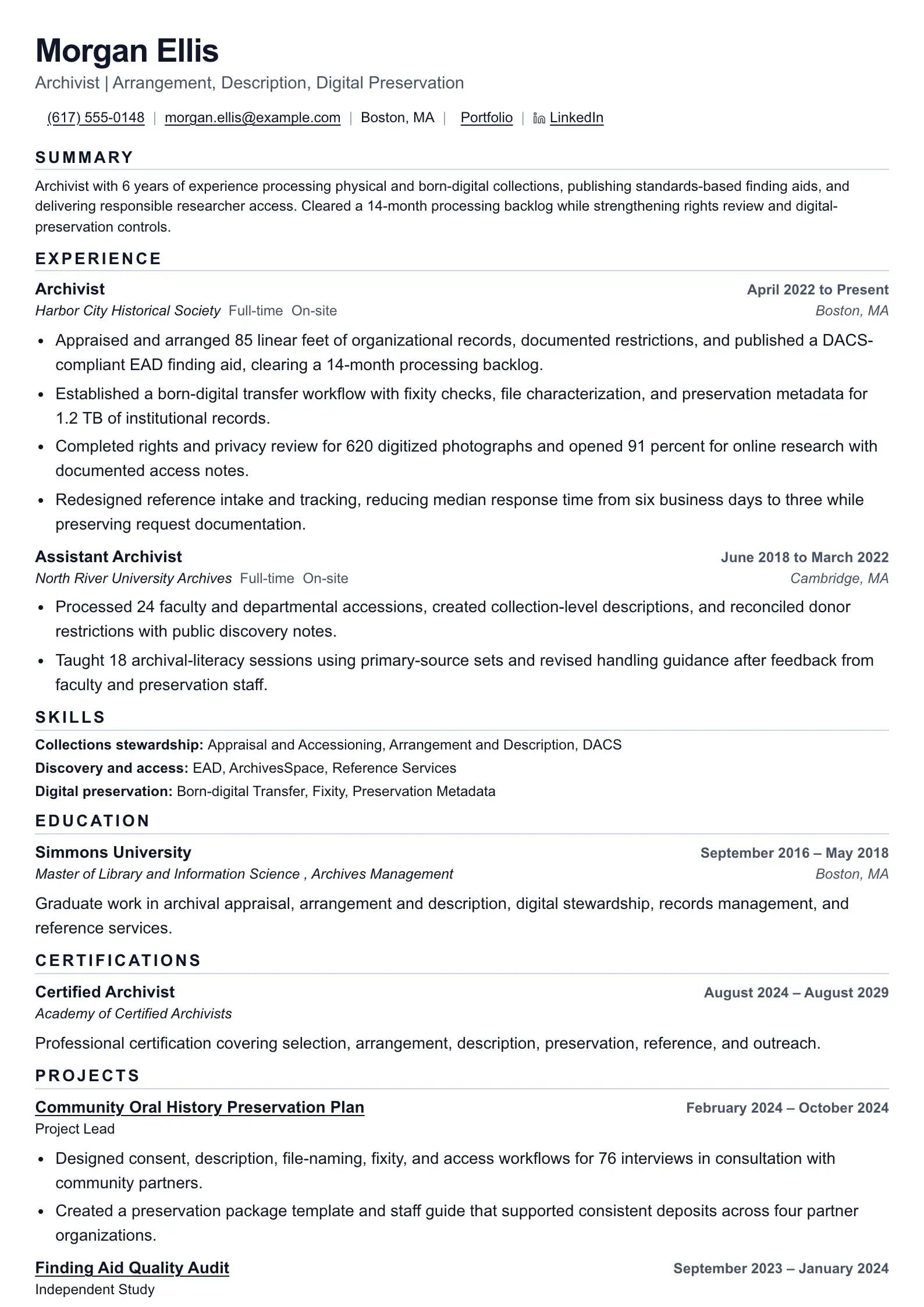
Use this resume template for archivist applications
Give collection scope, professional judgment, standards, and access outcomes a calm single-column reading order.
Frequently asked questions
- What should an archivist include on a resume?
- Show the collections you processed, their scale and formats, the standards or systems you used, and how your work improved discovery, preservation, or responsible access. Include reference service, rights review, donor communication, digital preservation, and records management when they match the position.
- How can a new archivist show experience?
- Use practicums, internships, graduate projects, community archives, and volunteer processing work. Describe the collection context, appraisal or arrangement decisions, finding aid or metadata produced, preservation actions, and users served. A bounded project with sound professional judgment is valid evidence.
- Should an archivist list every archival system?
- List systems requested in the posting that you can use competently, then connect important ones to experience. A bullet explaining how you created an EAD finding aid in ArchivesSpace or managed born-digital files is stronger than an unsupported software inventory.
- Does an archivist resume need a portfolio?
- A portfolio can help when it contains public finding aids, exhibits, collection guides, workflows, or redacted project documentation. Respect donor agreements, privacy, copyright, and institutional policy. Never publish restricted records or internal collection data to demonstrate your work.

Ready to build your Archivist resume?
Choose sample data or build your own resume, then personalize it before you download.