
An AI Engineer resume should make a hiring manager confident that you can turn probabilistic model behavior into a dependable product capability. Show how you built the data and retrieval path, defined evaluation criteria, deployed services, controlled risk, and improved the operating economics. Your strongest evidence connects model choices to measurable production outcomes, not merely to a completed chatbot, API integration, or prototype.
Atlas AI Engineer Resume
A focused structure for presenting model evaluation, retrieval systems, deployment ownership, and production reliability evidence.
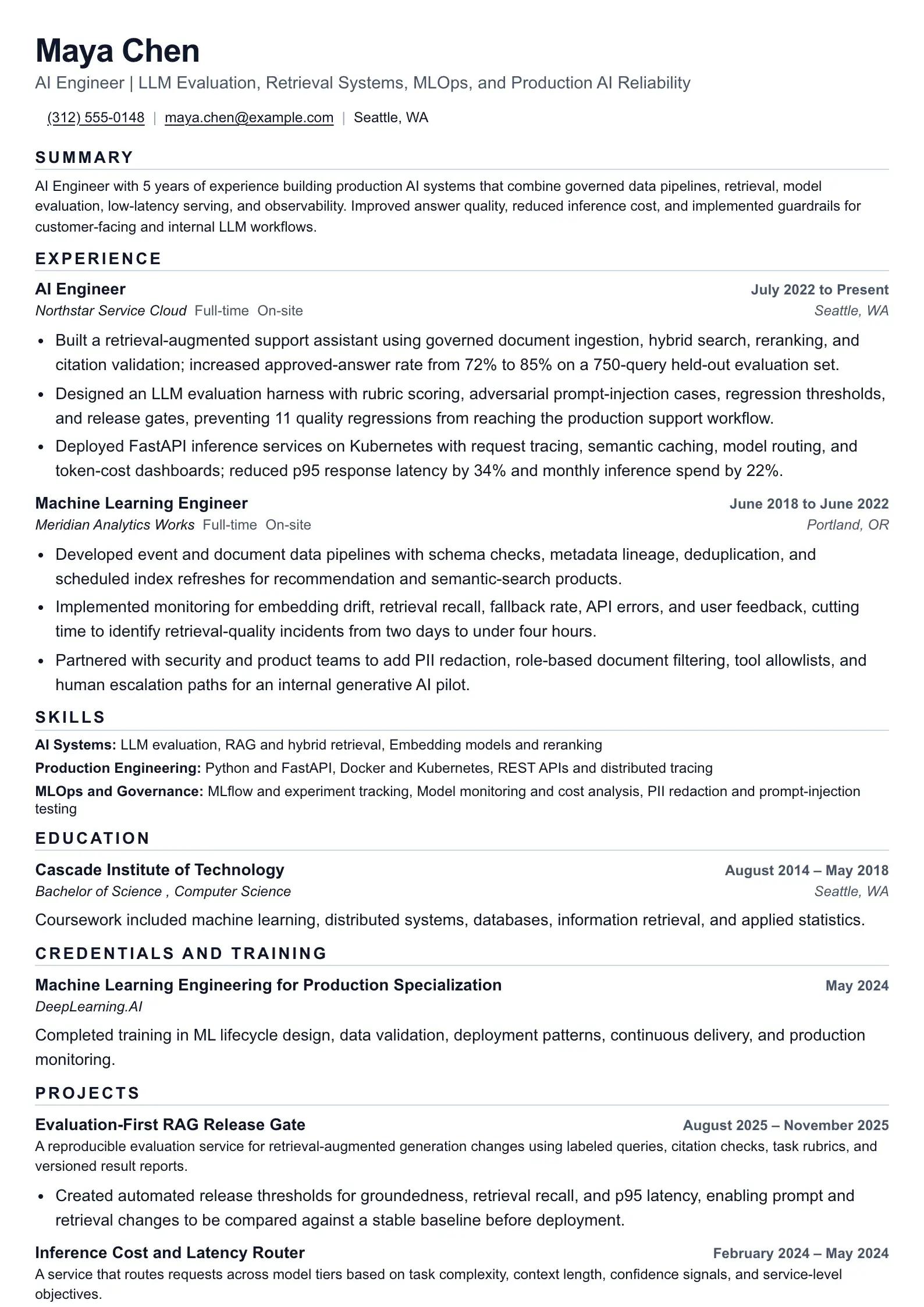
What AI Engineering Teams Validate First
What makes AI Engineer evidence credible
- Hiring signal
- Production ownership across evaluation, deployment, and iteration
- Evidence to show
- Name the evaluation dataset or rubric, the release gate, the serving or retrieval architecture, and an illustrative outcome such as lower p95 latency, fewer escalations, or reduced inference spend.
Use the same approach for platform work. If you built a shared inference gateway, explain how routing, caching, rate limits, telemetry, and fallback behavior improved reliability for downstream teams. If your metrics are illustrative examples, label them as examples in interview discussion and be prepared to explain the measurement window and baseline.
Skills That Prove Production AI Ownership
Model and retrieval engineering
- LLM evaluation
- RAG pipelines
- Embedding retrieval and reranking
Production AI systems
- Python and FastAPI
- Docker and Kubernetes
- Inference APIs and caching
MLOps and AI governance
- MLflow and experiment tracking
- Monitoring and tracing
- Prompt injection and PII controls
Describe data work with equal precision. AI Engineers often inherit documents, events, labels, or feedback that are incomplete, stale, duplicated, or access restricted. Show schema validation, chunking strategy, metadata filters, lineage, refresh cadence, and access controls when they materially affected model quality or safety. This makes your resume more credible than a generic list of vector databases and prompt libraries.
For ATS structure and readable parsing, use conventional section labels, consistent dates, and simple skill groups. Review practical formatting guidance in ATS-friendly resume guidance, then preserve enough detail for a technical reviewer to understand what you personally owned.
Write Bullets Around Evaluated System Outcomes
Write bullets as compact engineering narratives. Begin with a decisive action, identify the model or system mechanism, then report a measured production effect. Strong AI Engineer bullets also mention the evaluation signal that prevented a misleading launch metric. A faster response is not a success if answer grounding or user completion fell.
Action
Built or improved a production AI capability
Method
by naming the evaluation set, retrieval or model intervention, deployment path, and monitoring mechanism
Result
to report a verified change in quality, latency, cost, safety, or operational workload
A useful illustrative pattern is: “Built a hybrid retrieval service for support agents using metadata filtering, reranking, and citation checks; raised approved-answer rate from 71% to 84% on a 600-query held-out evaluation set while holding p95 response time below 2.2 seconds.” The numbers are only useful when you can define approved-answer rate, explain the held-out set, and clarify whether the result came from offline evaluation, production telemetry, or both.
Make deployment ownership visible. Mention CI checks for prompt or model changes, containerized serving, feature flags, canary releases, rollback triggers, and trace collection where relevant. For more bullet construction patterns, see strong resume bullet points. Avoid claiming that a model was “accurate” without specifying the task, error taxonomy, or evaluation method.
ATS Keywords for AI Engineering Roles
AI Engineer postings vary between applied AI, LLM platform, machine learning infrastructure, and retrieval roles. Mirror the terms used in the target posting only when they accurately describe your experience. Put high-value terms in experience bullets as well as skills, because contextual evidence is stronger than a keyword block alone.
AI Engineer keywords to substantiate with evidence
- LLM evaluation
- retrieval-augmented generation
- vector search
- reranking
- prompt engineering
- model serving
- MLOps
- MLflow
- Kubernetes
- feature flags
- observability
- distributed tracing
- latency optimization
- token cost management
- AI guardrails
- prompt injection defense
- PII redaction
- human feedback loops
A target role may use “agentic workflows,” “tool calling,” or “multimodal inference.” Include those terms only if you can explain orchestration, tool permissions, error handling, evaluation, and monitoring in an interview. Read more about selecting terms without stuffing them in resume keywords guidance. Vendor names can help ATS matching, but system outcomes should carry the narrative.
How AI Engineering Scope Changes by Seniority
As seniority rises, the resume should move from implementing isolated model features to owning the reliability and economics of AI capabilities across teams. An early-career AI Engineer can earn attention with disciplined evaluation, clean data pipelines, reproducible experiments, and well-instrumented deployments. A senior candidate should show architecture decisions, risk controls, platform leverage, and alignment with product or compliance stakeholders.
Match AI Engineer requirements to direct proof
| Job requirement | Matching evidence | Keyword |
|---|---|---|
| Evaluate LLM quality before release | Created labeled test sets, rubric-based grading, regression gates, and failure-category dashboards for prompt and model changes. | LLM evaluation |
| Build reliable retrieval systems | Implemented ingestion, chunking, metadata filtering, hybrid search, reranking, and citation verification for governed knowledge sources. | RAG |
| Operate production AI services | Deployed instrumented inference services with canary releases, p95 latency alerts, cost dashboards, and rollback criteria. | MLOps |
- 1
AI Engineer I
- Focus
- Ship bounded AI features with reproducible evaluations and supervised production releases.
- Proof to show
- Improved a retrieval or inference workflow using a defined test set, telemetry, and documented rollback path.
- 2
AI Engineer II
- Focus
- Own end-to-end AI services and resolve quality, latency, cost, and data issues across releases.
- Proof to show
- Led a measurable system improvement from data ingestion through deployment monitoring.
- 3
Senior AI Engineer
- Focus
- Set evaluation standards, platform patterns, and governance controls for multiple AI use cases.
- Proof to show
- Established reusable release gates or AI infrastructure that reduced risk and accelerated other teams.
For regulated, healthcare, financial, or public-sector use cases, describe the controls you implemented without implying legal approval authority unless that authority was formally part of your role. Employer policies, contractual requirements, and applicable regulations vary.
AI Engineer Resume Mistakes That Signal Prototype-Only Work
Replace prototype language with production evidence
- Why it hurts
- Built an LLM chatbot using a vector database and prompt engineering.
- Better approach
- Built a governed support assistant with document ingestion validation, hybrid retrieval, citation checks, prompt-injection tests, request tracing, and release gates; reduced agent search time by 28% in a monitored pilot.
Do not overstate safety claims. Say that you implemented PII redaction, content filters, tool allowlists, or adversarial test cases, then explain the coverage and escalation path. Guardrails reduce specific risks but do not guarantee harmless or compliant output. Similarly, distinguish offline evaluation gains from live-user outcomes and identify when human review remained in the workflow.
Keep bullets focused on your contribution. If a data scientist trained the model, explain your role in data contracts, inference serving, evaluation harnesses, retrieval architecture, observability, or release engineering. That precision helps employers understand why you are an AI Engineer rather than a general software engineer or research scientist.
Frequently asked questions
- What should an AI Engineer emphasize on a resume?
- Emphasize evidence that a model or AI system was evaluated, deployed, monitored, governed, and improved in production, including quality, latency, cost, and failure-rate outcomes.
- How is an AI Engineer resume different from a software engineer resume?
- An AI Engineer resume must show model behavior, data quality, retrieval performance, inference tradeoffs, guardrails, and ongoing evaluation rather than only application features and delivery dates.
- Should AI Engineers list model names?
- List model families and platforms when relevant, but pair them with the evaluation method, deployment architecture, and production result so the resume shows engineering judgment rather than tool familiarity alone.
- What metrics are useful for an AI Engineer resume?
- Useful metrics include grounded-answer rate, task completion, retrieval recall, latency, token cost, fallback rate, incident volume, evaluation coverage, and adoption. Use only metrics you can explain accurately.

Ready to build your AI Engineer resume?
Choose sample data or build your own resume, then personalize it before you download.