
An Accountant resume should make your accuracy, process discipline, and reporting judgment easy to assess. Show how you support the close cycle, investigate account activity, and document issues for review. Name the ledgers, entities, funds, account types, systems, and deadlines within your scope.
Target the accounting environment. Corporate roles may emphasize entity reporting and ERP workflows. Public accounting may prioritize client service, workpapers, and audit coordination. Nonprofit positions may focus on restricted funds and grant reporting, while government roles can involve fund accounting, appropriations, and compliance. State the context accurately without assuming one credential or framework applies to every employer.
Accountant Hiring Priorities
Hiring teams look for evidence that you can complete recurring work accurately, resolve discrepancies before reports are finalized, and meet close deadlines. Show how you prepare or review journal entries, reconcile accounts, maintain schedules, and escalate questions with support.
For reconciliations, include the account category, frequency, source records, reviewer process, and disposition of open items. That is more informative than “maintained accurate books.”
What Accounting Hiring Teams Need to See
- Hiring signal
- Evidence that you can complete recurring accounting work accurately, meet reporting deadlines, and maintain reviewable support.
- Evidence to show
- Name the close activity, account or reporting scope, system or source records used, and the control or review step that supported the result.
For an initial formatting and structure check, use this ATS-friendly resume guide. Conventional headings such as Experience, Education, Certifications, Technical Skills, and Professional Experience help applicant tracking systems and reviewers find relevant information.
Accountant Resume for Close and Reporting Work
Present month-end close responsibilities, reconciliations, reporting support, controls, and accounting systems in a focused experience record.
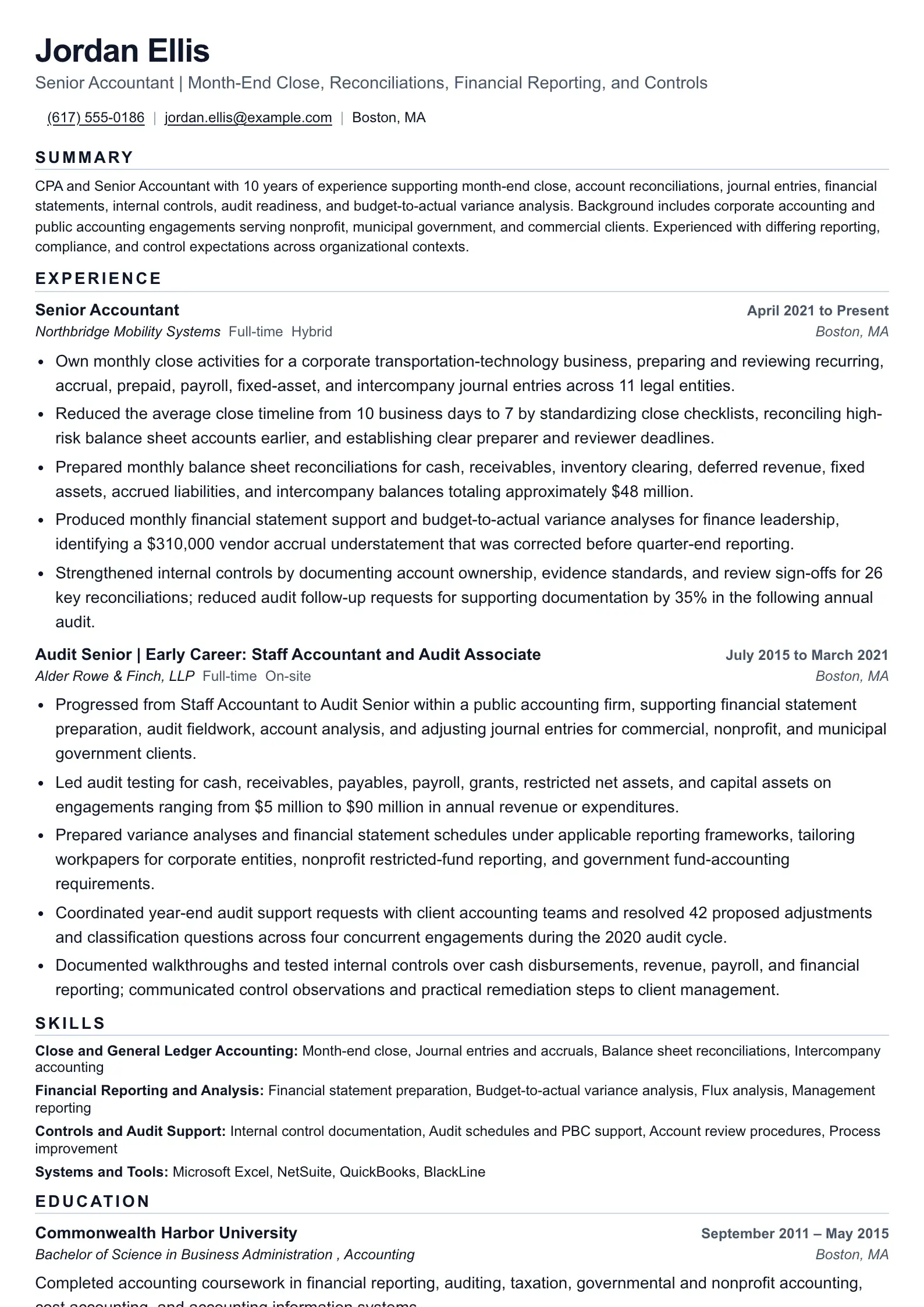
Accountant Skills to Demonstrate
Organize skills around work you have performed, not every term encountered. Core skills may include general ledger accounting, journal entry preparation, bank and balance sheet reconciliations, fixed assets, prepaid expenses, accruals, intercompany activity, accounts payable, accounts receivable, and cash management. List software or ERP platforms only if you can explain how you used them.
Reporting skills can include preparing schedules, supporting financial statements, researching variances, and answering reviewer questions. For controls, identify approval workflows, audit trails, documentation standards, or remediation tracking. Do not claim ownership of a control framework if you completed only part of the process.
Close and General Ledger
- month-end close
- journal entries
- accruals
- account reconciliations
- general ledger review
Reporting and Analysis
- financial statements
- variance analysis
- management reporting
- Excel
- financial schedules
Controls and Assurance
- internal controls
- audit support
- workpapers
- documentation
- issue follow-up
Accountant Achievement Bullets
Build achievement bullets around the accounting process and result. Include account scope, cadence, tools, stakeholders, and a verified outcome. Credible results can include clearing aged items, improving documentation, or identifying classification issues.
Use this guide to strong resume bullet points to refine structure. An illustrative, not benchmark, example is: “Prepared monthly reconciliations for 18 balance sheet accounts, researched unreconciled items with treasury and AP partners, and maintained reviewer-approved support before the close deadline.” It establishes scope and process without inventing a financial outcome.
A stronger quantified example might read: “Standardized an Excel reconciliation tracker for 12 recurring accounts, reducing outstanding follow-up items from 31 to 9 over two close cycles.” Use figures only when records support them. Do not imply sole responsibility for a broader financial result.
Action
Accounting action + account or reporting scope + process or control + documented result
Method
Prepared and reviewed recurring prepaid expense entries for three entities; reconciled supporting schedules to the general ledger and resolved timing differences before monthly reporting.
Result
State the verified scope, quality, timing, or service result without presenting an illustrative metric as a benchmark.
Accountant ATS Keywords
Tailor keywords to the posting, especially its reporting environment and systems. A staff accountant role may emphasize general ledger, reconciliations, close, prepaid expenses, accruals, and Excel. An audit-facing role may prioritize workpapers, PBC requests, internal controls, SOX testing, and external audit support. Nonprofit or government roles may use grant accounting, restricted funds, fund accounting, or compliance reporting.
Read the posting alongside this explanation of resume keywords. Use important terms naturally in your summary, skills, and experience sections. Do not add GAAP, governmental standards, grant compliance, tax preparation, or audit testing unless your experience supports them.
Accountant ATS Keywords to Tailor
- month-end close
- general ledger
- journal entries
- account reconciliations
- financial statements
- variance analysis
- internal controls
- audit support
- ERP systems
- advanced Excel
Accountant Seniority and Early-Career Progression
Early-career accountants can show readiness through journal entry support, routine reconciliations, invoice or payment review, fixed asset schedules, close checklists, and audit support. Include internships, rotational assignments, contract work, or academic projects when they involved accounting tools, documented procedures, or supervised analysis.
Be specific about review relationships without understating your contribution. “Prepared bank reconciliations for senior accountant review” is more credible than implying final approval authority. Highlight documentation quality, Excel capability, and the ability to investigate discrepancies with guidance. If pursuing a CPA or another credential, state the current status plainly.
More experienced accountants can show ownership of recurring close areas, complex reconciliations, financial statement schedules, control improvements, and audit requests. Senior accountants may add review responsibilities, process standardization, technical research, or mentoring when assigned. Accounting managers should clarify leadership scope, reporting ownership, team responsibilities, and oversight of close or control processes.
- 1
Early-Career Accountant
- Focus
- Build reliable accounting fundamentals under review while learning close procedures, systems, and documentation standards.
- Proof to show
- Prepared entries, completed assigned reconciliations, maintained schedules, resolved routine discrepancies, and supported audit requests.
- 2
Staff or Senior Accountant
- Focus
- Own recurring accounting areas, analyze exceptions, improve close readiness, and coordinate with operating partners.
- Proof to show
- Managed account certifications, prepared reporting schedules, explained variances, and strengthened recurring workflows.
- 3
Accounting Lead or Manager
- Focus
- Guide close execution, review complex work, maintain controls, and communicate financial information to leadership.
- Proof to show
- Reviewed deliverables, managed assigned teams or processes, coordinated audits, and implemented documented improvements.
Accountant Resume Mistakes to Avoid
Avoid duty-only bullets such as “completed month-end close” or “handled reconciliations.” Replace them with the account scope, process, and review or use of the work.
Do not overstate authority. Preparing a financial statement schedule differs from issuing external financial statements. Supporting an audit differs from leading an audit or providing an audit opinion. Participating in a control process does not necessarily mean designing the organization’s controls.
Protect confidential information. Describe authorized, supportable account volume, timing, error resolution, reporting cadence, or percentage changes, but avoid sensitive financial figures, client data, employee information, or nonpublic business details.
Replacing a Vague Reconciliation Bullet
- Why it hurts
- Responsible for monthly bank reconciliations and resolving discrepancies.
- Better approach
- Prepared monthly bank reconciliations for six operating accounts, researched unmatched transactions with treasury and AP teams, and documented resolution status for controller review before close.
Clarify Review Authority
- Why it hurts
- A bullet says the candidate approved financial statements when the documented role was preparation and review support.
- Better approach
- State the assigned scope: prepared schedules, investigated variances, answered reviewer questions, and incorporated approved adjustments before reporting.
Frequently asked questions
- What should an accountant resume emphasize?
- An accountant resume should emphasize the accounting cycle: journal entries, account reconciliations, month-end close, financial statement preparation, variance analysis, internal controls, and audit support. Tailor the scope to the employer’s industry, systems, reporting requirements, and assigned entities or funds.
- How can an accountant show results without overstating impact?
- Describe the process improved, the accounts or reports involved, the time period, and the observed result. For example, explain how a reconciliation tracker reduced open items or how a reporting review identified classification issues. Use verified figures and label hypothetical examples as illustrative.
- Should an accountant list CPA status on a resume?
- List CPA status, exam progress, licenses, or other relevant credentials accurately when applicable. Requirements vary by employer and setting. Public accounting firms, government employers, corporate finance teams, and nonprofit organizations may weigh credentials differently depending on the role.
- Which accounting keywords are useful for ATS screening?
- Useful accounting keywords may include month-end close, general ledger, journal entries, reconciliations, GAAP, financial statements, variance analysis, internal controls, audit support, accounts payable, accounts receivable, ERP systems, and advanced Excel. Use only terms supported by your experience.

Ready to build your Accountant resume?
Choose sample data or build your own resume, then personalize it before you download.