
Introduction
A speculative application, also called an unsolicited cover letter or letter of interest, approaches an employer without responding to a specific vacancy. Its job is to identify a credible area of need, show relevant evidence, and make a reasonable request without pretending that a role exists.
This page focuses on the decision the letter must help a reader make. It does not replace the resume, application form, interview, or documents the employer requests. Follow the posting first, keep every date and claim consistent, and use the letter to interpret the strongest evidence for this particular opportunity.
Research must be specific and current, but do not infer private hiring plans from vague signals. Address a function, problem, or type of work you can support. A speculative letter is different from asking a stranger to invent a job around a generic profile. Review the general cover letter content framework if you need a baseline for the opening, evidence paragraphs, and close. The guidance below adapts that framework to this situation.
What to address directly
Why does this context matter?
- Hiring manager concern
- The reader may notice an unusual application detail and form an incomplete explanation.
- What your letter should prove
- Give only the accurate context needed to understand the application, then move to job-related evidence.
Can the candidate do this work?
- Hiring manager concern
- Context alone does not prove a match for the role's responsibilities.
- What your letter should prove
- Build a concise value proposition from evidence. Explain the kind of contribution you make, support it with one result, and connect it to an observable employer priority such as a published service, expansion, program, or customer group.
Is the application credible?
- Hiring manager concern
- Unsupported claims, vague praise, or inconsistent details can weaken trust.
- What your letter should prove
- Use facts you can explain, match the posting accurately, and keep names, dates, titles, and outcomes consistent across materials.
Why this employer now?
- Hiring manager concern
- A reusable letter may show interest in getting any job rather than this role.
- What your letter should prove
- Connect one observable employer need to relevant evidence without guessing at private plans or flattering the organization generically.
Structural approach for a speculative cover letter
Start by naming the exact [Job Title] and giving the strongest reason your background fits. The opening should help the reader understand the application in a few sentences. Avoid a dramatic life story, a generic statement of excitement, or a summary of everything in your resume.
Handle the scenario-specific context in the smallest useful space. Research must be specific and current, but do not infer private hiring plans from vague signals. Address a function, problem, or type of work you can support. A speculative letter is different from asking a stranger to invent a job around a generic profile. If the posting asks a direct question, answer it in the required field as well. Do not use polished wording to hide a material fact.
Build the center of the letter around proof. Build a concise value proposition from evidence. Explain the kind of contribution you make, support it with one result, and connect it to an observable employer priority such as a published service, expansion, program, or customer group. Explain the situation briefly, identify your own action, and state a result you can support. Results do not need to be percentages. A completed delivery, improved decision, avoided error, satisfied requirement, or clear customer outcome can be credible when described precisely.
Connect that evidence to [Company Name]. Use a public, current detail from the posting, organization, product, program, or team. Do not invent a culture claim or imply inside knowledge. State what you could contribute while recognizing that you will need to learn the employer's specific systems and priorities.
Close with a direct professional sentence. Confirm any requested attachment or availability detail, thank the reader, and invite a conversation. Read the final letter beside the posting and resume. Remove repetition, confirm every proper noun, and check that the scenario does not consume more space than your qualifications.
- 01
Establish the match
Name the role and lead with the strongest relevant qualification.
- 02
Give necessary context
Address this scenario accurately and in proportion to what the reader needs.
- 03
Prove contribution
Use a specific action and outcome tied to an employer requirement.
- 04
Close clearly
Confirm the next step without pressure, apology, or unsupported certainty.
Use this template for a letter of interest
Present one credible area of contribution and a low-pressure next step without implying that a vacancy already exists.
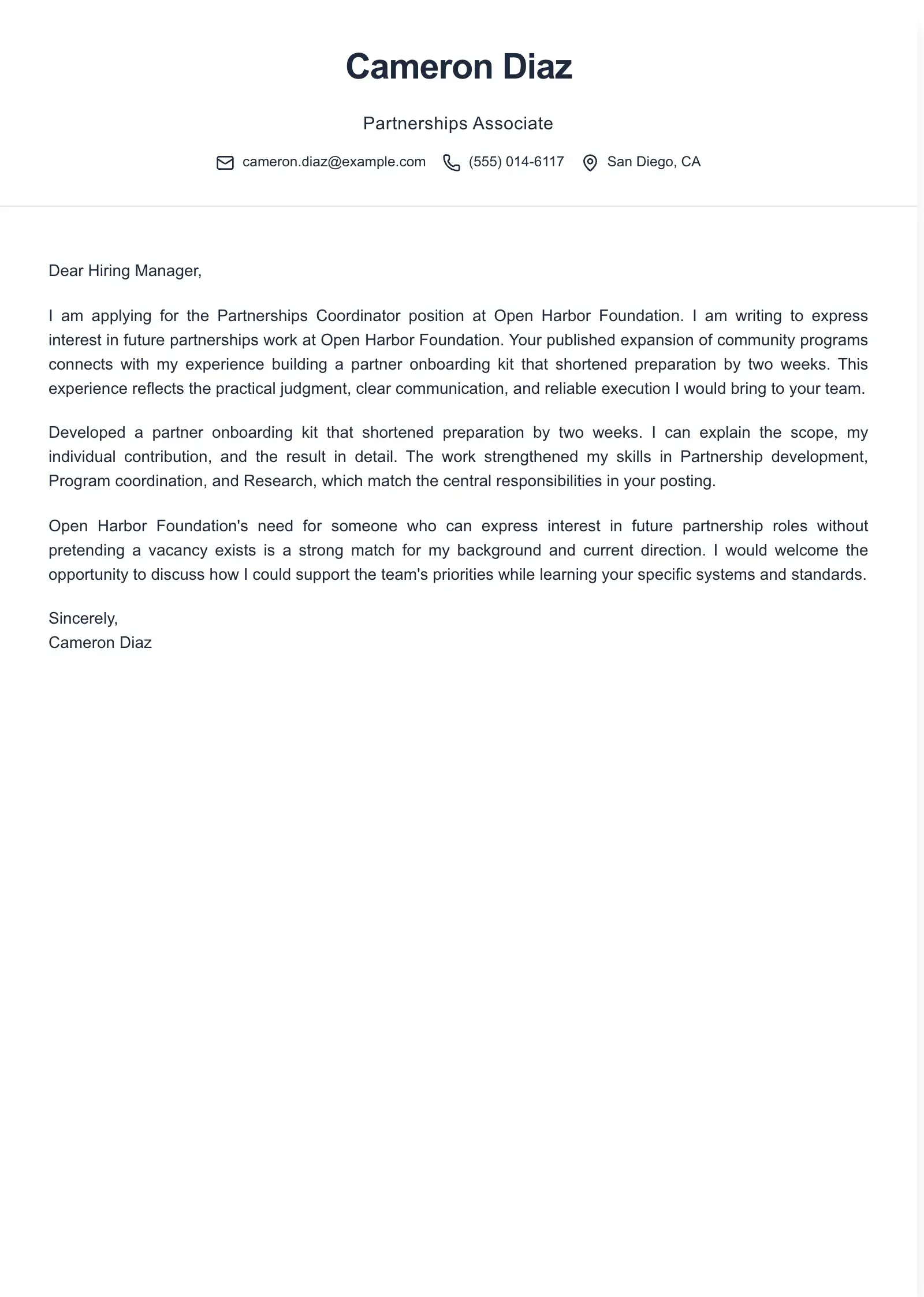
Example paragraphs
“I am writing to express interest in future [Function or Role Type] opportunities at [Company Name]. Your published work on [Specific Initiative] connects with my experience [Relevant Work], including [Action and Verified Result].”
“In my current role, I [Action] for [Scope], which led to [Outcome]. If [Company Name] is strengthening [Observable Area], I could contribute experience in [Capabilities] while learning the team's specific systems and priorities.”
“I understand that you may not have a suitable opening now. If this background is relevant to planned work in [Area], I would value a brief conversation or guidance on the appropriate way to monitor future opportunities.”
Adapt these examples to facts you can defend. Replace every bracketed placeholder, remove any sentence that is not true for you, and preserve the employer's terminology only when it accurately describes your experience. A concrete but modest example is stronger than an impressive claim that becomes vague when questioned.
Common mistakes in a speculative cover letter
Pretending a vacancy exists
- What goes wrong
- Assumptions about hiring can make the message feel careless.
- Better approach
- Acknowledge that timing or openings may be unknown.
Sending a generic biography
- What goes wrong
- A long career summary gives the employer no reason to respond.
- Better approach
- Focus on one credible need and one supporting result.
Using invented research
- What goes wrong
- Unverified growth claims or copied praise weaken trust.
- Better approach
- Refer only to current public information you can substantiate.
Demanding a meeting
- What goes wrong
- Cold outreach creates no obligation for the recipient.
- Better approach
- Make a specific, low-pressure request and accept no response.
A final review should test both substance and consistency. Ask whether a stranger can understand the relevant context, your actual contribution, and the reason this employer is a sensible target. Then compare titles, dates, results, and explanations with the resume and application form.
Frequently asked questions
- Is a speculative cover letter the same as a letter of interest?
- The terms often overlap. Both express interest without applying to a confirmed opening. A useful letter identifies the work you could support, offers evidence, and acknowledges that timing may not align.
- Who should I send it to?
- Use a relevant public contact or approved careers channel. A functional leader may be appropriate when contact details are published, but avoid guessing personal addresses or bypassing stated application rules.
- Should I attach a resume?
- Attach one when the contact method allows it and the document supports the proposed contribution. Mention the attachment and use a clear file name. Do not send unnecessary files.
- How should I follow up?
- One brief follow-up after a reasonable interval may be appropriate unless the organization says otherwise. Add useful context, avoid repeated messages, and continue monitoring official vacancies.

Put this career change approach into practice
Choose sample data or build your own cover letter, then personalize it before you download.