
Introduction
A cover letter with no formal experience still needs evidence. The evidence simply comes from places other than a conventional job history. Coursework, personal projects, volunteering, student organizations, caregiving responsibilities, community work, and short-term paid tasks can all demonstrate relevant capabilities when you describe them accurately. The goal is not to disguise your starting point. It is to help the employer see what you can already do and why this particular role is a sensible next step.
Start by replacing the question, “What jobs have I had?” with “Where have I done work like this?” A role asking for careful records may connect to a research project. A customer-facing position may connect to event support or community service. A job requiring coordination may connect to organizing a club activity with deadlines and multiple contributors. The work experience definition is broader than permanent employment, but every example must be labeled honestly.
What to address directly
Can this person perform the basic work?
- Hiring manager concern
- Without a related job title, the reviewer has less direct proof that you understand the tasks and expectations.
- What your letter should prove
- Choose two or three core requirements and connect each one to a specific action from a project, course, volunteer role, or other responsibility.
Do they understand the role?
- Hiring manager concern
- A generic application can suggest that the candidate is applying everywhere without understanding this position.
- What your letter should prove
- Refer to a real responsibility from the posting and explain why your preparation or interests connect to that work.
Will they learn reliably?
- Hiring manager concern
- An entry-level hire may need instruction, so the employer looks for evidence of follow-through, feedback, and steady improvement.
- What your letter should prove
- Describe a time you learned a tool, revised work after feedback, or completed a demanding project. Show the process, not just enthusiasm.
Are the claimed skills credible?
- Hiring manager concern
- Words such as communication, leadership, and organization are difficult to evaluate without context.
- What your letter should prove
- Attach each important skill to a task, constraint, and observable result. Use modest, precise language rather than inflated claims.
Structural approach for a no-experience cover letter
Open by naming the [Job Title] and one strong point of fit. That point might be relevant study, a completed project, sustained volunteer work, or direct familiarity with the problem the organization solves. Avoid opening with “Although I have no experience.” It makes absence the main message before the reader sees your preparation.
Use the middle paragraphs for evidence. Select examples based on the posting, not on which activity sounds most impressive. For each example, explain the situation, your own action, and the useful result. If it was a group project, distinguish your contribution from the group outcome. If the result was qualitative, state what was completed, improved, clarified, or delivered without inventing a percentage.
Then explain why [Company Name] and this role make sense for your next step. A specific product, audience, method, or responsibility is more persuasive than praise about reputation. Close by restating the contribution you are prepared to make and inviting a conversation. A useful general structure is also available in what to put in a cover letter.
- 01
Lead with fit
Name the role and your strongest relevant source of preparation.
- 02
Prove two requirements
Translate projects, education, service, or responsibilities into concrete evidence.
- 03
Show direction
Connect your preparation to this employer and close with realistic readiness.
Use this template for a first-job cover letter
Organize relevant preparation and practical evidence without making experience level the headline.
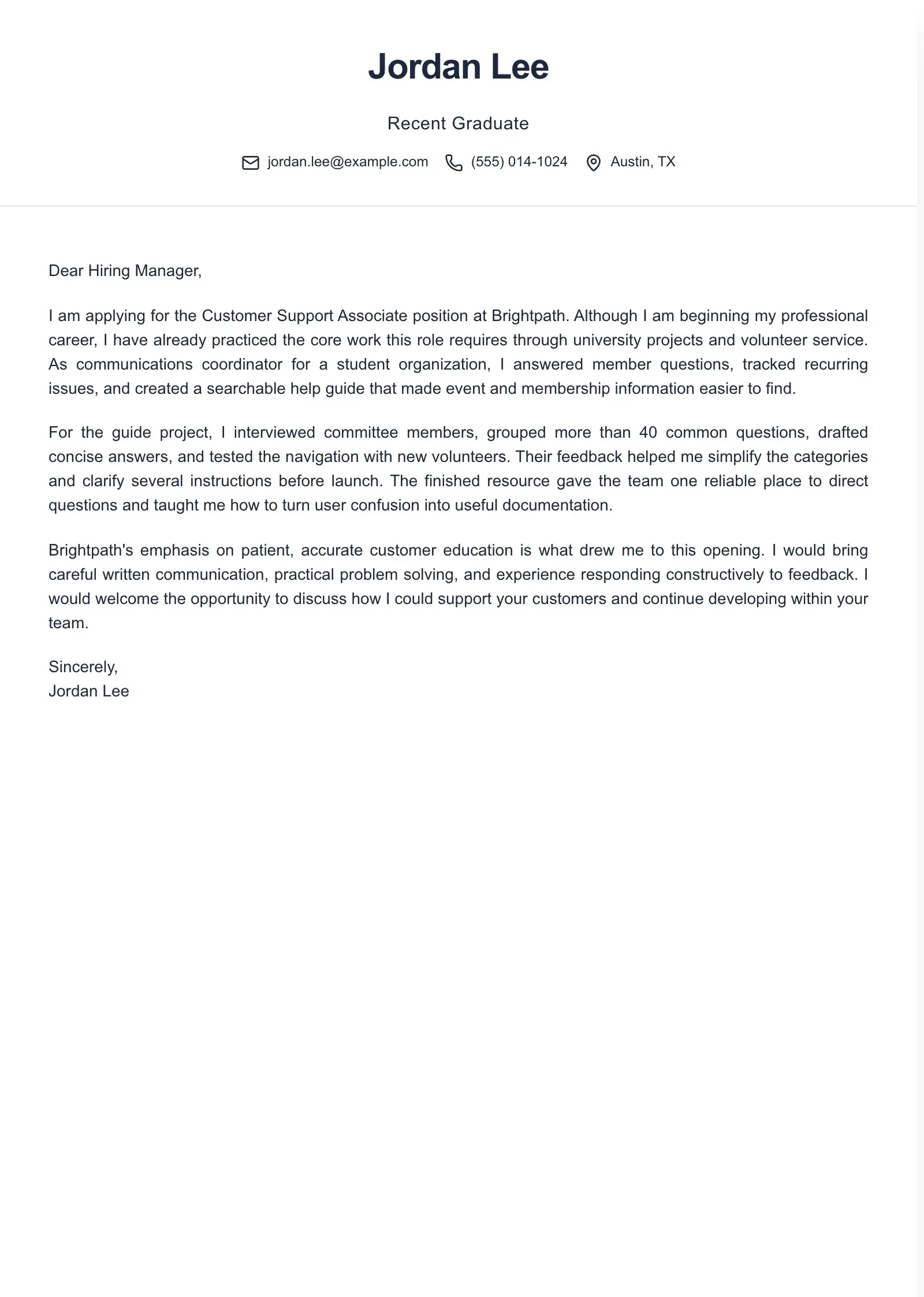
Example paragraphs
“I am applying for the [Job Title] position at [Company Name]. Through [Course, Project, Volunteer Role, or Responsibility], I developed experience with [Relevant Task] and completed [Specific Output]. Your need for someone who can [Requirement From Posting] closely matches the work I have already practiced and want to deepen in a professional setting.”
“For a recent [Course or Personal Project], I was responsible for [Your Responsibility]. I [Specific Action], used [Relevant Tool or Method], and delivered [Result or Output] by [Constraint or Deadline]. Feedback from [Instructor, User, Organizer, or Teammate] led me to [Improvement], which strengthened both the final work and my ability to respond constructively.”
“I am especially interested in [Company Name] because [Specific Product, Audience, or Working Method]. My experience with [Relevant Preparation] would help me contribute to [Named Responsibility], while the role would let me build deeper capability in [Appropriate Growth Area]. I would welcome the opportunity to discuss how I could support your team.”
These examples do not pretend that a project is identical to paid employment. They identify transferable evidence and leave room for learning. That balance is more credible than either minimizing your preparation or claiming expert-level ability.
Common mistakes in a no-experience cover letter
Apologizing in the opening
- What goes wrong
- Leading with what you lack frames the rest of the letter as a request for an exception.
- Better approach
- Lead with the strongest relevant evidence, then describe your experience level accurately if context requires it.
Listing traits without proof
- What goes wrong
- Calling yourself hardworking, passionate, or a fast learner gives the reviewer nothing concrete to assess.
- Better approach
- Show one demanding task, the action you took, and how you completed or improved the work.
Treating every activity as a job
- What goes wrong
- Inflating coursework, volunteering, or informal responsibilities can create trust problems when details are checked.
- Better approach
- Use accurate labels and focus on the genuine skills, scope, and results of the activity.
Sending the same letter everywhere
- What goes wrong
- A generic letter cannot explain why your limited evidence fits one employer's actual needs.
- Better approach
- Choose examples after reading the posting and connect them to named responsibilities at that organization.
Frequently asked questions
- What do I put in a cover letter if I have no experience?
- Use evidence from coursework, projects, volunteering, community responsibilities, or customer-facing activities. Match two or three examples to the job requirements and explain what you did, how you approached it, and what changed because of your work.
- Should I say that I have no experience?
- Do not lead with an apology or a broad claim that you have no experience. If you lack formal employment in the field, acknowledge that briefly when needed, then show relevant preparation and evidence from other settings.
- How long should a no-experience cover letter be?
- Aim for about three or four concise paragraphs on one page. Give the employer enough context to understand your target, two relevant examples, and your reason for applying without repeating every item on your resume.
- Can school projects count as experience?
- Yes, when the project required work that relates to the position. State the goal, your individual contribution, the tools or skills you used, and the result. Label it accurately as coursework or a project rather than presenting it as employment.

Put this career change approach into practice
Choose sample data or build your own cover letter, then personalize it before you download.