
Introduction
A military-to-civilian cover letter should translate, not minimize, your service. The reader needs to understand the scope of your work, the problems you solved, and how those capabilities match a civilian role. Rank, unit names, and acronyms provide little value unless you explain what they meant in practice.
This page focuses on the decision the letter must help a reader make. It does not replace the resume, application form, interview, or documents the employer requests. Follow the posting first, keep every date and claim consistent, and use the letter to interpret the strongest evidence for this particular opportunity.
Do not assume that a civilian title is a direct equivalent of your military occupation. Match the job posting's actual responsibilities and describe transferable work in plain language while preserving the truth about your role and authority. Review the general cover letter content framework if you need a baseline for the opening, evidence paragraphs, and close. The guidance below adapts that framework to this situation.
What to address directly
Why does this context matter?
- Hiring manager concern
- The reader may notice an unusual application detail and form an incomplete explanation.
- What your letter should prove
- Give only the accurate context needed to understand the application, then move to job-related evidence.
Can the candidate do this work?
- Hiring manager concern
- Context alone does not prove a match for the role's responsibilities.
- What your letter should prove
- Choose evidence that a civilian hiring manager can evaluate: people led, assets maintained, schedules coordinated, risks reduced, training delivered, or standards met. Explain scale and outcome without sharing classified, controlled, or sensitive information.
Is the application credible?
- Hiring manager concern
- Unsupported claims, vague praise, or inconsistent details can weaken trust.
- What your letter should prove
- Use facts you can explain, match the posting accurately, and keep names, dates, titles, and outcomes consistent across materials.
Why this employer now?
- Hiring manager concern
- A reusable letter may show interest in getting any job rather than this role.
- What your letter should prove
- Connect one observable employer need to relevant evidence without guessing at private plans or flattering the organization generically.
Structural approach for a military-to-civilian cover letter
Start by naming the exact [Job Title] and giving the strongest reason your background fits. The opening should help the reader understand the application in a few sentences. Avoid a dramatic life story, a generic statement of excitement, or a summary of everything in your resume.
Handle the scenario-specific context in the smallest useful space. Do not assume that a civilian title is a direct equivalent of your military occupation. Match the job posting's actual responsibilities and describe transferable work in plain language while preserving the truth about your role and authority. If the posting asks a direct question, answer it in the required field as well. Do not use polished wording to hide a material fact.
Build the center of the letter around proof. Choose evidence that a civilian hiring manager can evaluate: people led, assets maintained, schedules coordinated, risks reduced, training delivered, or standards met. Explain scale and outcome without sharing classified, controlled, or sensitive information. Explain the situation briefly, identify your own action, and state a result you can support. Results do not need to be percentages. A completed delivery, improved decision, avoided error, satisfied requirement, or clear customer outcome can be credible when described precisely.
Connect that evidence to [Company Name]. Use a public, current detail from the posting, organization, product, program, or team. Do not invent a culture claim or imply inside knowledge. State what you could contribute while recognizing that you will need to learn the employer's specific systems and priorities.
Close with a direct professional sentence. Confirm any requested attachment or availability detail, thank the reader, and invite a conversation. Read the final letter beside the posting and resume. Remove repetition, confirm every proper noun, and check that the scenario does not consume more space than your qualifications.
- 01
Establish the match
Name the role and lead with the strongest relevant qualification.
- 02
Give necessary context
Address this scenario accurately and in proportion to what the reader needs.
- 03
Prove contribution
Use a specific action and outcome tied to an employer requirement.
- 04
Close clearly
Confirm the next step without pressure, apology, or unsupported certainty.
Use this template to translate military experience
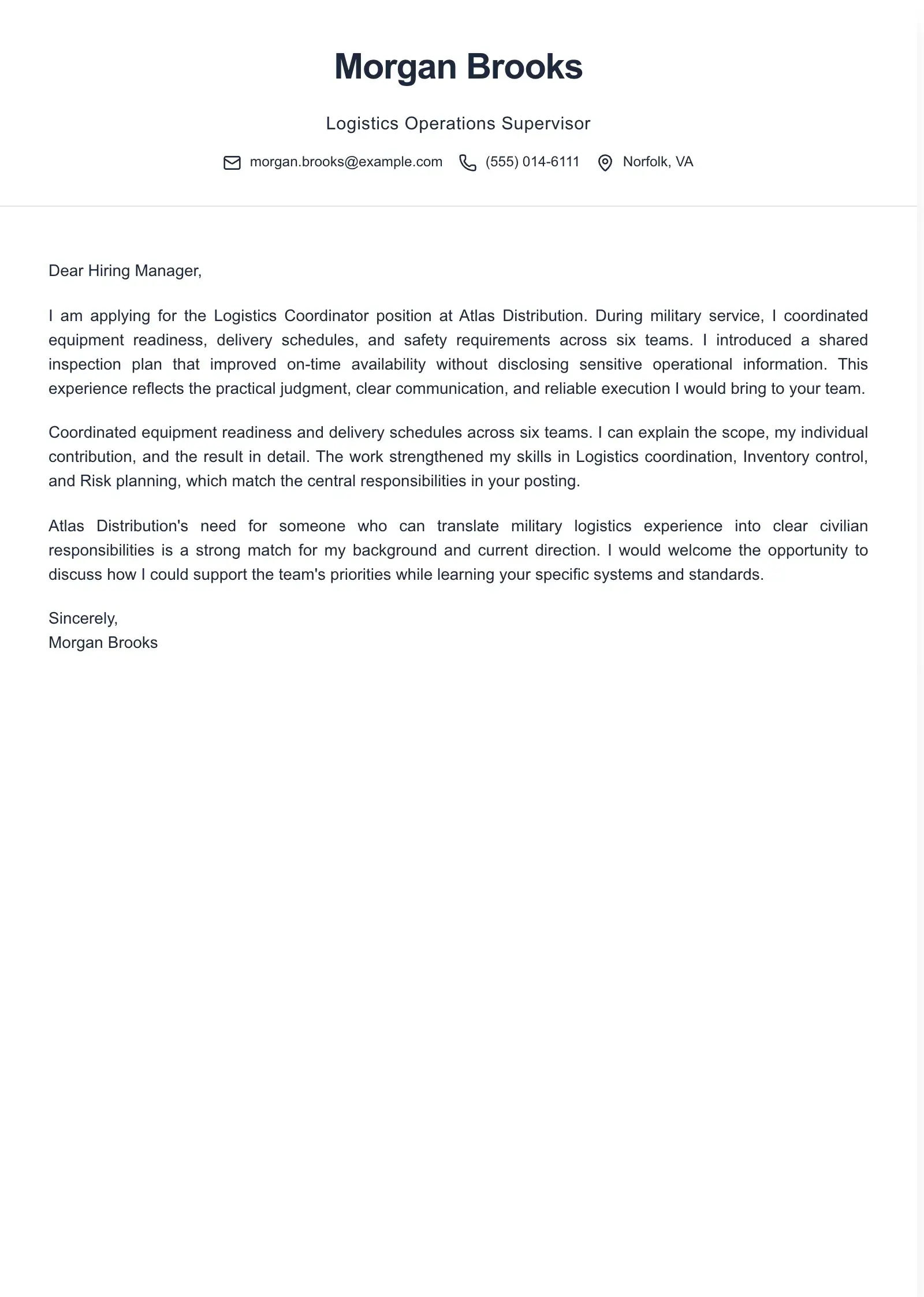
Present service accomplishments in clear civilian language while preserving accurate titles, scope, and results.
Example paragraphs
“As a [Military Role], I coordinated [Plain-Language Scope] across [Number] teams while meeting strict safety and readiness requirements. By introducing [Action], I improved [Verified Result]. This experience aligns with your need for [Civilian Requirement].”
“My service required calm decisions when priorities and resources changed quickly. During [Non-Sensitive Situation], I [Action] and kept [Operational Outcome] on schedule. I would apply that planning discipline to the [Job Title] role at [Company Name].”
“As I transition from military service, I am targeting roles in [Civilian Field] because they use my experience in [Capabilities]. I have also completed [Civilian Credential or Project], which helped me apply that background using [Relevant Civilian Tool or Standard].”
Adapt these examples to facts you can defend. Replace every bracketed placeholder, remove any sentence that is not true for you, and preserve the employer's terminology only when it accurately describes your experience. A concrete but modest example is stronger than an impressive claim that becomes vague when questioned.
Common mistakes in a military-to-civilian cover letter
Leaving acronyms unexplained
- What goes wrong
- Military abbreviations and unit-specific language can hide the value of strong experience.
- Better approach
- Use civilian terms and explain necessary military context.
Inflating equivalence
- What goes wrong
- A military title does not automatically equal a corporate title with different authority or duties.
- Better approach
- Describe actual scope and let the employer assess level.
Listing traits without proof
- What goes wrong
- Words such as leadership and discipline are too broad without a situation or outcome.
- Better approach
- Show one action, constraint, and verified result.
Sharing sensitive details
- What goes wrong
- Operational specifics may be inappropriate or unnecessary for an application.
- Better approach
- Use cleared, non-sensitive descriptions of scope and outcomes.
A final review should test both substance and consistency. Ask whether a stranger can understand the relevant context, your actual contribution, and the reason this employer is a sensible target. Then compare titles, dates, results, and explanations with the resume and application form.
Frequently asked questions
- Should I mention my military rank?
- You may include rank when it helps establish scope, but translate what you were responsible for. A civilian reader should not need military knowledge to understand your leadership, technical work, or results.
- How do I translate military jargon?
- Replace acronyms with the underlying function. Describe personnel as team members, missions as projects or operations when accurate, and readiness work as maintenance, planning, training, or compliance.
- Can I use a civilian job title?
- Do not replace your official title in a way that becomes inaccurate. You can pair it with a plain-language functional description, then explain your duties and scope in the letter.
- Should I disclose veteran status?
- Disclosure is your choice unless an application asks for information under a specific program. The cover letter should focus on relevant service evidence and the transition to the target role.

Put this career change approach into practice
Choose sample data or build your own cover letter, then personalize it before you download.