
Introduction
A military spouse cover letter should connect your experience to the job, not become a record of every move. If a PCS-related move affected your work timeline or availability, explain its professional effect briefly and then show relevant evidence. A move by itself does not prove a particular skill, so use examples from your own work.
This page is about a spouse managing their own career across moves. It is different from a military-to-civilian cover letter, which focuses on a service member's own experience and its relevance to civilian work. You do not need to share private family details unless they help explain a point relevant to this application.
What to address directly
How much of a PCS move to explain
- Hiring manager concern
- A PCS-related move may explain why a role ended, a gap occurred, or your location changed. A detailed account of orders, household arrangements, and each past location can take attention away from your fit.
- What your letter should prove
- Mention a move when it clarifies a relevant part of your work history or availability. Give its professional effect in a short, factual statement, then turn to the experience you would bring. If the move does not explain anything the employer needs to assess, you may not need to include it.
How to address a move-related gap
- Hiring manager concern
- A gap may need context, but an apology or lengthy defense can make the letter revolve around personal circumstances instead of your qualifications.
- What your letter should prove
- If an explanation is useful, give a neutral fact about the timing or effect of the move and return to current evidence of fit. You do not have to account for every month in a cover letter. For broader help, see how to explain an employment gap.
How to show portable skills and realistic work fit
- Hiring manager concern
- Frequent moves do not automatically demonstrate adaptability, and remote work does not necessarily mean there are no location, travel, or attendance expectations.
- What your letter should prove
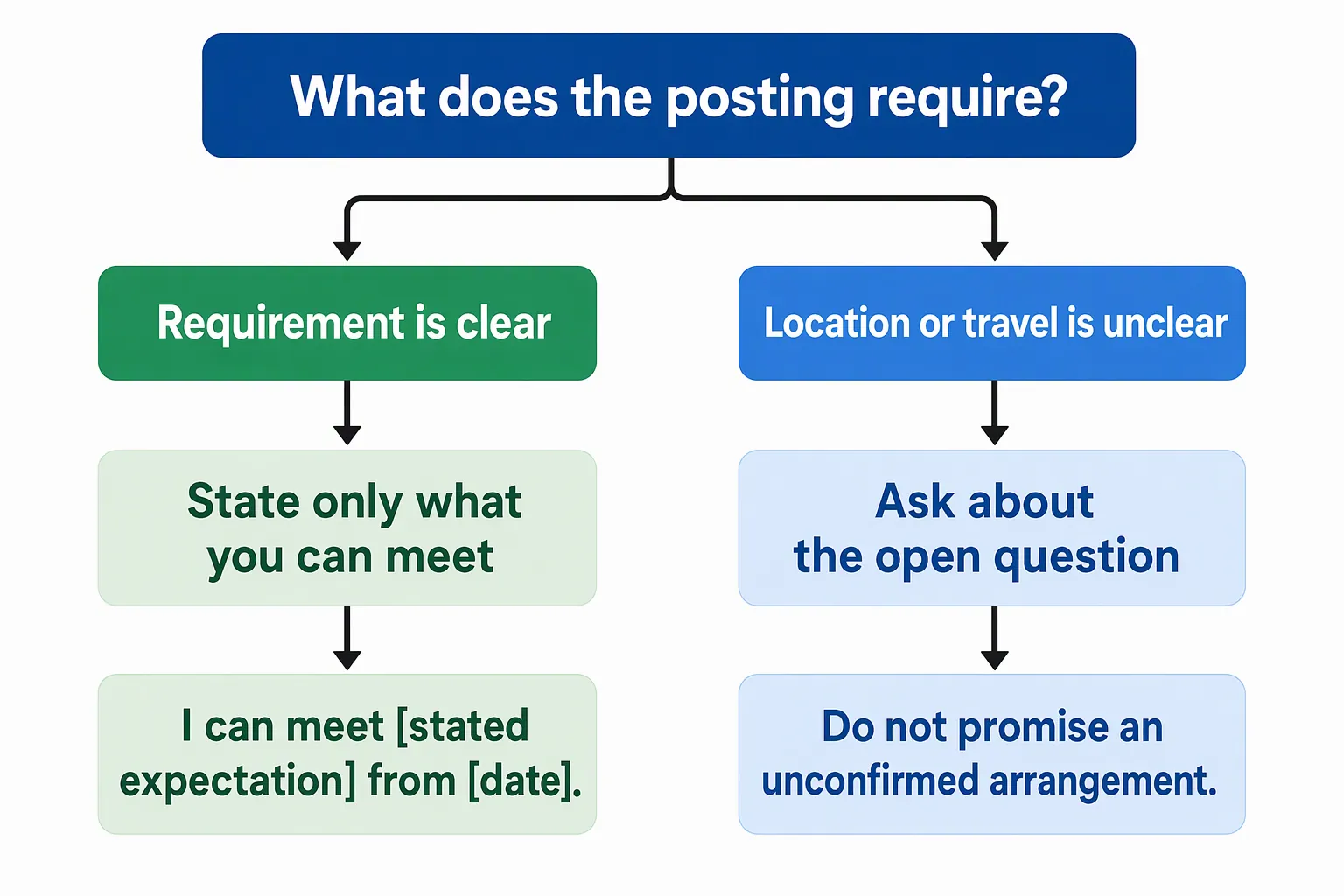
- Choose a specific example of work that transfers to this job, such as coordinating a handoff or keeping colleagues informed, and explain what you did. Check the actual posting before describing location, travel, or remote availability. Do not promise an arrangement you cannot confirm.
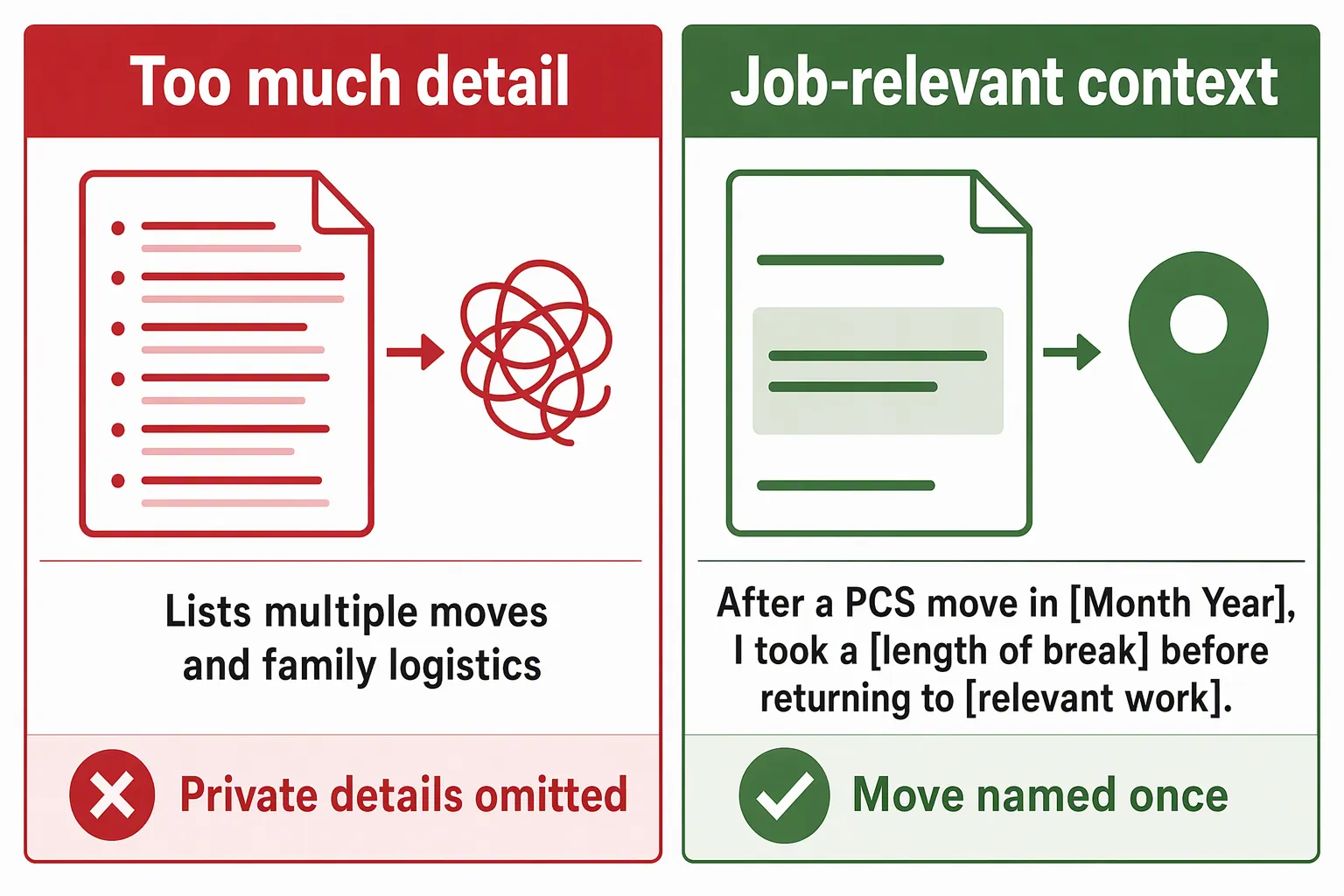
Structural approach: explain the move, then show your fit
Keep the letter focused on the employer's stated needs. A practical sequence is to name the role and a specific reason for applying, explain a move or gap only if context is useful, give evidence of a relevant skill, and state availability accurately. The cover letter structure guide covers the document's general parts; the steps below apply them to a career affected by moves.
- 01
Start with this job
Name [Job Title] and [Company Name], then identify a responsibility or work arrangement from the posting that connects to your experience. Do not open with a spouse's orders or a list of past locations.
- 02
Explain only the move that needs context
If a PCS-related move explains a recent departure, gap, or location change, state the timing and professional effect briefly. Skip private details and repeated move-by-move explanations. If the timeline is clear and the move does not affect availability, there may be no reason to mention it.
- 03
Support a portable skill with evidence
Choose one relevant action and a factual result from your own experience. For example, describe how you organized a handoff, maintained a process through a transition, or coordinated colleagues across locations. Do not rely on relocation itself as proof of a skill.
- 04
Set accurate expectations
Address location, remote work, travel, or a possible future move only when it matters to the posting. State what you can confirm now. If an expectation is unclear, name the open question rather than promising indefinite availability or an unconfirmed schedule.
Military spouse cover letter example
Preview a fictional example that briefly explains a PCS-related career pause, then connects coordination experience and confirmed availability to the role.
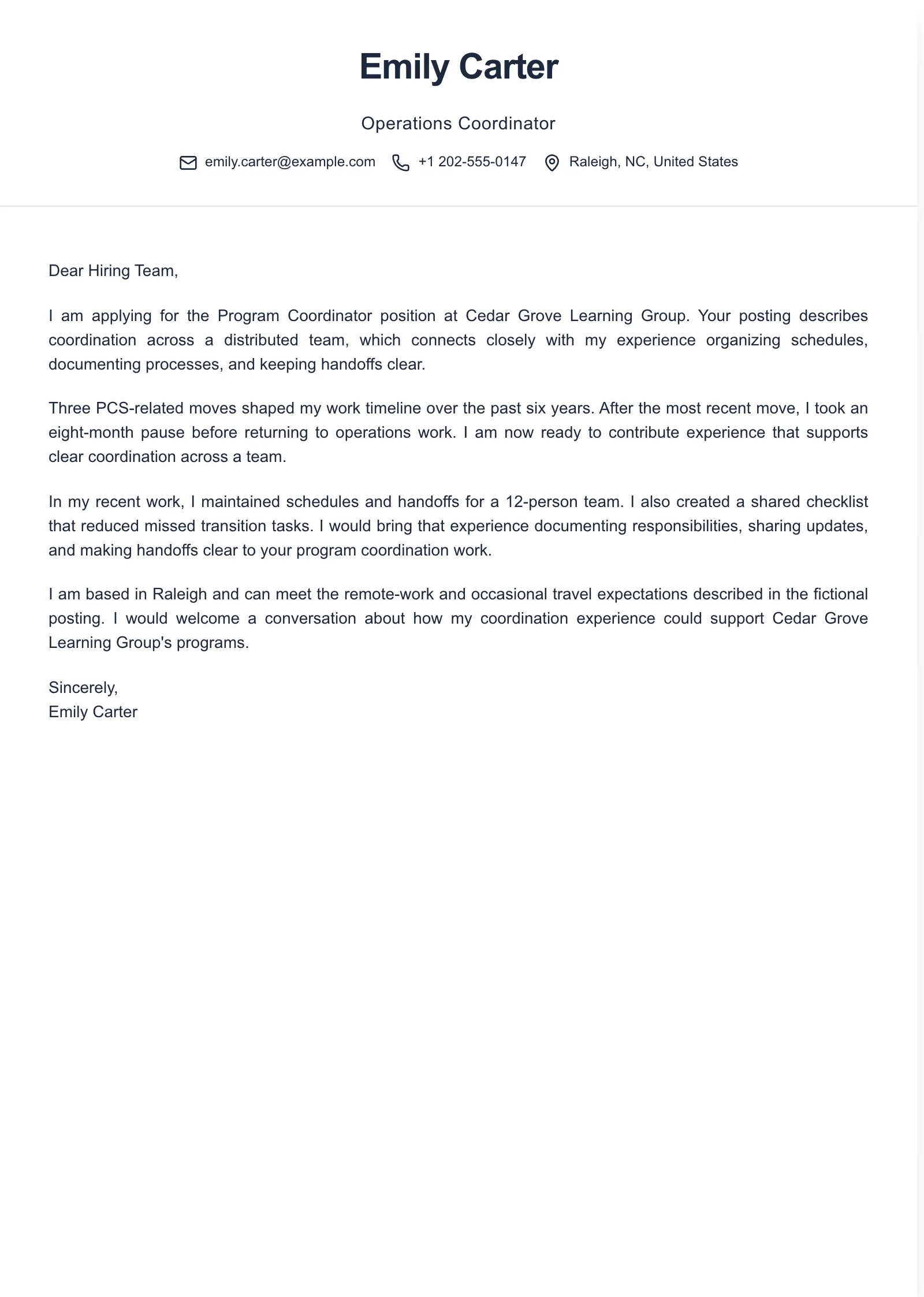
Example paragraphs
“After a PCS move in [Month Year], I took a [length of break] before returning to [relevant work or activity]. I am now applying my experience in [relevant skill] to the [Job Title] role at [Company Name].”
“In [previous role or project], I [specific action] and achieved [verifiable result]. This experience is relevant to [responsibility named in the posting] at [Company Name].”
“The posting for [Job Title] at [Company Name] states [location, travel, or attendance expectation]. I can meet that expectation by [date or accurate arrangement]. I would be glad to discuss [specific open question] if needed.”
Use these as paragraph-level models, not as a complete letter. Replace every bracket with a fact you can support. Keep job titles and dates accurate, and remove any sentence that does not clarify the move, show relevant fit, or describe availability. If the posting leaves a location or travel requirement unclear, ask about it rather than assuming what it means.
Common mistakes in a military spouse cover letter
Turning the letter into a move-by-move account
- What goes wrong
- Listing every PCS-related move and household transition uses space without showing how your experience fits this job.
- Better approach
- Include only the move that explains a relevant gap, departure, or availability detail. Give brief professional context, then return to your evidence of fit.
Apologizing for a gap or move
- What goes wrong
- Calling a move a problem or asking the employer to overlook a gap can frame personal circumstances as a shortcoming.
- Better approach
- Use a neutral explanation if one is useful. Follow it with current, relevant evidence and leave out personal details that do not help explain your application.
Claiming flexibility without evidence
- What goes wrong
- Saying that you are adaptable or automatically suited to remote work relies on assumptions rather than evidence from your own work.
- Better approach
- Describe a specific transferable action and result. Check the posting's location, travel, and attendance expectations before stating what you can do.
Treating a spouse-focused program as proof of fit
- What goes wrong
- Relying on a program as if it guarantees an interview, offer, or exception can create expectations that are not established by the posting.
- Better approach
- Check the specific program's current terms, but keep this letter focused on the employer's stated qualifications. Use accurate job titles and dates, and do not change your work history to hide a move.
Frequently asked questions
- Do I need to mention that I am a military spouse?
- You can decide whether to mention it. Include it only if it helps explain a move, a gap, or a location detail relevant to this application. You can describe the career effect of a move without sharing private family information.
- How much should I explain a gap connected to a move?
- If the gap needs context, a brief, factual sentence is usually enough. Give the timing and professional effect, then return to your current evidence of fit. You do not need to account for every month or describe family logistics.
- Should I promise that I can work remotely or relocate?
- State only arrangements you can confirm. Check the posting's location, travel, and attendance expectations, and describe your actual availability. If a requirement is unclear, say you would like to discuss it instead of promising an arrangement.
- Can a military spouse hiring program guarantee an interview or job?
- Do not assume a program guarantees an interview, offer, remote arrangement, or exception to a posting's requirements. Program services and terms can differ, so check the specific program's current information and address the employer's stated qualifications.

Put this career change approach into practice
Choose sample data or build your own cover letter, then personalize it before you download.