
Introduction
An internship cover letter should show more than a desire to gain experience. The employer is offering supervision, access, and real work, so the letter must explain why you are prepared to use that opportunity well. Even when you have never held a formal job, you can make a credible case through coursework, projects, campus activities, volunteering, competitions, or independent practice.
For an internship with no experience, specificity matters more than volume. A small project described clearly is stronger than a long list of subjects. Name what you built, researched, organized, analyzed, wrote, or improved. Explain your individual contribution and connect it to the internship. Employers understand that interns are still learning. They still need evidence that you can follow through, accept feedback, and contribute at an appropriate level.
What to address directly
Why this internship?
- Hiring manager concern
- A broad statement about wanting experience does not show why the organization, team, or work is a deliberate choice.
- What your letter should prove
- Identify a responsibility, project area, product, or audience that connects to your preparation and interests.
What can the student contribute now?
- Hiring manager concern
- The employer may see potential but still need evidence that the applicant can complete useful work.
- What your letter should prove
- Match a project or activity to one or two internship tasks and describe the output, your role, and the standard you met.
Can they learn in a workplace?
- Hiring manager concern
- Internships require candidates to act on direction, communicate progress, and improve after feedback.
- What your letter should prove
- Use an example showing how you learned a method, handled revision, asked useful questions, or met a deadline.
Is the application tailored?
- Hiring manager concern
- High-volume internship applications often repeat generic praise and course lists.
- What your letter should prove
- Use details from the posting and the organization. Explain the connection rather than copying its language.
Structural approach for an internship cover letter
Begin with the exact internship title, your current area of study or preparation when relevant, and your strongest connection to the work. If someone referred you, include that only with permission and explain the professional context. Your first paragraph should answer what you are applying for and why the reader should continue.
In the middle, prove readiness through one or two examples. A laboratory assignment can show accurate documentation. A club event can show coordination. A portfolio project can show research, iteration, or technical practice. The education section provides context, but the cover letter should interpret the most relevant learning rather than repeat a course list. Use evidence that aligns with the posting's actual responsibilities.
Add a specific reason for choosing [Company Name]. Research enough to identify a real connection, such as its users, current work, training model, or approach to a problem. Do not praise the company as prestigious or claim it has always been your dream. Close with a concise statement of availability if required, the value you can offer, and interest in a conversation.
- 01
Name the match
Connect the internship to your field, preparation, and strongest relevant capability.
- 02
Demonstrate potential
Use projects or activities to prove contribution, learning, and follow-through.
- 03
Choose the employer
Give a researched reason for this placement and close with clear interest.
Use this template for an internship application
Present student experience, project evidence, and employer fit in a clear professional sequence.
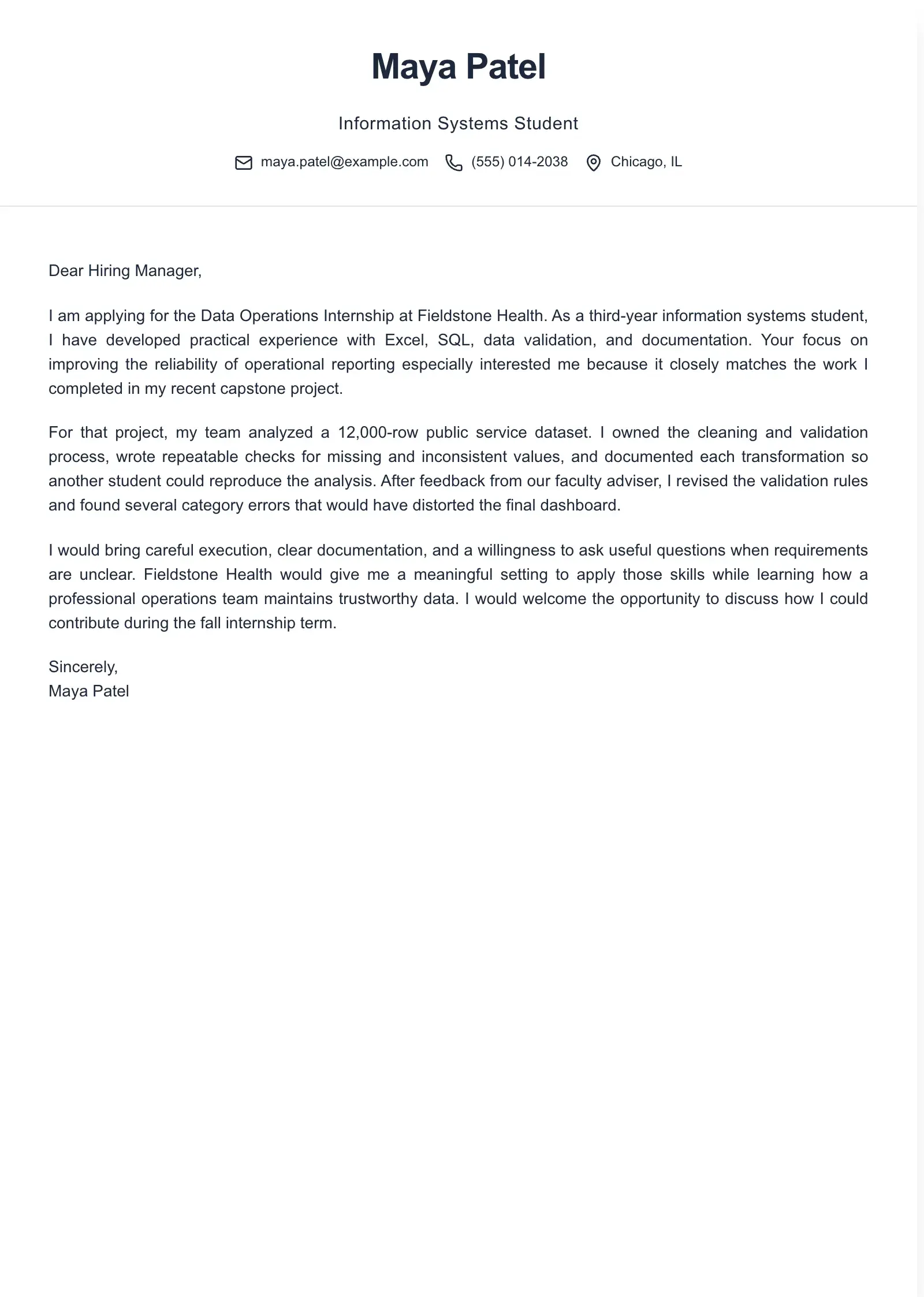
Example paragraphs
“I am applying for the [Internship Title] at [Company Name]. As a [Year or Program] student studying [Field], I have developed practical experience with [Relevant Task] through [Course, Project, or Activity]. I was particularly interested in your focus on [Specific Team Priority], because it connects directly to the work I completed on [Brief Example].”
“In [Course or Project], I took responsibility for [Specific Contribution]. I used [Tool or Method] to [Action], documented [Output], and revised the work after [Type of Feedback]. The final project [Concrete Result], and the process taught me how to communicate progress and improve work against a defined requirement.”
“[Company Name]'s work with [Product, Audience, or Initiative] would give me a relevant setting to apply my preparation in [Skill Area]. I would bring careful execution, experience with [Specific Capability], and a willingness to seek and use feedback. I would welcome the opportunity to discuss how I could support [Team or Project] during [Internship Period].”
If you have previous part-time work, include it when the behavior transfers. Handling customers, balancing shifts with study, or maintaining accurate records can be relevant even when the industry differs. Explain the connection rather than assuming the job title will do it for you.
Common mistakes in an internship cover letter
Making learning the only benefit
- What goes wrong
- Saying only that the internship would help your career describes what you receive, not why the employer should select you.
- Better approach
- Pair your learning goal with evidence of what you can contribute to the team's current work.
Repeating the transcript
- What goes wrong
- A list of courses and grades does not explain how you applied the knowledge or which internship task it supports.
- Better approach
- Choose one or two assignments and describe your action, output, feedback, and relevant result.
Overstating project ownership
- What goes wrong
- Presenting a group result as individual work can make the evidence unreliable.
- Better approach
- State your role precisely, credit the team outcome, and identify the part you personally completed.
Using generic company praise
- What goes wrong
- Calling an employer innovative or prestigious could apply to many organizations and signals limited research.
- Better approach
- Name a specific project, audience, responsibility, or working method and explain its connection to your preparation.
Frequently asked questions
- How do I write an internship cover letter with no experience?
- Match coursework, projects, campus activities, service, or personal work to the internship requirements. Give specific examples of what you produced, learned, or improved, and explain why this employer offers a relevant setting for your next stage of development.
- What should a student include in an internship cover letter?
- Include the internship title, your relevant field or preparation, one or two evidence-based examples, a specific reason for choosing the organization, and a concise close. Mention availability only when the posting requests it or timing needs clarification.
- Should I mention my GPA?
- Mention it only when the employer requests it or when it is strong and meaningfully supports your candidacy. Relevant coursework, projects, and demonstrated skills often provide more useful evidence than a number by itself.
- Can I apply if I do not meet every internship requirement?
- Yes, if you meet the central requirements and can show credible preparation for the work. Do not claim missing skills. Focus on the strongest matches and describe practical steps you have taken to learn what is new.

Put this career change approach into practice
Choose sample data or build your own cover letter, then personalize it before you download.