
Introduction
Applying for a full-time position where you interned gives you specific evidence to draw on: work you contributed to, feedback you received, and a firsthand view of the team. Your letter still needs to make a case for the posted role. Do not rely on the hiring team to infer that your internship should continue.
This guide focuses on moving from an internship to a full-time job at the same company. For a general internship application, see internship cover letters. For a current employee applying to a different role, see internal-position cover letters.
What to address directly
Show what changed because of your work
- Hiring manager concern
- An internship title or list of duties does not show what you contributed. The reviewer needs to understand how you approached a task, what you delivered, and what happened next.
- What your letter should prove
- Choose one or two projects you personally supported. State your part clearly, distinguish it from the team's work, and include a concrete deliverable or outcome when you can verify it. If a number would not clarify the result, explain what your work made easier, clearer, or more consistent.
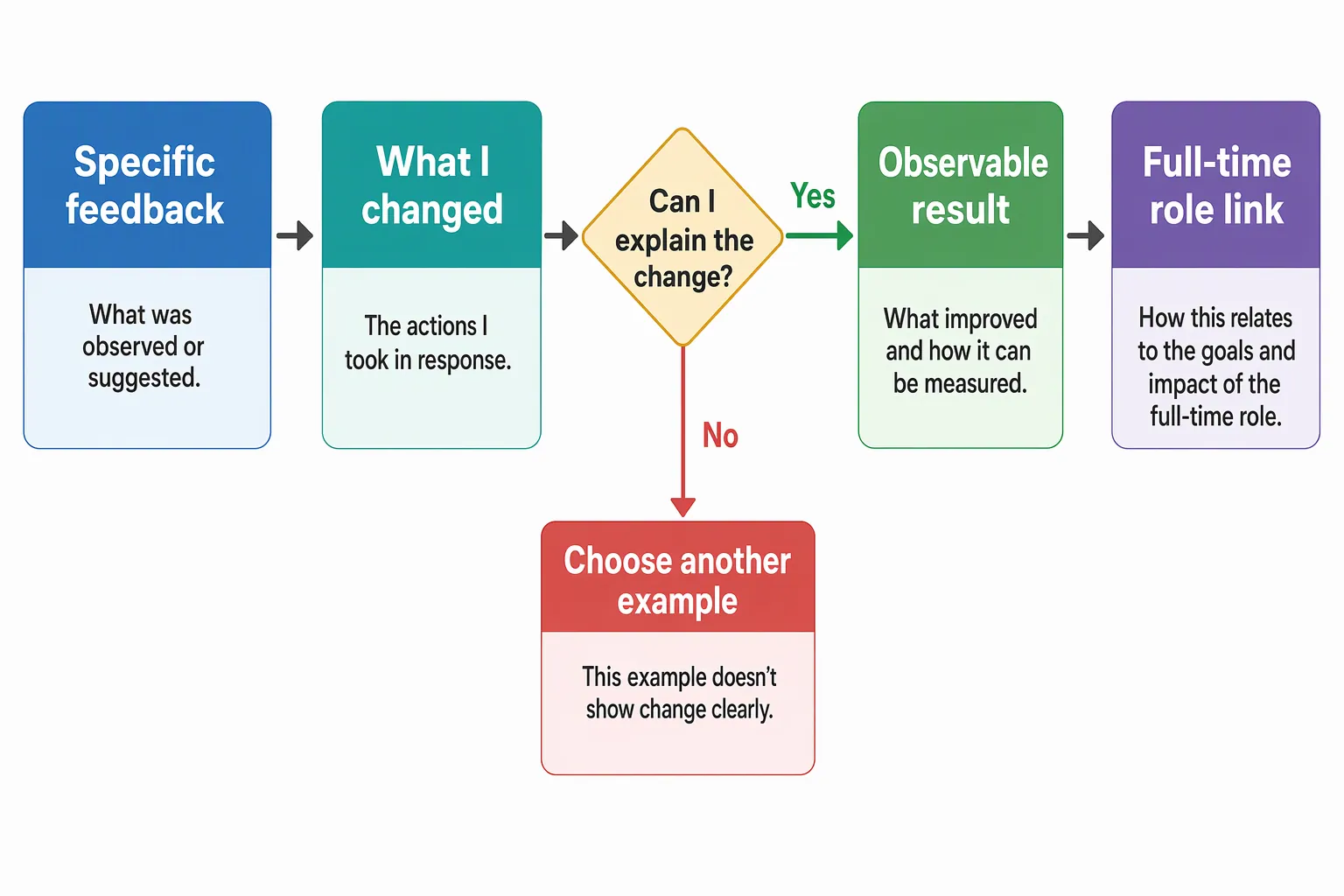
Use feedback to show how you developed
- Hiring manager concern
- Saying that you learned a lot is too broad to demonstrate what changed. Quoting praise without context can also leave the reviewer unsure how you work.
- What your letter should prove
- Describe a specific piece of feedback, what you changed in response, and an observable result or improvement. Use feedback you are comfortable sharing and can explain. Keep the focus on your response, not on treating one positive comment as proof of a full-time offer.
Explain fit without assuming familiarity
- Hiring manager concern
- You may know the people and routines, but the full-time role can involve different responsibilities or expectations. Familiarity alone does not show why you fit the next step.
- What your letter should prove
- Connect something you observed during the internship to a responsibility in the posting. Explain how your experience could help you approach that responsibility and what you still expect to learn. Give enough context for someone outside your immediate team to understand the example.
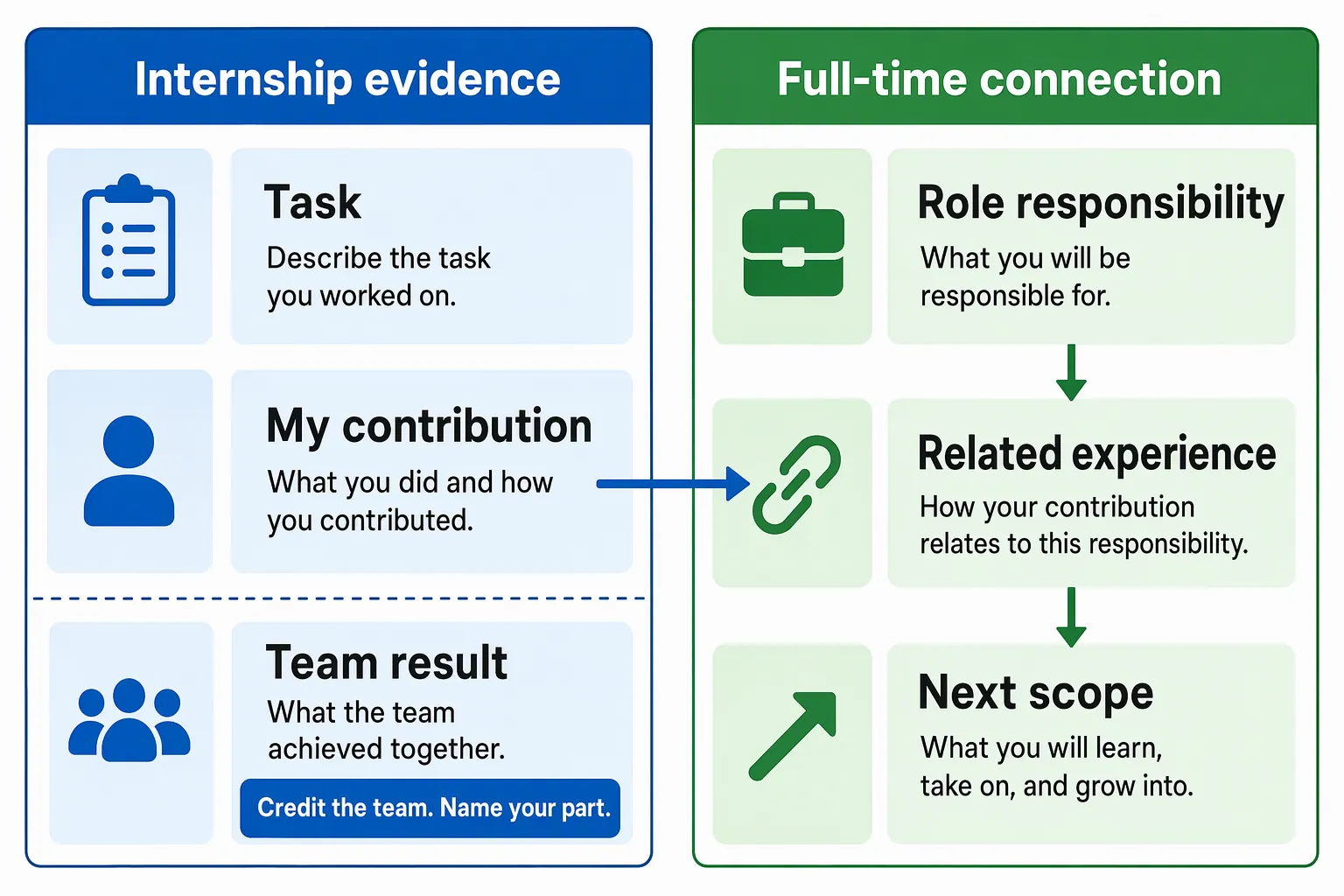
Structural approach: turn internship experience into a full-time case
Keep the letter centered on the full-time opening, not on a request to extend your internship. Select evidence that makes the transition clear: a relevant contribution, a useful response to feedback, and a reason your knowledge of the team relates to the role's responsibilities. To compare what different forms of internship experience can demonstrate, see internships, freelance work, or open source.
Use a clear sequence rather than a complete internship diary. Introduce the posted role and your connection to the company, develop one or two pieces of evidence, then explain how they relate to the full-time position's scope. Close by restating your interest in that role and inviting a conversation; do not imply that an offer is automatic. For general paragraph placement, see cover letter structure, while keeping your reasoning specific to the internship transition.
- 01
Name the role and your internship
Identify the full-time job and state when or where you interned at the company. Follow any application instructions or required format in the posting. Make clear that you are applying for the full-time position, not asking about an extension.
- 02
Select evidence that matches the posting
Compare the role's responsibilities with projects, tasks, or deliverables from your internship. Pick examples for their relevance, not simply because they are recent. Describe your contribution accurately and credit collaborators where appropriate.
- 03
Make feedback useful
Choose feedback that led to an observable change in your approach or work. Briefly state what you adjusted and what improved. If the feedback was informal, describe what you learned without presenting it as an official performance rating.
- 04
Connect team knowledge to the next scope
Name a workflow, shared goal, or team priority you learned about and relate it to a responsibility in the full-time posting. Explain how your experience could help you contribute, without promising results for work you have not done.
A focused case for the next role
This fictional example connects an intern's project, response to feedback, and team knowledge to a full-time application.
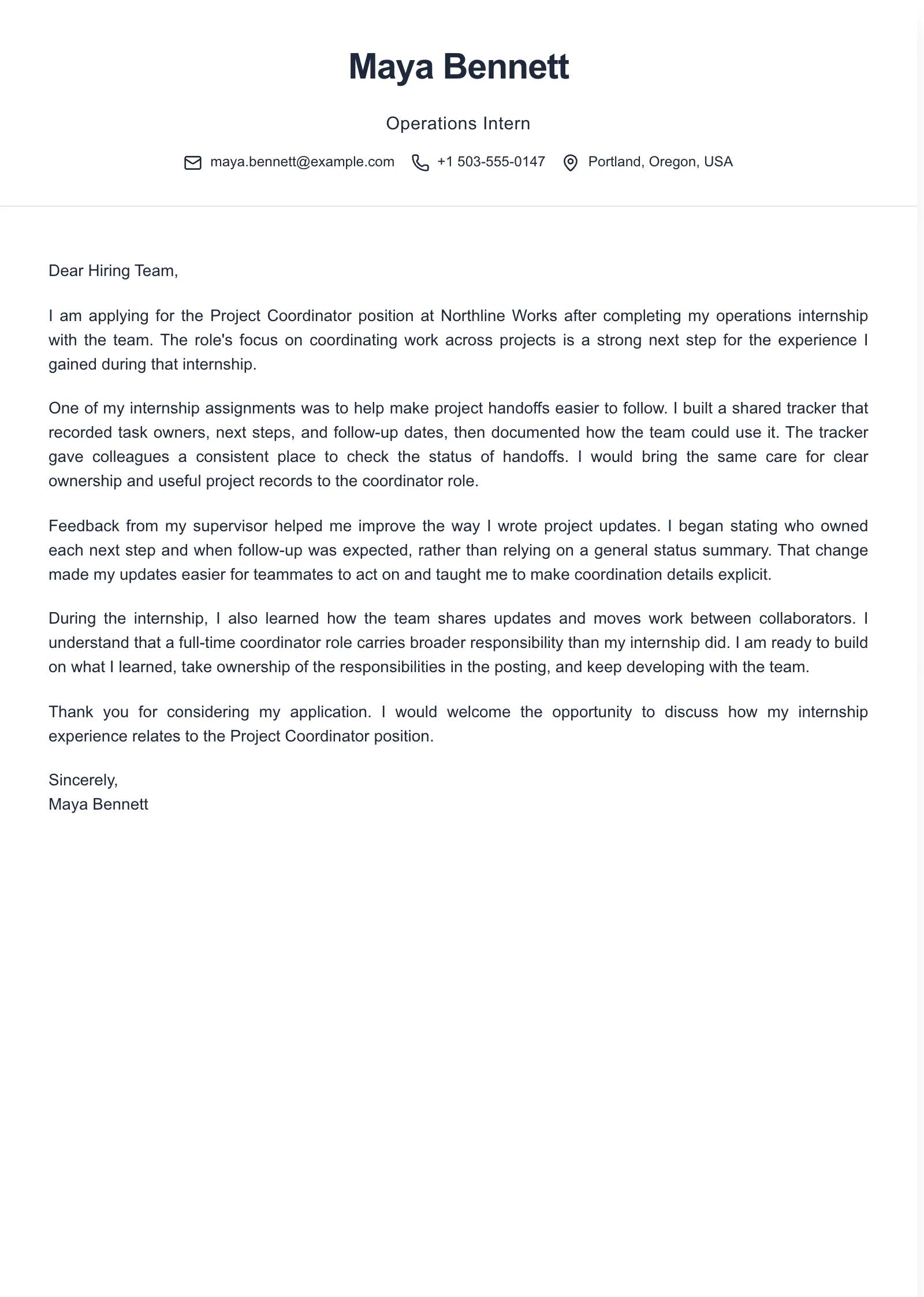
Example paragraphs
“During my internship at [Company Name], I supported [specific project] by [your factual contribution]. My work contributed to [verifiable deliverable or outcome]. I would bring that experience to the [Job Title] role, particularly its responsibility for [related responsibility].”
“After receiving feedback about [specific part of your work], I changed how I [relevant task] by [action you took]. That adjustment led to [verifiable result or observable improvement]. I would apply the same learning to [related responsibility] in the [Job Title] role at [Company Name].”
“My internship at [Company Name] helped me understand [specific workflow or team priority]. In the [Job Title] role, I could apply that knowledge to [posted responsibility], while continuing to develop [relevant area you still need to learn].”
Treat these as paragraph options, not a full letter to paste in. Use only details you can support, and connect each example to the posted full-time responsibilities. If your internship was brief or the project was shared, be precise about what you personally did. Do not add a result, responsibility, or endorsement to make the transition sound more certain than it is.
Common mistakes in an intern-to-full-time cover letter
Writing as if the role is an automatic extension
- What goes wrong
- A request to keep working with the team can leave the full-time job's requirements unanswered.
- Better approach
- Address the posted role directly. Use internship experience to show relevant preparation, then explain how it connects to the new responsibilities.
Describing the team instead of your contribution
- What goes wrong
- Statements such as “we improved the process” do not tell the reviewer what you personally did.
- Better approach
- Use accurate first-person wording for your contribution and describe the shared result separately. Do not claim ownership of work completed by the team.
Treating positive feedback as proof of fit
- What goes wrong
- Praise without an example of how you acted on it gives little information about how you work.
- Better approach
- Explain the feedback, your response, and a result or change you can support. Then connect that learning to a requirement in the full-time posting.
Assuming the reviewer already knows your work
- What goes wrong
- Your application may be read by people who did not supervise your internship or see your project firsthand.
- Better approach
- Give each example enough context to stand on its own: the task, your part, and why it matters to the role. Use the job titles stated in the posting.
Frequently asked questions
- How long should a cover letter be for a full-time job after an internship?
- There is no universal length requirement. A few focused paragraphs are usually enough to connect your internship work, feedback, and team knowledge to the full-time role. Follow any instructions in the posting.
- Should I mention that I already know the team?
- Yes, when you can explain how that familiarity relates to the role. Name a relevant workflow, shared goal, or team priority, but give enough context for a reviewer who did not work with you during the internship.
- What if my internship project was not directly related to the full-time role?
- Choose a transferable example and explain the connection. Describe your contribution, what you learned or improved, and how that experience relates to a responsibility in the posting.
- Is this the same as applying for another internal position?
- The situations can overlap, but this page focuses on an intern applying for a full-time role at the internship host. An internal-position application can be for a current employee changing roles or seeking a promotion, without an internship transition.

Put this career change approach into practice
Choose sample data or build your own cover letter, then personalize it before you download.