
Introduction
An employment gap does not need to dominate your cover letter. Its purpose is to provide enough context that the reader can understand the timeline, then direct attention to the evidence that makes you a strong candidate now. A concise, truthful explanation usually works better than silence when a recent gap is substantial and obvious, but it also works better than a detailed personal narrative.
Treat the gap and your qualifications as two separate questions. First, decide whether the gap needs clarification. Then build the main case for the role using relevant achievements, skills, and preparation. The employment-gap guidance for resumes can help you decide what belongs in the resume itself. Your letter should add context and interpretation, not repeat dates already visible there.
What to address directly
Why is there a gap?
- Hiring manager concern
- A recent unexplained break may leave the reviewer making assumptions about availability, performance, or direction.
- What your letter should prove
- If clarification is useful, give one neutral sentence with the broad reason and omit private details that do not affect the job.
Is the candidate ready now?
- Hiring manager concern
- The employer may wonder whether the circumstances behind the gap still affect timing or commitment.
- What your letter should prove
- State your current availability or readiness when relevant, then support it with recent preparation or a clear return to the field.
Are the skills current?
- Hiring manager concern
- A longer gap can raise questions about tools, standards, or industry changes.
- What your letter should prove
- Point to credible refreshers such as recent coursework, projects, professional reading, volunteer work, or renewed practice, but only when completed.
What value remains relevant?
- Hiring manager concern
- An explanation alone does not establish fit for the open role.
- What your letter should prove
- Spend most of the letter on prior or recent evidence that matches the employer's most important requirements.
Structural approach for an employment-gap cover letter
Open with the [Job Title] and a strong match between your background and the employer's needs. Unless the gap is the essential context for your application, do not make it the first sentence. Establish professional value before explaining the timeline.
Address the gap in one or two sentences. Use plain language: “I took time away from full-time work for [broad reason] and am now ready to return.” If the break included relevant activity, mention it accurately, without turning informal learning into a credential or caregiving into a corporate role. Then make a clean transition to current readiness.
Use the next paragraph for proof. Choose an achievement from before the gap or meaningful recent work and connect it to a priority in the posting. If you refreshed a skill, describe what you completed and applied. Close on the contribution you can make at [Company Name], not on gratitude for overlooking the gap. General cover-letter structure can be reviewed in what to put in a cover letter.
- 01
Establish value
Lead with the role and evidence that matches an important employer need.
- 02
Clarify briefly
Give proportionate context for the gap and state current readiness.
- 03
Return to proof
Show current skills, relevant achievements, and a forward-looking contribution.
Use this template to explain an employment gap
Keep the explanation proportionate while giving your evidence and current readiness most of the space.
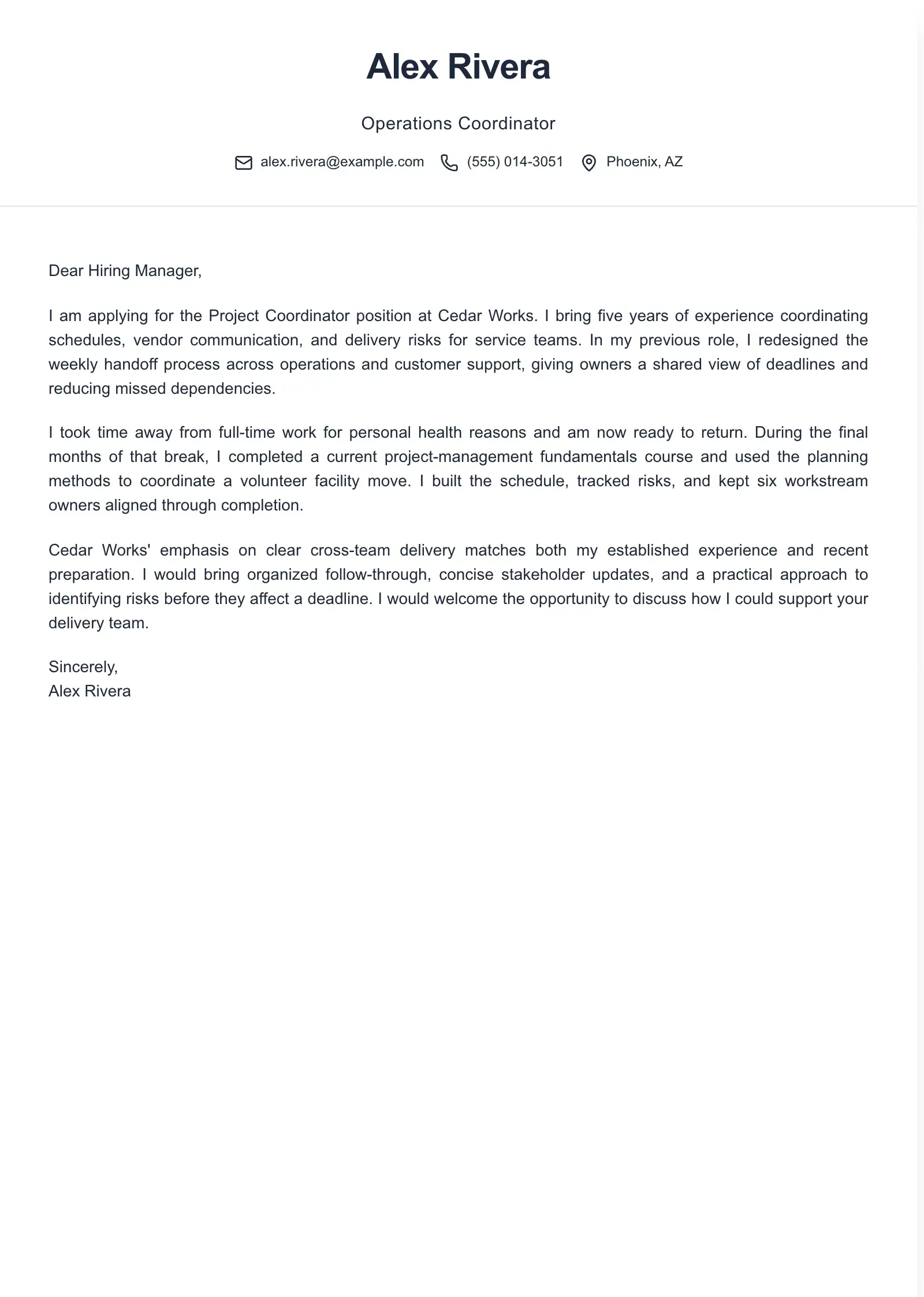
Example paragraphs
“After several years in [Field], I took a planned break from full-time work to manage personal responsibilities. Those responsibilities are now resolved, and I am ready to return to a [Job Title] position. I am bringing forward my experience in [Relevant Capability], including [Brief Achievement], which closely matches your need for [Requirement].”
“During the final part of my break, I refreshed my knowledge of [Relevant Tool or Practice] through [Completed Course or Project]. I applied it by [Concrete Action or Output], which helped me become current with [Relevant Change]. Combined with my previous experience [Doing Related Work], this preparation would help me contribute to [Team Priority].”
“Before my break, I was responsible for [Scope or Responsibility] at [Previous Organization]. When [Relevant Situation], I [Action] and achieved [Verified Result]. That experience is directly relevant to [Company Name]'s need for someone who can [Requirement], and I would welcome the opportunity to discuss how I can apply it now.”
The wording should be factual and calm. You do not need to call the gap beneficial, disclose a sensitive event, or account for every month. You do need to ensure that dates and explanations are consistent across the letter, resume, application form, and interview.
Common mistakes in an employment-gap cover letter
Oversharing private details
- What goes wrong
- Medical histories, family conflicts, or another person's circumstances can distract from the role and reveal information you did not need to provide.
- Better approach
- Use a broad truthful phrase, then move to readiness and job-related evidence.
Hiding an obvious recent gap
- What goes wrong
- Leaving a substantial break entirely unexplained can invite speculation when a short sentence would resolve the question.
- Better approach
- Add concise context when it improves understanding, while keeping the main focus on fit.
Calling the gap a job
- What goes wrong
- Corporate titles for caregiving, travel, or informal activity can look evasive and make accurate experience harder to assess.
- Better approach
- Label the period honestly and describe relevant activity without converting it into employment.
Making the whole letter defensive
- What goes wrong
- Repeated apologies and requests for understanding leave little room for evidence of contribution.
- Better approach
- Explain once, transition clearly, and devote most of the letter to matched qualifications and current preparation.
Frequently asked questions
- Should I explain an employment gap in my cover letter?
- Explain a substantial recent gap when the context helps the employer understand your timeline or readiness. Keep it brief, truthful, and proportionate. You do not need to disclose private medical, family, or legal details.
- How do I phrase an employment gap positively?
- Use neutral facts rather than a forced positive spin. State the broad reason if you choose, mention relevant activity or preparation when accurate, and move quickly to evidence that shows what you can contribute now.
- What if I did not work or study during the gap?
- Do not invent productive activities. A simple explanation such as taking time away for personal responsibilities can be enough. Focus the rest of the letter on prior achievements, refreshed skills, and current readiness.
- How much detail should I share about a health or family gap?
- Share only what you are comfortable disclosing and what is useful to the application. A phrase such as personal health reasons or family responsibilities is usually enough. The letter should not include a diagnosis or another person’s private information.

Put this career change approach into practice
Choose sample data or build your own cover letter, then personalize it before you download.