
Introduction
A co-op placement cover letter should help an employer see how your academic placement connects to the role. Name the program you are enrolled in, the term you can confirm, and one relevant example of work you have actually done. Then explain a learning goal that relates to the employer's listed duties.
Co-op and internship labels can overlap. Follow the posting and your school's process instead of relying on a universal definition. This page focuses on the usable task in the co-op search: making the program context, placement timing, and relevant evidence clear. The internship cover letter guide addresses a closely related application; adapt either approach to the details requested.
If you need help organizing the letter, use the cover letter structure guide. Keep the co-op details here: your confirmed placement information, the connection to this role, and any school coordination you have verified.
What to address directly
Will the placement dates work?
- Hiring manager concern
- The employer may need to compare its proposed dates with the term you can complete through your program.
- What your letter should prove
- Check the posting and confirm your placement window with your school. State dates only when you can verify them. If the employer's dates differ from your confirmed term, ask about the mismatch before presenting yourself as available for the full period.
What program information matters?
- Hiring manager concern
- The employer needs enough context to understand that you are applying for an academic placement, without a long explanation of your course plan.
- What your letter should prove
- Name your program and school, then include only the placement or coordination details relevant to this application. If a form, school contact, or learning plan may be involved, verify that with your co-op office before describing it as a requirement.
What evidence can you offer?
- Hiring manager concern
- You may not have paid experience in the field, and a general claim such as being eager to learn does not show how you can contribute.
- What your letter should prove
- Choose one real example from a course, project, volunteer activity, or previous job. Describe your own action and its connection to a listed duty. Name the setting accurately, and distinguish a skill you have practiced from a goal you hope to develop.
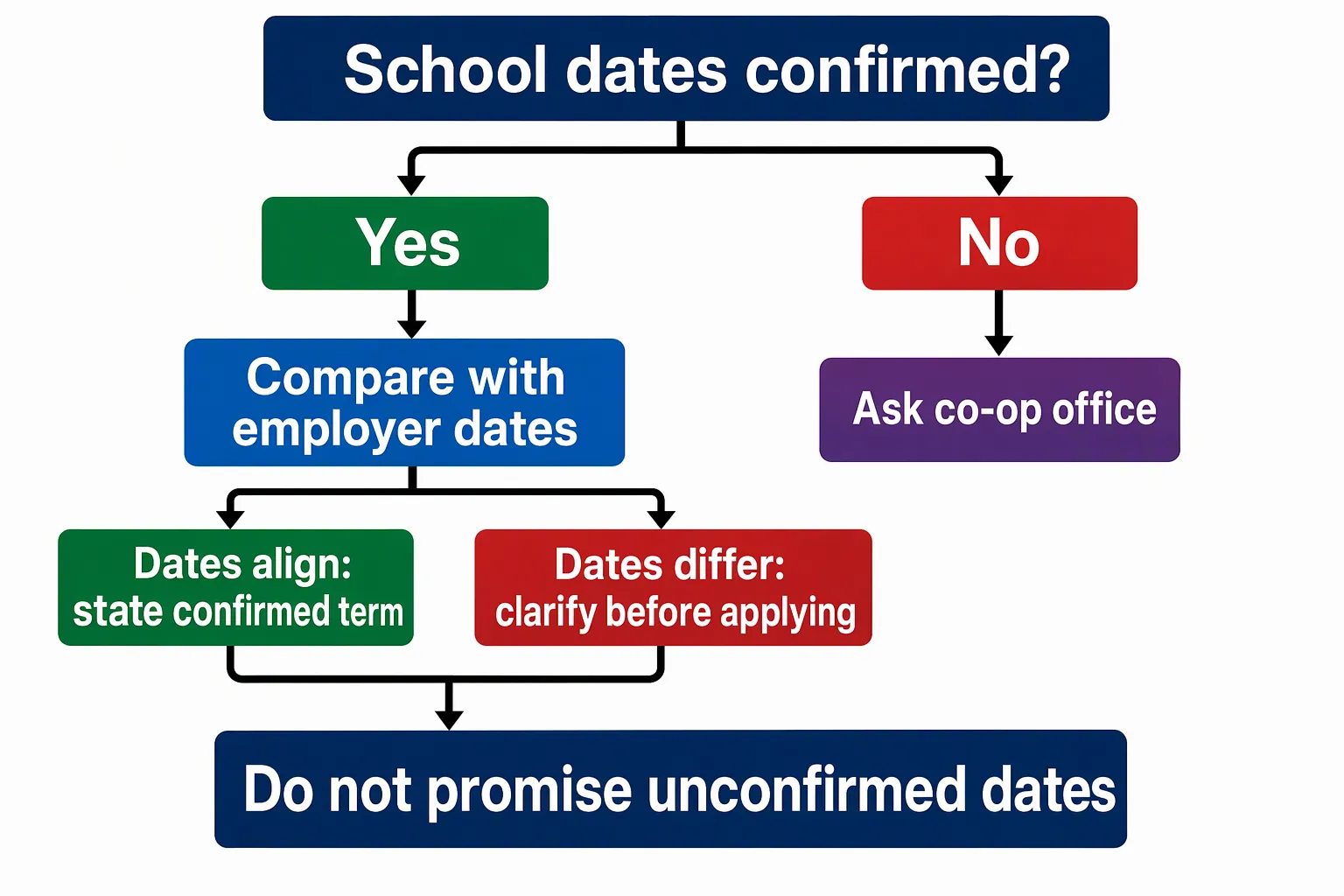
Structural approach: connect the program to the placement
Build the letter around three facts: the role, your confirmed placement window, and evidence relevant to the work. Use the employer's instructions first, including any requested documents or questions. Do not assume every co-op application uses the same format or asks for the same school information.
For applications in Canada, Job Bank guidance on applying for jobs recommends researching the employer and matching your application to the actual job. Apply that advice by selecting evidence for the duties in this posting, not by listing every course or making unsupported claims about what a co-op employer must provide.
- 01
Confirm the placement facts
Read the posting for its proposed dates, schedule, and document instructions. Confirm your program name and placement window with your school. If the dates differ, ask whether they can be reconciled before stating that you are available.
- 02
Choose one relevant learning goal
Pick a goal connected to a duty in the posting. Explain what you hope to develop and pair it with something you can already contribute. Avoid presenting a school's learning objective as an employer obligation unless that has been confirmed.
- 03
Select truthful evidence
Use one specific course assignment, project, volunteer activity, or job task. State what you did and how it relates to the role. Identify classroom work as classroom work, and do not add results, responsibilities, or tools you cannot support.
- 04
Explain coordination only when relevant
If a school contact, form, or agreement applies, verify the detail with your co-op office and mention it briefly when useful to the employer. Close by inviting a conversation about your fit and confirmed term; do not imply that the employer has agreed to host the placement.
Co-op placement cover letter example
This fictional example connects a confirmed placement term, a course-based example, and a learning goal to the duties in a fictional posting.
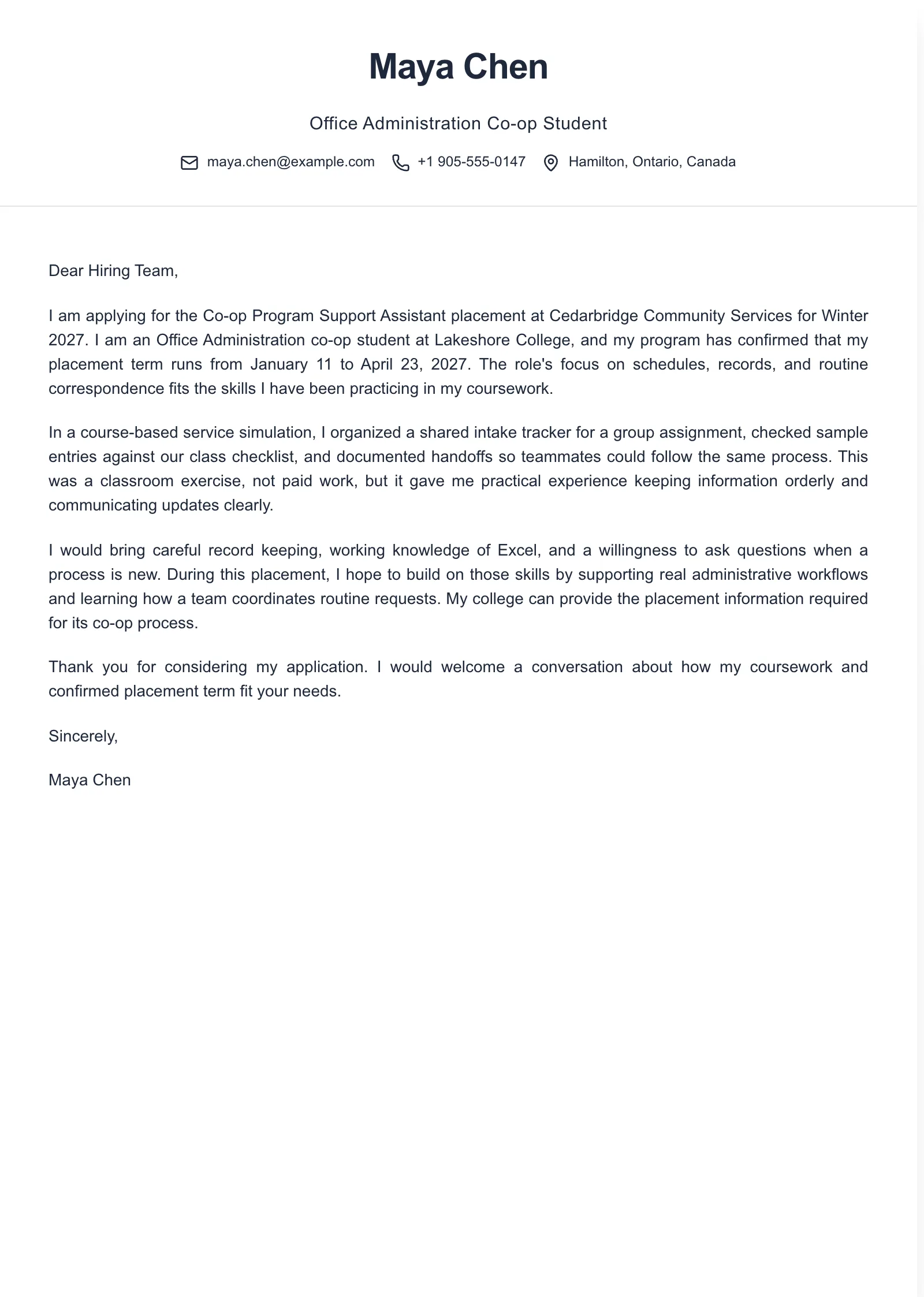
Example paragraphs
“I am applying for the [Job Title] placement at [Company Name] for [confirmed co-op term or dates]. I am enrolled in [Program Name] at [School Name], and my school has confirmed that this period is available for my placement.”
“I am interested in [specific duty from the posting] because it relates to my goal of developing [relevant learning goal]. In [course, project, or activity], I [specific action you took], which gave me practice with [related skill].”
“My confirmed placement dates are [start date] to [end date]. [Briefly state a verified school coordination detail, if relevant.] I would welcome a conversation about how my experience with [relevant example] could support [Company Name] during that term.”
Adapt each paragraph to facts you can confirm. Replace bracketed text with your own details or remove it if it does not apply. Check program requirements with your school and use the posting to decide which duties and documents to address.
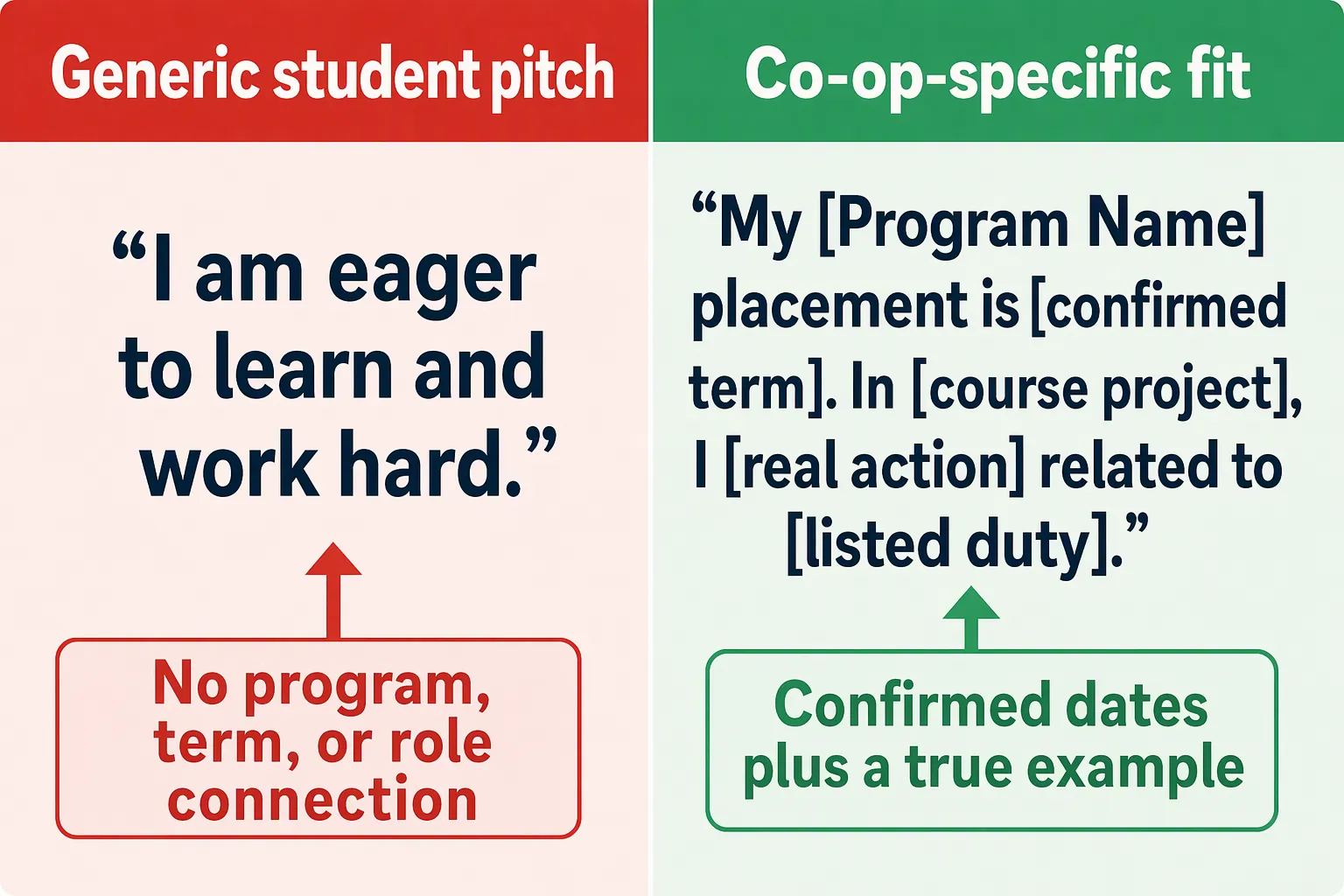
Common mistakes in a co-op placement cover letter
Leaving the term unclear
- What goes wrong
- Saying only that you are available for co-op does not tell the employer how your placement window compares with the dates in the posting.
- Better approach
- Give your confirmed term or dates. If you are waiting for confirmation, say so and check before promising availability.
Assuming what the school requires
- What goes wrong
- Saying an employer must complete a form or follow a particular learning plan can confuse the application if you have not verified that process.
- Better approach
- Confirm school procedures with your co-op office. Mention only coordination that applies to this placement, and describe it accurately.
Presenting coursework as employment
- What goes wrong
- Calling a class assignment professional experience or overstating your responsibility makes it harder to judge what you have actually done.
- Better approach
- Name the setting and your role. Explain the task you completed and its relevance without claiming an outcome you cannot support.
Focusing only on what you hope to learn
- What goes wrong
- A letter built entirely around your learning goals does not show what you can contribute to the placement.
- Better approach
- Pair a relevant goal with a current skill or example. Refer to a formal learning plan only when the school and employer have confirmed it applies.
Frequently asked questions
- What should a co-op cover letter include?
- Identify the [Job Title] and [Company Name], name your co-op program and the placement term you are applying for, and connect a relevant example to the role. Include school coordination details only when they apply and you have confirmed them.
- How is a co-op cover letter different from an internship cover letter?
- The terms can overlap, so follow the employer's wording and your school's process rather than assuming there is one universal distinction. When the application is for an academic co-op placement, make the program, confirmed term, and relevant learning goals clear. The same details may also matter for an internship.
- Should I include exact co-op dates?
- Include dates or a term when your school has confirmed them and they match the information you have about the placement. If dates are pending or do not align, say so accurately and clarify before promising availability.
- What if I have no work experience in the field?
- Use a real course assignment, project, volunteer activity, or other relevant experience. Identify the setting, explain what you did, and connect it to the role. Do not describe coursework as paid work or claim skills you have not used.

Put this career change approach into practice
Choose sample data or build your own cover letter, then personalize it before you download.