
Introduction
A layoff is an employer decision that usually reflects restructuring, funding, demand, or role elimination rather than individual misconduct. Your letter can clarify that fact when the departure is recent or likely to raise a question, but it should not become a defense of your employment history.
This page focuses on the decision the letter must help a reader make. It does not replace the resume, application form, interview, or documents the employer requests. Follow the posting first, keep every date and claim consistent, and use the letter to interpret the strongest evidence for this particular opportunity.
Keep a layoff distinct from being fired for performance or conduct. Use the employer's accurate language, such as role eliminated during a reorganization, and never imply that an individual termination was a reduction in force. Review the general cover letter content framework if you need a baseline for the opening, evidence paragraphs, and close. The guidance below adapts that framework to this situation.
What to address directly
Why does this context matter?
- Hiring manager concern
- The reader may notice an unusual application detail and form an incomplete explanation.
- What your letter should prove
- Give only the accurate context needed to understand the application, then move to job-related evidence.
Can the candidate do this work?
- Hiring manager concern
- Context alone does not prove a match for the role's responsibilities.
- What your letter should prove
- Select an achievement from the affected role that matches the new employer's priorities. This reminds the reader that the end of the role did not erase the value of the work completed before it.
Is the application credible?
- Hiring manager concern
- Unsupported claims, vague praise, or inconsistent details can weaken trust.
- What your letter should prove
- Use facts you can explain, match the posting accurately, and keep names, dates, titles, and outcomes consistent across materials.
Why this employer now?
- Hiring manager concern
- A reusable letter may show interest in getting any job rather than this role.
- What your letter should prove
- Connect one observable employer need to relevant evidence without guessing at private plans or flattering the organization generically.
Structural approach after a layoff
Start by naming the exact [Job Title] and giving the strongest reason your background fits. The opening should help the reader understand the application in a few sentences. Avoid a dramatic life story, a generic statement of excitement, or a summary of everything in your resume.
Handle the scenario-specific context in the smallest useful space. Keep a layoff distinct from being fired for performance or conduct. Use the employer's accurate language, such as role eliminated during a reorganization, and never imply that an individual termination was a reduction in force. If the posting asks a direct question, answer it in the required field as well. Do not use polished wording to hide a material fact.
Build the center of the letter around proof. Select an achievement from the affected role that matches the new employer's priorities. This reminds the reader that the end of the role did not erase the value of the work completed before it. Explain the situation briefly, identify your own action, and state a result you can support. Results do not need to be percentages. A completed delivery, improved decision, avoided error, satisfied requirement, or clear customer outcome can be credible when described precisely.
Connect that evidence to [Company Name]. Use a public, current detail from the posting, organization, product, program, or team. Do not invent a culture claim or imply inside knowledge. State what you could contribute while recognizing that you will need to learn the employer's specific systems and priorities.
Close with a direct professional sentence. Confirm any requested attachment or availability detail, thank the reader, and invite a conversation. Read the final letter beside the posting and resume. Remove repetition, confirm every proper noun, and check that the scenario does not consume more space than your qualifications.
- 01
Establish the match
Name the role and lead with the strongest relevant qualification.
- 02
Give necessary context
Address this scenario accurately and in proportion to what the reader needs.
- 03
Prove contribution
Use a specific action and outcome tied to an employer requirement.
- 04
Close clearly
Confirm the next step without pressure, apology, or unsupported certainty.
Use this template for an application after a layoff
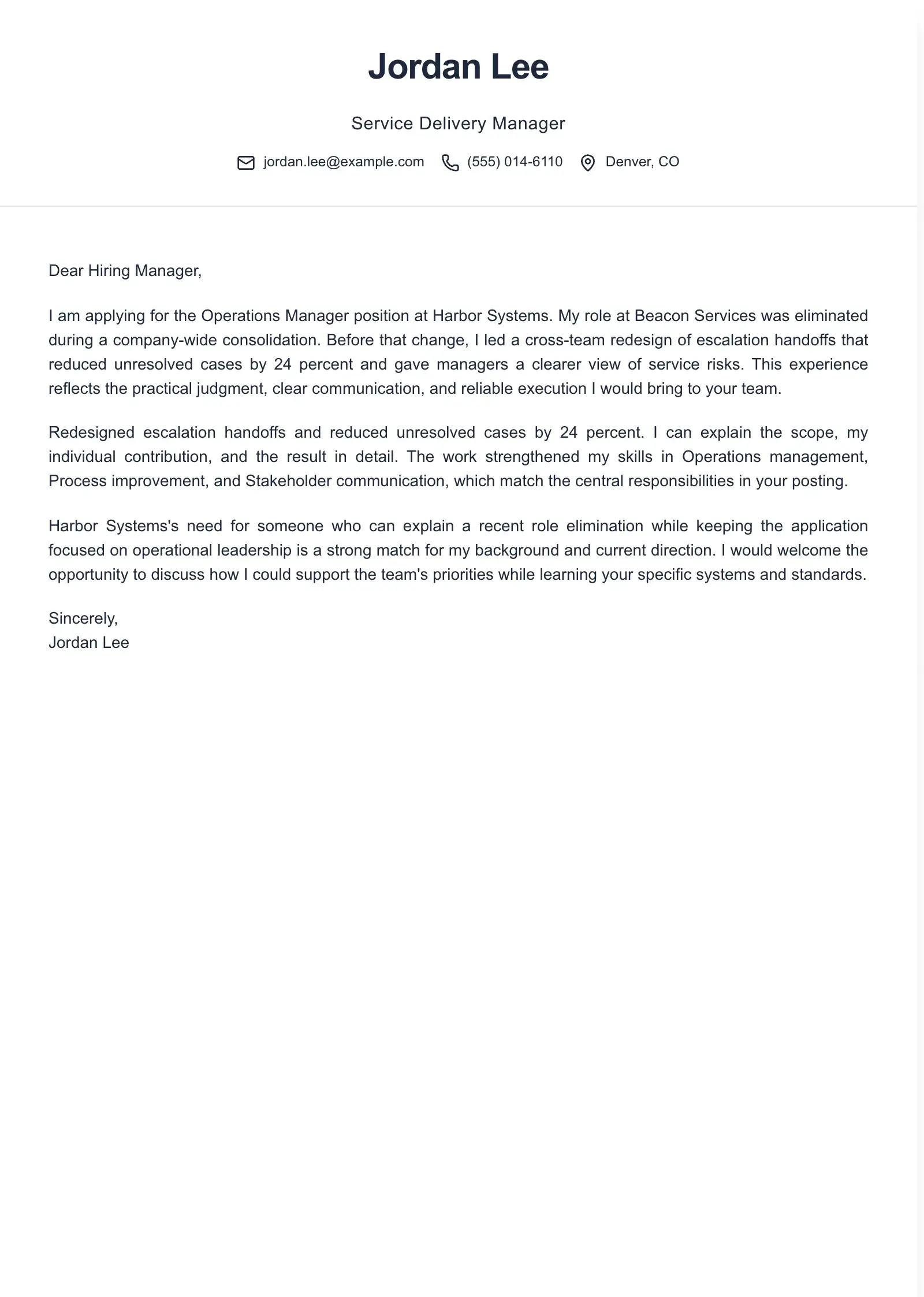
Clarify the role elimination briefly, then give relevant achievements and present readiness most of the space.
Example paragraphs
“My position was eliminated when [Former Company] consolidated its [Function] teams. Before that change, I led [Relevant Project], which [Verified Result]. That experience closely matches your need for [Requirement], and I am ready to bring the same disciplined approach to [Company Name].”
“Since the reduction in force, I have kept my [Skill] current by completing [Course or Project] and applying it to [Concrete Output]. I am available to start [Accurate Timing] and would contribute practical experience in [Relevant Capability].”
“In my most recent role, I coordinated [Scope] during a period of shifting priorities. By [Action], I helped the team achieve [Result]. I am interested in [Company Name] because the [Job Title] role calls for that same combination of judgment and execution.”
Adapt these examples to facts you can defend. Replace every bracketed placeholder, remove any sentence that is not true for you, and preserve the employer's terminology only when it accurately describes your experience. A concrete but modest example is stronger than an impressive claim that becomes vague when questioned.
Common mistakes in a post-layoff cover letter
Apologizing for the layoff
- What goes wrong
- A layoff does not require an apology, and defensive language gives the event more weight than it needs.
- Better approach
- State the fact neutrally, then return to qualifications.
Criticizing the former employer
- What goes wrong
- Speculation about executives, finances, or colleagues can sound unprofessional and may be inaccurate.
- Better approach
- Use one verified sentence about the organizational change.
Hiding the distinction
- What goes wrong
- Calling every departure a layoff can create contradictions during references or background checks.
- Better approach
- Use terminology that matches the actual separation.
Making urgency the pitch
- What goes wrong
- Financial pressure is real, but it does not show why you fit the employer's role.
- Better approach
- Build the case around evidence, readiness, and contribution.
A final review should test both substance and consistency. Ask whether a stranger can understand the relevant context, your actual contribution, and the reason this employer is a sensible target. Then compare titles, dates, results, and explanations with the resume and application form.
Frequently asked questions
- Should I mention that I was laid off?
- Mention it when a recent departure is visible and one sentence prevents confusion. If the role ended in a well-known reduction, say so plainly. You do not need to explain internal finances or provide names.
- Will a layoff hurt my application?
- A layoff is not proof of poor performance. Employers may still assess your skills, results, references, and explanation. Keep your dates consistent and prepare a concise account for interviews.
- Can I say my role was eliminated?
- Yes, when that description is accurate. You can write that your position was eliminated during a reorganization or reduction in force, then move directly to relevant evidence and current availability.
- What if several months have passed?
- Address the layoff briefly, then show how you stayed prepared without inventing activity. Completed training, contract work, volunteering, or projects can help when genuine, but prior achievements still count.

Put this career change approach into practice
Choose sample data or build your own cover letter, then personalize it before you download.