
Introduction
A weekend job cover letter should make your availability easy to assess. Name the days and time ranges you can genuinely work, then connect that availability to one relevant example of follow-through. “I am flexible” is less useful than a clear schedule the employer can compare with the shifts in the posting.
Weekend work may suit a student, someone with weekday responsibilities, or a person looking for a second job. You do not need to explain your whole routine. Give only the context needed to make your availability clear, then show how your experience or working habits fit the role.
What to address directly
A schedule you can sustain
- Hiring manager concern
- The posting may call for particular weekend shifts, while your own availability may have limits. A broad claim such as “open on weekends” can obscure whether you can work the hours the employer is seeking.
- What your letter should prove
- Compare the stated shifts with your real availability. Name the days and time ranges you can commit to. If you can work Saturdays but not Sundays, or can cover only part of a shift, make that boundary clear.
Evidence behind a reliability claim
- Hiring manager concern
- Saying you are dependable does not show what that means in practice, especially when the role involves a recurring schedule.
- What your letter should prove
- Choose one truthful example related to keeping commitments, completing recurring responsibilities, or communicating when plans change. Use a detail you can explain if asked. Do not claim a perfect attendance record or experience you do not have.
Availability that matches the application
- Hiring manager concern
- If the hours in your letter differ from what you enter elsewhere, the employer may not be able to tell which schedule you can work.
- What your letter should prove
- Check your letter against the application and the posting before you submit it. If your availability varies, explain the pattern accurately instead of implying that every weekend or shift is available.
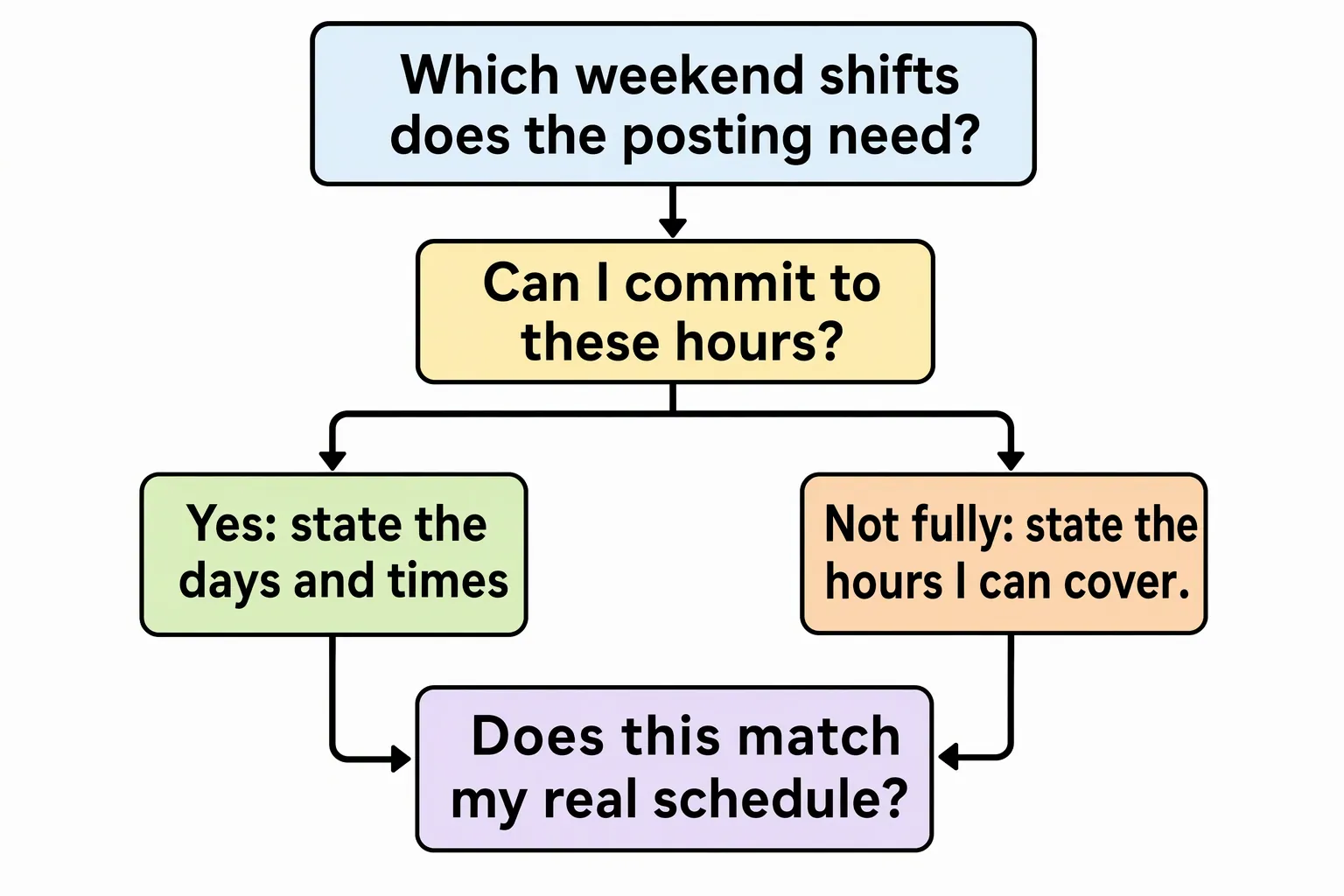
Structural approach: make your schedule easy to assess
Keep the letter focused on the employer’s weekend schedule. A useful sequence is to name the role and your reason for applying, state your available days and hours, support your reliability with one relevant example, and close by inviting a conversation. For the general paragraph sequence, see cover letter structure; the weekend-specific decisions and examples you need are explained here.
Make an availability statement precise but sustainable. Check it against your existing commitments and any travel time that affects whether you can reach a shift. You do not need to disclose private details. If your schedule has a known limitation, state it directly and describe the hours you can offer instead.
- 01
Identify the weekend shifts
Read the posting for named days, shift windows, and any schedule pattern it describes. Decide which of those hours you can genuinely work. If the posting requests a separate response to selection criteria, provide that separately rather than trying to replace it with the cover letter.
- 02
State your available hours
Name the days and times you can work, including whether you can cover both Saturday and Sunday. For example, “Saturdays and Sundays from 8:00 a.m. to 4:00 p.m.” is more informative than “weekends.” If you can work only part of the weekend, say so.
- 03
Support reliability with one fact
Choose a brief, accurate example related to keeping a schedule or completing a recurring responsibility. It may come from work, study, volunteering, or another commitment. Explain what you did and what it shows; do not substitute a general claim such as “hard-working” for evidence.
- 04
Check the commitment
Compare the hours in your letter with your other commitments and the availability you give elsewhere in the application. State only what you can maintain. If your schedule varies, describe the pattern honestly instead of promising coverage you cannot provide.
Weekend Job Cover Letter Example
Preview a fictional example that pairs specific weekend availability with a relevant reliability detail. Use it as a starting point, then replace its details with your own.
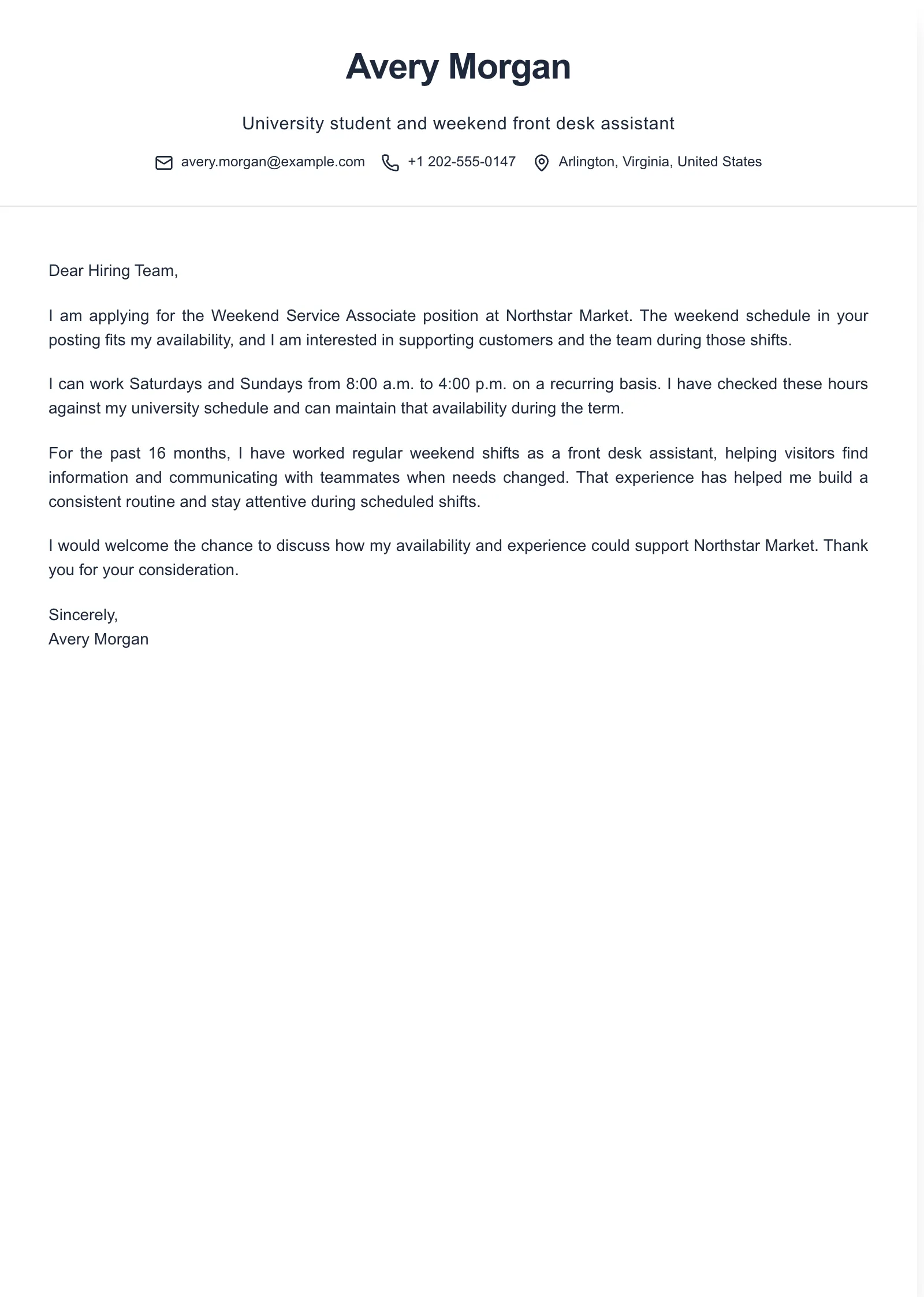
Example paragraphs
“I am applying for the [Job Title] position at [Company Name]. The weekend schedule in your posting matches my availability, and my experience with [relevant recurring responsibility] could help me contribute to [specific need in the posting].”
“I can work [specific days] from [start time] to [end time] [on the schedule stated in the posting]. I have checked those hours against my commitments, so I can offer this availability for the [Job Title] role at [Company Name].”
“In [role, study, or volunteer setting], I [specific action that shows follow-through] over [accurate period or number of occasions]. That experience reflects how I would approach recurring weekend responsibilities as a [Job Title] at [Company Name].”
Use these as separate paragraph patterns, not as a complete letter. Replace every bracket with a truthful detail and remove any sentence that does not fit. Keep the stated hours consistent with your actual availability; a narrower, accurate commitment is more useful than an uncertain promise.
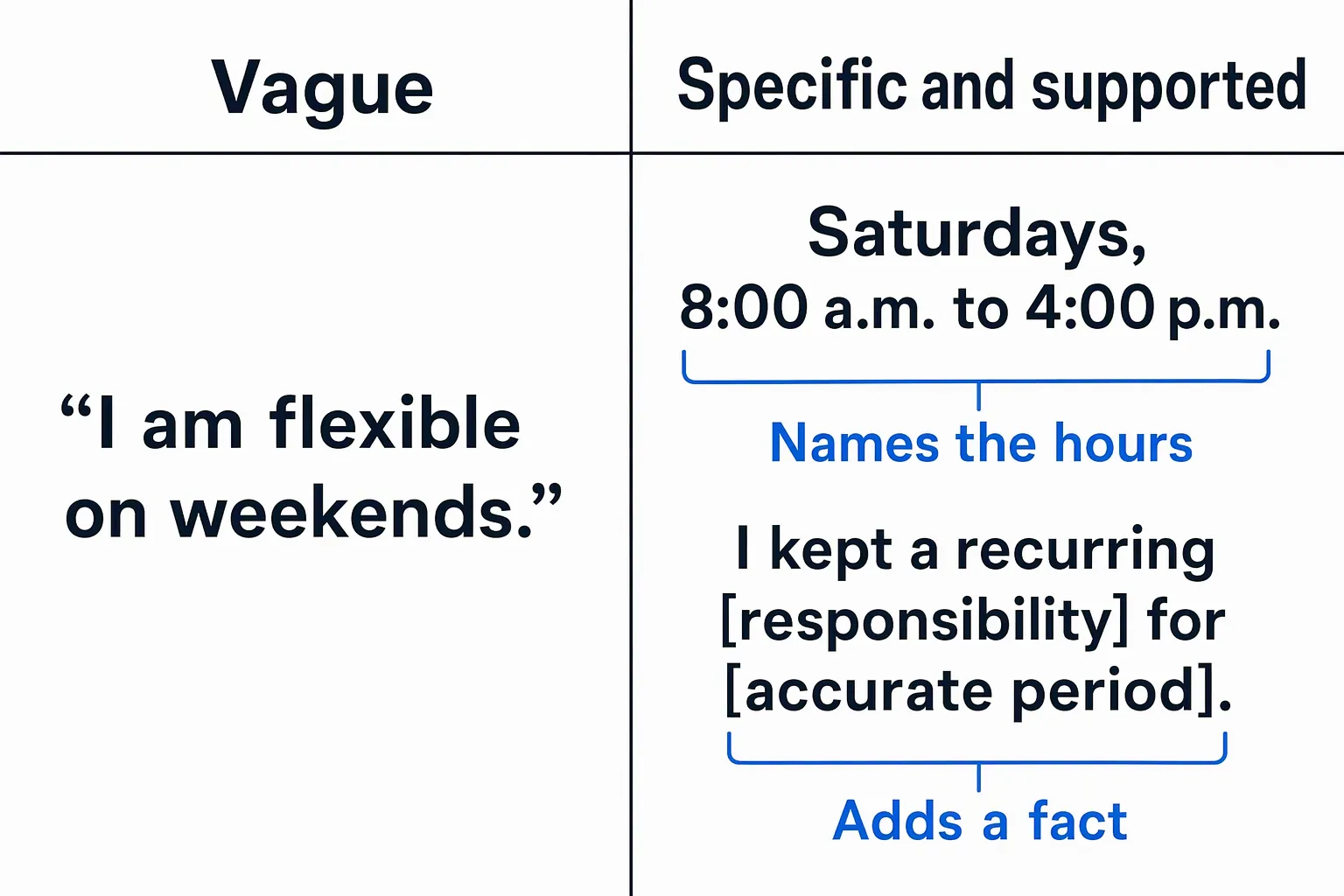
Common mistakes in a weekend job cover letter
Writing “any weekend” without checking
- What goes wrong
- Broad availability can mislead an employer if you have regular limits or can work only certain shifts.
- Better approach
- Name the days and hours you can sustain. If your availability varies, explain the pattern instead of implying that every weekend is open.
Explaining your whole personal routine
- What goes wrong
- A long account of classes, family responsibilities, or another job can bury the schedule information and include more personal detail than the employer needs.
- Better approach
- Share only the context needed to explain your availability. Use the rest of the letter to show your fit for the work and give a relevant example.
Claiming reliability without an example
- What goes wrong
- Calling yourself dependable does not show what that means in practice for a role with weekend shifts.
- Better approach
- Add one specific, truthful example of keeping a commitment, completing recurring work, or communicating responsibly. Keep the claim proportional to what happened.
Promising hours you have not checked
- What goes wrong
- Offering shifts without checking your commitments can create a mismatch between your letter and your actual availability.
- Better approach
- Verify your schedule before applying and state only the hours you can commit to. If you cannot cover all the posted hours, be clear about the overlap.
Frequently asked questions
- Should I say that I am a student or have another job?
- Mention it only if it helps explain your availability or a relevant commitment. Focus on the hours you can reliably work, and leave out personal details that do not help explain your fit for the schedule.
- What if my weekend availability changes from week to week?
- Do not promise a fixed schedule if you cannot keep it. State the days and times you can commit to, describe any regular variation accurately, and check that your availability fits the posting. If the schedule is unclear, you can ask the employer about it.
- Should I list exact hours or just say I am available on weekends?
- Use exact days and times when you know them. “Available on weekends” does not tell the employer whether you can work mornings, evenings, or both days. If the posting names shifts, say which of those shifts you can cover.
- How is a weekend job letter different from a part-time job letter?
- Weekend work can also be part-time. A weekend-specific letter focuses on the Saturday or Sunday hours you can reliably work, while a part-time schedule might include weekdays or other patterns. Tailor your letter to the schedule in the actual posting rather than treating these labels as opposites.

Put this career change approach into practice
Choose sample data or build your own cover letter, then personalize it before you download.