
Introduction
On Upwork, the cover-letter message is part of a proposal for a specific posted project. Start with the client's stated need, connect it to one relevant piece of work, and ask a question that clarifies scope. The aim is to make your fit and next step clear, not to paste a general pitch.
Use the term “cover letter” when that is how the task is described, but follow the posting and proposal flow rather than assuming every job uses the same text field. Upwork says proposals include terms and a cover letter; some postings instead use a video interview. Check the official proposal guidance and each job's displayed instructions. The details can vary.
What to address directly
Make the client recognize their project
- Hiring manager concern
- A standard introduction or career history delays the information that connects your proposal to this posting.
- What your letter should prove
- Name the requested deliverable and one meaningful detail the client included, such as a format or timeline. Say what you can do about that need. Use only details in the post; do not repeat the whole brief or claim to know unstated preferences.
Support your fit with relevant work
- Hiring manager concern
- A broad claim about your abilities gives the client little basis for understanding how your experience relates to the project.
- What your letter should prove
- Choose one real project that involved a similar task. State what you personally did and one result or deliverable you can verify. If the example comes from outside Upwork, identify it honestly rather than implying it is platform history.
Ask a question that helps clarify scope
- Hiring manager concern
- A vague question may not help clarify the work, while a long list can burden a client whose brief is already clear.
- What your letter should prove
- Ask about one unresolved detail that could affect the work, such as an unclear source file, approval step, or expected output. If the post already answers those points, ask a focused confirmation or next-step question instead of inventing uncertainty.
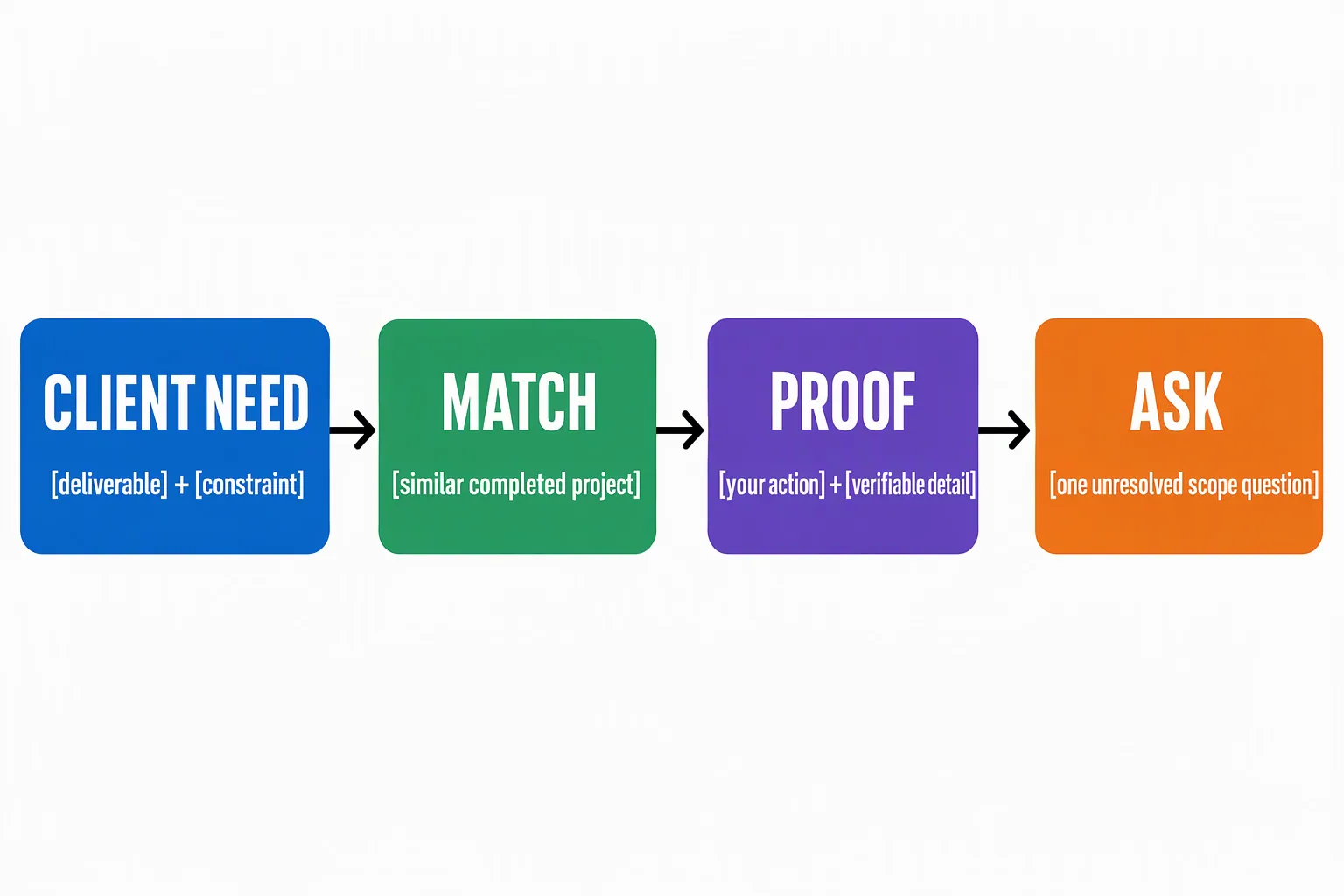
Structural approach: shape the proposal around the posting
Before drafting, separate the requested outcome from the process or constraints in the brief, then choose evidence that supports the outcome. The cover letter structure guide explains general paragraph roles. For this Upwork task, make each line respond to this client's posting, and keep the message distinct from any other proposal components the posting asks you to complete.
- 01
Extract the need and constraint
Write down the main deliverable and one important constraint stated in the posting. It might be a format, deadline, tool, or review process. Use only information the client provided, and do not restate the full job description.
- 02
Select one relevant example
Choose completed work that demonstrates a similar action or result. State your role and a concrete detail you can support. If you have not done the exact task, describe a genuinely related skill without presenting it as identical experience.
- 03
Connect the proof to the project
Explain briefly how your example relates to the client's stated need. Avoid a list of unrelated skills or a long biography. The client should be able to follow the connection between the project, your experience, and the work you are proposing.
- 04
Check the other proposal requirements
Ask one useful question about an unresolved point, then check the posting and proposal flow for terms, questions, documents, or a video interview. Complete the components as prompted. A text message alone may not cover everything the specific application requests.
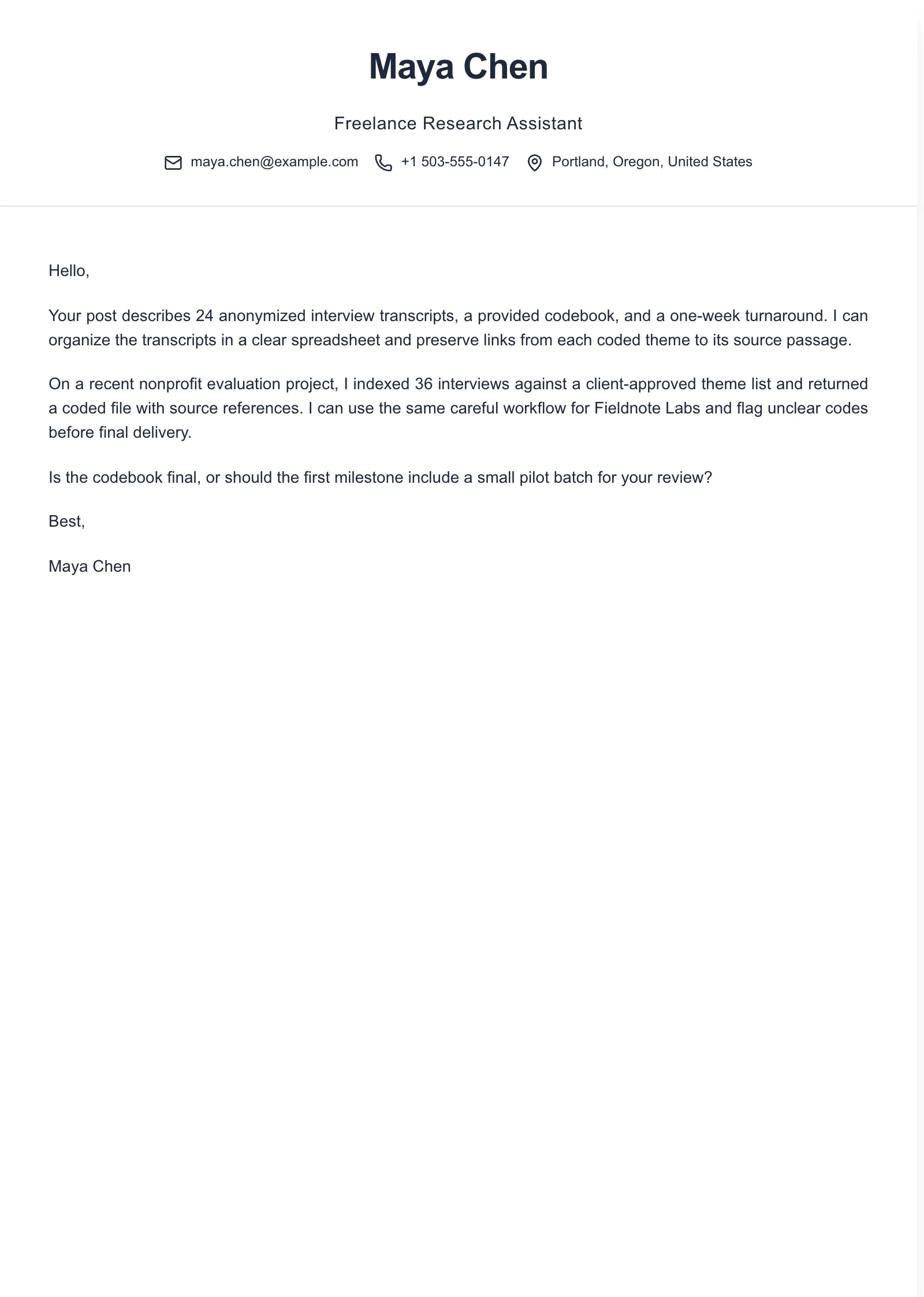
Fictional Upwork proposal example
A fictional interview-research project shows how to name the client's need, connect relevant work, and ask one scope question.
Example paragraphs
“Your post needs a [deliverable] by [deadline], and the [scope detail] makes [stated priority] important. As a [Job Title], I can support [Company Name] by [specific relevant action]. Is [one unresolved project detail] already defined?”
“In my work as a [Job Title], I handled [similar task] for [type of client or project] and produced [verifiable result or deliverable]. That experience relates to [Company Name]'s need for [specific requirement] because [brief factual connection].”
“For the [Job Title] project at [Company Name], I would start by [first concrete action], check [quality or scope point], and deliver [output or milestone]. Would [specific question about the brief] help confirm the best first step?”
Use these as paragraph patterns, not text to paste unchanged. Replace every bracket with accurate details from the posting and your own work; remove any line you cannot support. Fewer than 150 words in the main proposal message is this guide's editorial target, not a platform limit. The Democruit builder provides editable text for you to adapt. It does not submit an Upwork proposal or record a requested video.
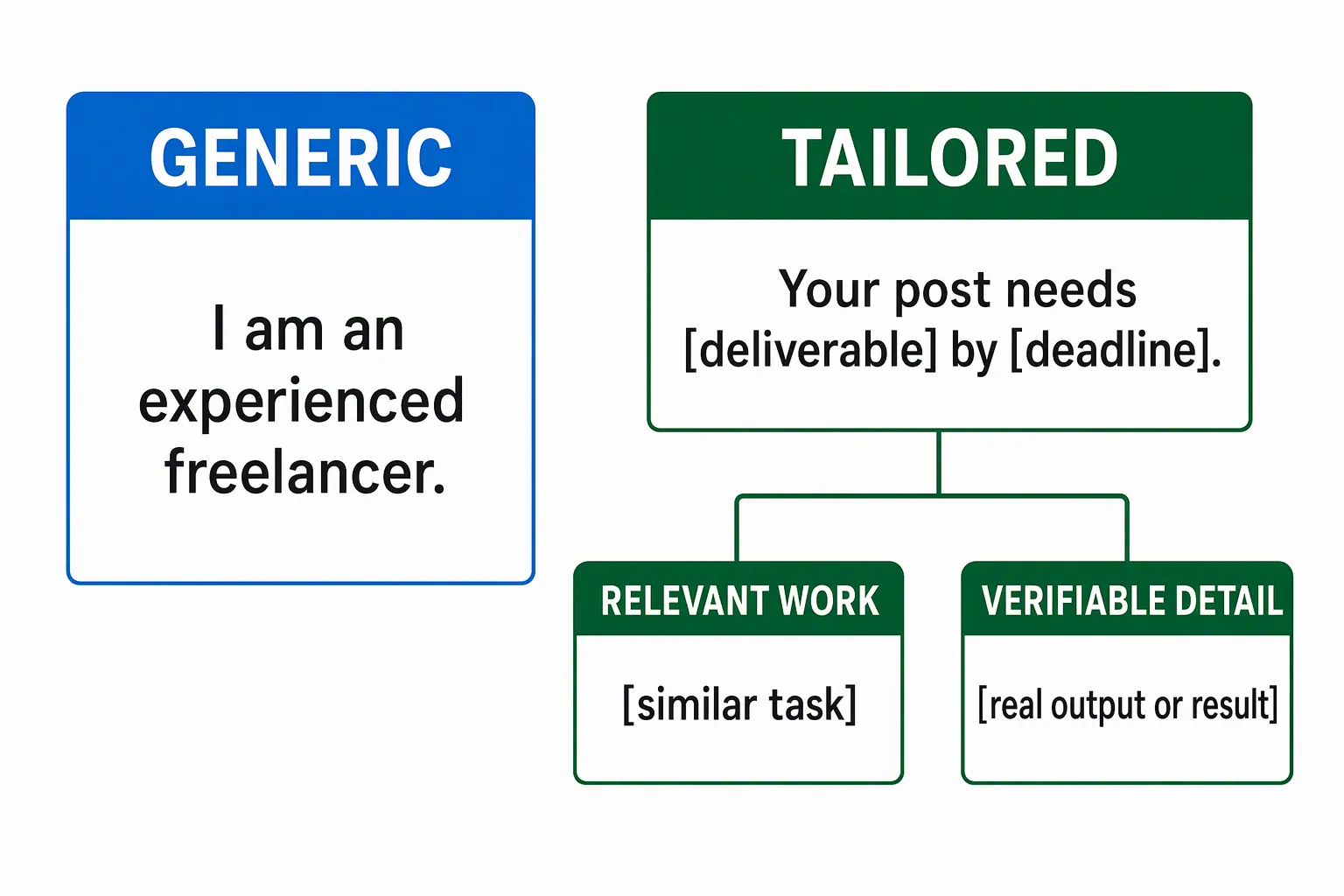
Common mistakes in an Upwork proposal
Opening with a biography
- What goes wrong
- A long account of your career can push the client's specific need out of view.
- Better approach
- Start with the requested deliverable or constraint, then include only the background that supports your fit.
Sending copied boilerplate
- What goes wrong
- A generic pitch may mention services the client did not request and fail to show that you read the posting.
- Better approach
- Keep a reusable structure, but rewrite the client need, relevant proof, and question for each project.
Making unsupported claims
- What goes wrong
- Unverified numbers, overstated results, or implied platform history can misrepresent your contribution.
- Better approach
- Describe your own role and a result or deliverable you can verify. Say when relevant experience came from outside Upwork.
Ignoring the posting's requested format
- What goes wrong
- A polished text message may still omit requested answers, terms, documents, or a video interview.
- Better approach
- Check the instructions for each job and provide requested items separately when needed. The text builder does not submit them for you.
Frequently asked questions
- How long should an Upwork cover letter be?
- Aim for fewer than 150 words in the main proposal message as an editorial target, not an Upwork limit. Include the client's need, one relevant proof point, and a useful question. Follow the instructions and any displayed limits for the specific posting.
- Can I reuse the same Upwork cover letter for every job?
- Reuse a structure, not the same message. Rewrite the client-specific need, choose evidence that fits the project, and ask a question relevant to its scope. A generic pitch may not make clear how your experience relates to that posting.
- What if I do not have Upwork client history?
- You can describe real, relevant work from another setting. State what you did and what you can verify. Do not imply that a project was completed through Upwork or claim platform feedback you have not received.
- Does every Upwork posting accept a cover letter?
- No. Application requirements vary by posting, and some postings use a video interview instead of a cover letter. Check the job instructions and provide the requested materials or answers. A prepared text draft does not replace another required application item.

Put this career change approach into practice
Choose sample data or build your own cover letter, then personalize it before you download.